
Catfishing is one of those dating risks that is easy to dismiss until a profile starts feeling slightly off. The photos look convincing, the conversation feels personal, and the person seems interested enough to lower your guard. But if the identity behind the profile is false, even a normal chat can become a privacy, emotional, or financial risk. In gay dating, where some people are selectively out or careful about who sees their profile, verifying a match can also be an important part of protecting your identity.
If you want the wider privacy framework behind this topic, read Gay Dating Privacy: How to Protect Your Identity, Photos and Location. This guide focuses on one specific step before meeting: how to check whether the person you are talking to is likely to be who he says he is.
The goal is not to investigate every match like a detective. Most verification can stay simple. Look at whether the photos and details make sense together. Ask for a quick live interaction when the conversation becomes serious. Notice whether stories stay consistent. Most importantly, do not let emotional momentum pressure you into skipping basic checks. A genuine match usually understands why a little verification makes meeting safer for both people.
In this article
What Catfishing Actually Looks Like in Gay Dating
Catfishing means presenting a false or heavily misleading identity online. Sometimes that involves stolen photos and a completely invented name. In other cases, the person is real but lies about age, relationship status, appearance, location, job, or other important details. The common thread is that the profile encourages you to trust an identity that does not match reality.
Not every inaccurate profile is a catfish. Someone using an old photo or exaggerating his height is not necessarily running a fake identity. What matters is the scale of deception and whether the false information changes your decision to interact, share personal details, or meet.
This distinction matters because verification is not about demanding perfection. It is about confirming the basics before you give someone more access to your life. If a profile claims to belong to a specific person, the photos, voice, stories, and live behavior should generally support that claim.
Check Profile Photos for Signs They Belong to Someone Else
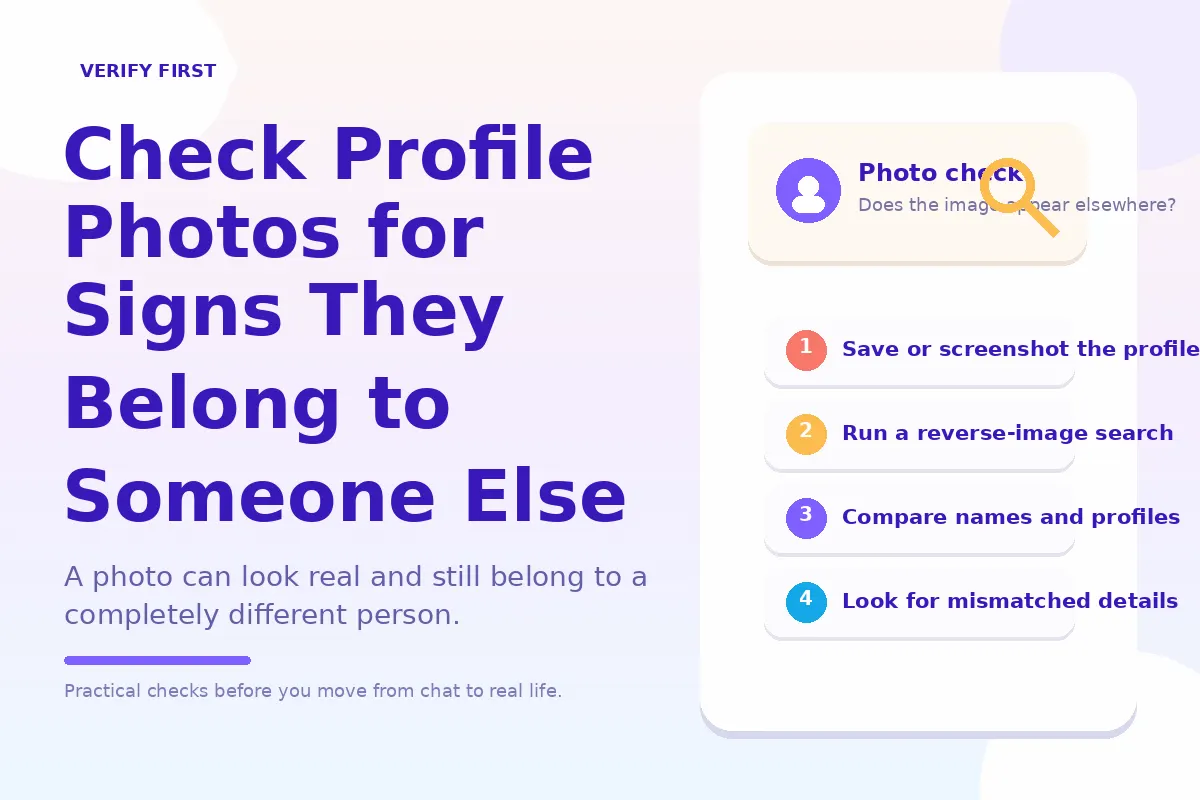
Photos are usually the easiest place to start because catfish accounts often depend heavily on images that were copied from somewhere else. If a match starts feeling suspicious, you can check whether the profile pictures appear online under another name or on unrelated accounts. A reverse-image search can sometimes reveal that a photo belongs to a model, influencer, public profile, or another person entirely.
Do not rely on one search result alone. Images may be cropped, edited, mirrored, or too new to appear in search databases. Instead, use the result as one piece of the pattern. Compare facial features across all profile pictures. Look at whether age, tattoos, hair, body type, locations, and image quality make sense together. A profile that seems to contain photos from several different people deserves more caution.
Also pay attention to the kind of photos being used. Catfish profiles sometimes rely on unusually polished pictures while avoiding casual images, recent selfies, or anything that would be easy to verify in real time. That is not proof by itself, but it becomes more meaningful if the person also refuses simple verification later.
- Check whether a suspicious profile photo appears elsewhere online.
- Compare details across several images, not only the face.
- Notice whether every picture looks professionally staged or unusually old.
- Use photo checks as evidence, not as the only test.
Compare His Story With What the Profile Shows
Catfishing becomes easier to notice when you stop looking at individual details and start looking for consistency. If he says he has lived in one city for years, do the locations and stories he shares fit? If he talks about a particular job or routine, does he understand basic details naturally, or does every answer stay vague?
You do not need to interrogate him. Normal conversation gives people plenty of opportunities to remain consistent. Ask follow-up questions naturally. Return to topics from earlier chats. Genuine people can forget small things, of course, but major identity facts usually stay stable. A person inventing a story has more work to do, so contradictions often appear over time.
One inconsistency is not automatically evidence of deception. Several inconsistencies combined with defensiveness, avoidance, or pressure are more significant. The best verification method is often the pattern created by many small signals.
Use a Quick Video Call to Verify the Person
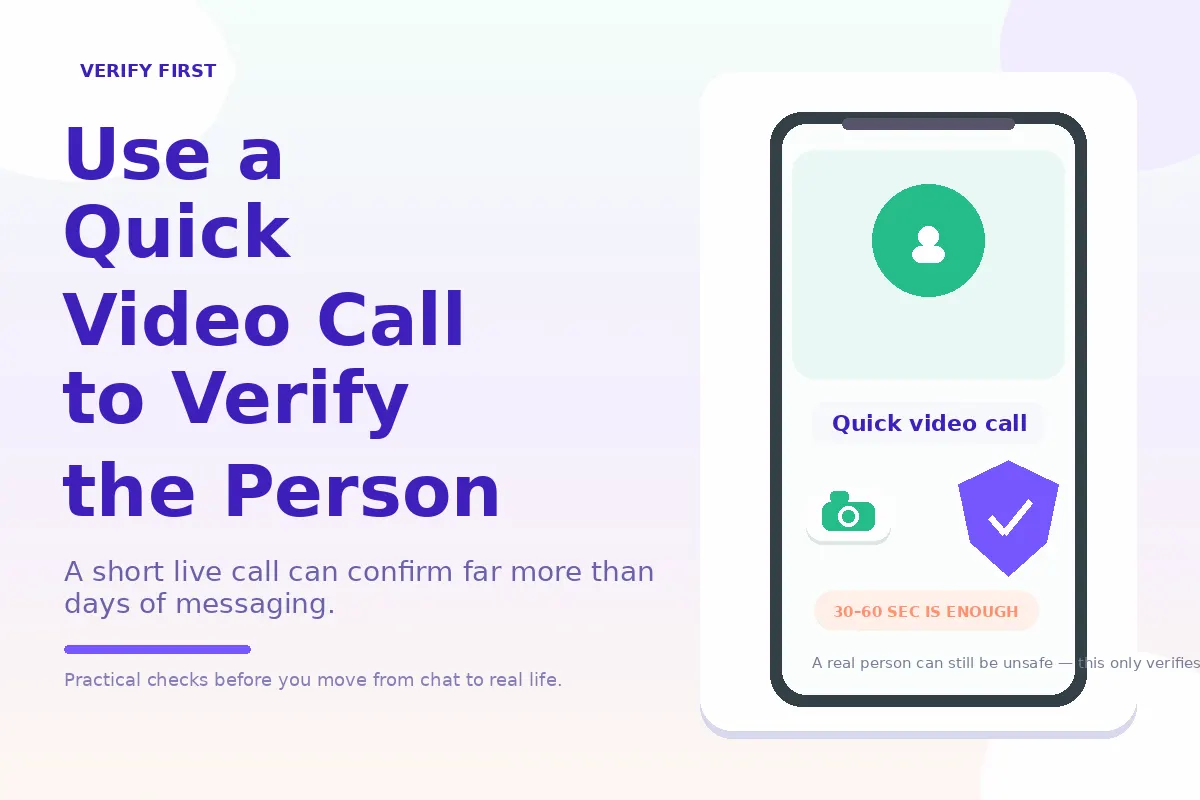
A brief video call is one of the fastest ways to confirm that a match resembles his profile photos and is interacting with you in real time. It does not need to become a formal date. Even thirty seconds to a minute can answer a basic question that messaging cannot: is this the person shown in the profile?
You can make the request casual. Something like, “Before we meet, want to say hi on video for a minute?” is enough. A genuine person may feel shy or dislike video calls, so one refusal is not proof of catfishing. What matters is how he handles reasonable alternatives. Is he willing to send a current casual photo, do a voice call, or find another low-pressure way to confirm the basics?
Repeated excuses are more concerning when they continue despite serious plans to meet. A broken camera once is believable. A different reason every time, combined with pressure for personal information or intimacy, deserves more caution.
Watch for Red Flags That Often Come With Catfishing
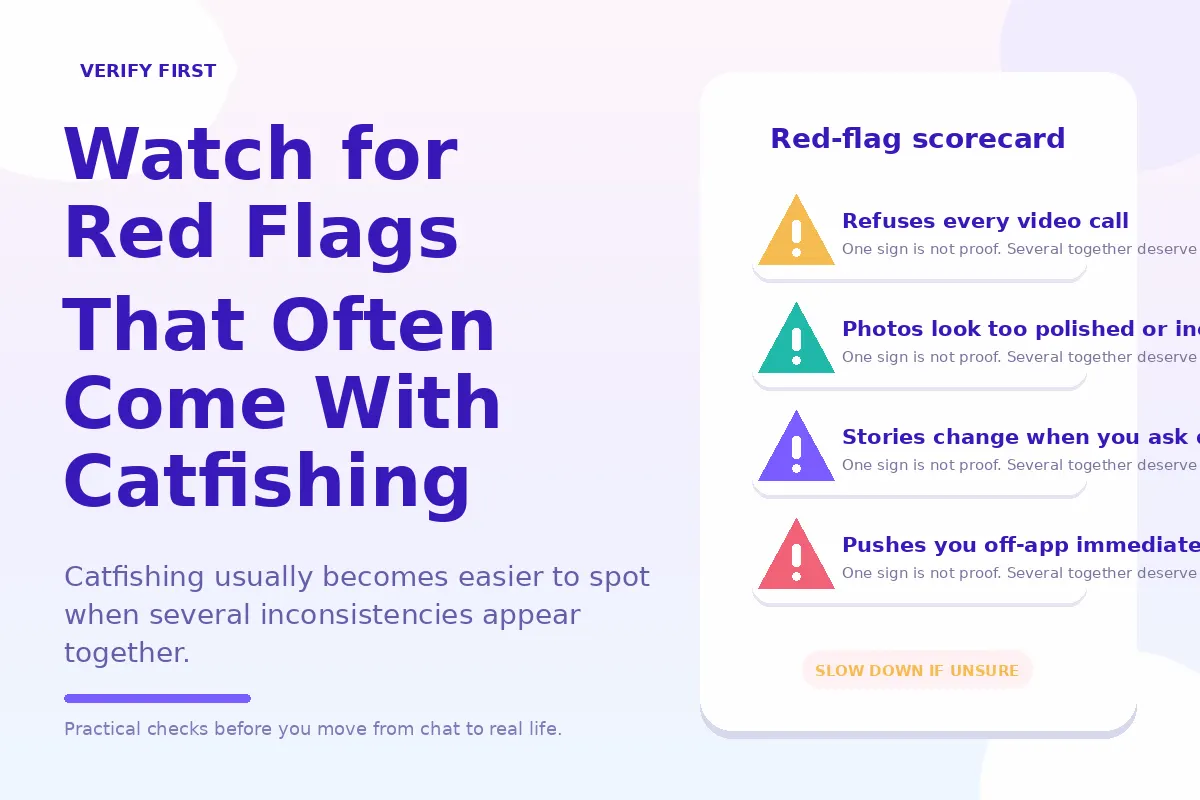
Catfishing usually becomes more obvious when several warning signs appear together. One common pattern is resistance to live verification. Another is unusually fast emotional intensity. Someone may talk about strong feelings, exclusivity, or a future together before the relationship has earned that level of trust. That intensity can make you feel guilty for asking ordinary questions.
Other warning signs include constantly changing stories, very limited profile history, pressure to move conversations off the dating app immediately, and requests for money, gift cards, verification codes, account access, or financial help. Those requests should be treated very seriously. A romantic explanation does not make a financial request safer.
Pay attention to how you feel too. If you are constantly explaining away contradictions because you like the person, slow the interaction down. Attraction can make a suspicious pattern feel more reasonable than it actually is.
| Signal | What it may mean | Better response |
|---|---|---|
| Always avoids video | Identity may not match the profile | Pause meeting plans until basic identity is clearer. |
| Stories keep changing | Important details may be invented | Compare patterns rather than arguing about one detail. |
| Very fast emotional intensity | Trust may be getting rushed | Slow the pace and keep normal boundaries. |
| Requests money or codes | Potential scam behavior | Do not send money, credentials, or verification codes. |
| Pressures you to meet privately | Safety boundaries are being ignored | Keep the first meeting public or cancel. |
Be Careful With “Verification” Requests From the Other Person
Some scammers reverse the idea of verification. Instead of refusing to verify themselves, they tell you that you need to prove you are safe by using a particular website, paying a fee, sharing card details, or sending a code. This can sound reasonable because it uses the language of dating safety.
Real verification should not require giving a stranger access to your bank account, passwords, authentication codes, or sensitive identity documents. Be especially cautious with links sent in chat that claim to be mandatory safety checks. If a dating service has legitimate verification features, access them through the app or official site directly rather than through a random link a match sends you.
If someone becomes angry because you refuse to pay for a verification service or share a one-time code, end the interaction. Protecting your account and financial information matters more than preserving a suspicious conversation.
Verify Enough Before You Meet in Person
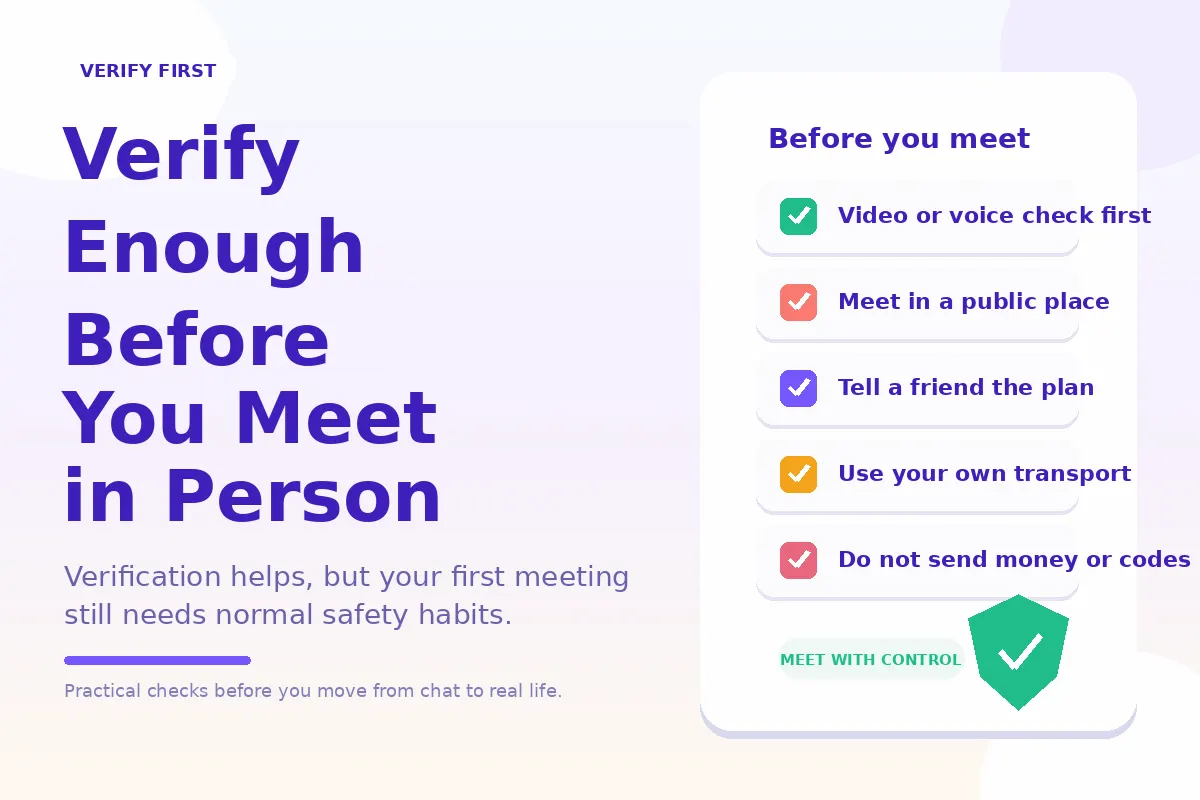
Verification does not need to become perfect certainty before a first date. You are looking for enough consistency that the meeting feels reasonable. The profile photos look coherent. The conversation makes sense. You have heard his voice or seen him live when appropriate. He does not pressure you for money, sensitive information, or private access. Those basic checks reduce uncertainty significantly.
Even after verification, use normal first-date safety habits. Meet in a public place, manage your own transportation when possible, and tell a trusted friend where you are going. Verification confirms identity more than character. A real person can still behave badly, so do not replace ordinary safety habits with confidence from a successful video call.
If the person refuses reasonable verification while also demanding that you meet privately, that combination is enough reason to walk away. You do not need courtroom-level proof that someone is fake. You only need enough uncertainty to decide that meeting is not worth the risk.
- Confirm that the photos and live person broadly match.
- Keep the first meeting public.
- Tell someone you trust where you are going.
- Do not share home access simply because identity was verified.
Trust the Pattern, Not One Perfect Explanation
A skilled catfish can usually explain one suspicious detail. There can be a reason for the missing video call, a reason for the old photos, and a reason the story changed. That is why verification works better when you look at the full pattern instead of debating every excuse individually.
Ask yourself whether the relationship is becoming easier or harder to trust as time passes. Genuine people usually become more understandable. Their details connect naturally. They do not need endless explanations to maintain the same identity. A deceptive profile often creates the opposite experience: the closer you look, the more complicated the story becomes.
You are allowed to stop engaging before you know the entire truth. Dating safety is not a legal investigation. If the pattern does not feel trustworthy enough to continue, that is sufficient information for your own decision.
Verification Should Make Dating Calmer, Not More Suspicious
The point of checking a match is not to become distrustful of everyone. It is to remove avoidable uncertainty before you invest more emotion, privacy, or time. Most verification habits take only a few minutes. Once the basics make sense, you can focus on the more important question: whether you actually like each other in real life.
Gay dating catfishing becomes less intimidating when verification stays simple. Check suspicious photos. Pay attention to consistency. Use a quick video or voice interaction when it makes sense. Never let someone rush you into financial or privacy risks. Then keep your first meeting public and controlled.
On Quicky, or any dating environment, healthy trust should grow through evidence rather than pressure. A person who is worth meeting usually does not need you to ignore reasonable questions in order to prove that you are interested.