
Gay dating can be exciting, but it can also turn self-esteem into a scoreboard if you are not careful. Matches, replies, compliments, profile views, and dates can start to feel like evidence that you are attractive enough, interesting enough, or worthy enough. When the attention is high, confidence rises. When the attention disappears, confidence crashes. That cycle is exhausting because it gives other people too much control over how you feel about yourself.
Healthy confidence works differently. It does not mean you never care what anyone thinks. It means attention becomes information rather than identity. You can enjoy being desired without needing constant proof. You can feel disappointed by rejection without turning it into a verdict on your worth. And you can use dating apps, including Quicky, without making every match responsible for how you see yourself.
Gay dating confidence grows when your self-esteem has a stronger foundation than outside validation. That foundation comes from knowing what you bring, setting standards, choosing people who meet you with mutual effort, and learning how to recover when someone is not interested. The goal is not to become emotionally invincible. It is to become more stable.
In this article
Why Dating Apps Can Turn Attention Into a Scoreboard
Dating apps are built around visible feedback. Someone matches you or does not. A message gets answered or ignored. A conversation becomes a date or disappears. Because these signals are immediate, it is easy to start using them as measurements of your value. The problem is that dating feedback is noisy. Timing, preferences, mood, distance, app habits, attraction, and personal circumstances all affect who responds to whom.
If you treat every outcome as a statement about your worth, you will end up asking dating to answer a question it cannot answer reliably. A match tells you there was enough interest to connect. It does not prove that you are valuable. A rejection tells you that this particular connection did not move forward. It does not prove that you are lacking.
This distinction is simple but powerful. When you stop turning every dating outcome into a self-esteem judgment, you create room for curiosity. Instead of asking, “What is wrong with me?” you can ask, “Was this a good fit?” That is a healthier question because compatibility is mutual.
Stop Using Attention as Proof of Your Worth
Attention feels good because it activates something deeply human: the desire to be seen. There is nothing wrong with enjoying compliments, flirty messages, or a strong match. The problem begins when attention stops being pleasant and starts becoming necessary. If your mood depends on who is messaging you, your confidence becomes fragile because it has to be constantly refilled from outside.
One useful habit is noticing what you are actually seeking when you open the app. Are you looking for connection, or are you checking whether someone wants you? Are you interested in the person you are chatting with, or mainly relieved that he is interested in you? These questions can feel uncomfortable, but they help separate real dating interest from validation-seeking.
You do not have to reject attention. You just need to stop treating it as proof. Let compliments be compliments. Let interest be interest. Your worth existed before the message arrived and remains after the conversation ends.
- Enjoy positive attention without making it a requirement.
- Notice when you are checking apps mainly for reassurance.
- Ask whether you actually like the person, not only whether he likes you.
Measure Confidence by Your Standards, Not Your Matches
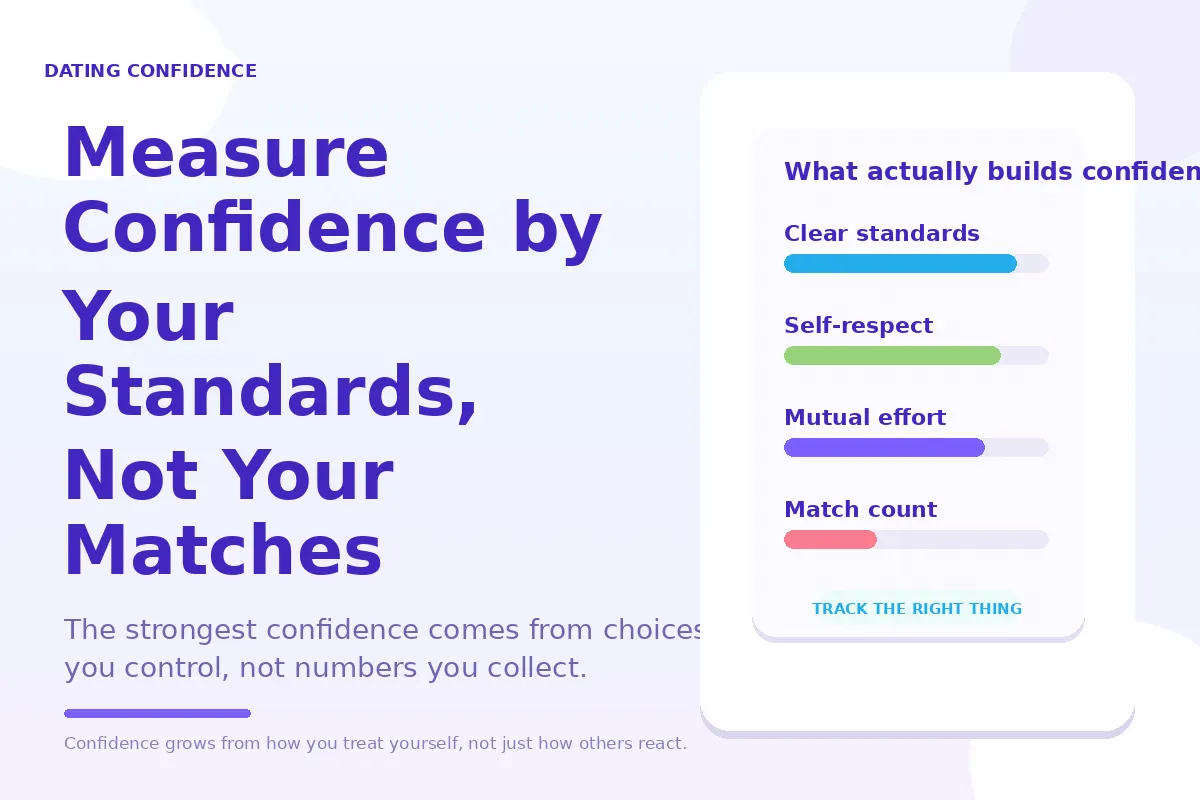
A better way to measure dating confidence is to focus on things you control. Did you communicate honestly? Did you choose someone who respected your boundaries? Did you leave a conversation that was making you feel small? Did you show up as yourself instead of performing for approval? Those are stronger markers of confidence than the number of matches on your screen.
Standards matter because they move you from passive evaluation to active choice. When your only question is “Does he want me?” you put all the power on the other person. When you also ask “Do I want this?” and “Does this fit what I need?” you become a participant in the decision rather than an applicant waiting for approval.
That shift changes the emotional tone of dating. You can still feel attracted, nervous, or hopeful, but you are less likely to abandon yourself to keep someone interested. Confidence becomes less about looking desirable and more about making decisions that respect your own life.
Build a Self-Image That Exists Outside Dating
Self-esteem becomes more resilient when dating is only one part of your identity. If your main source of excitement, affirmation, or belonging comes from romantic attention, every dating setback carries too much weight. A slow week on the apps can feel like a personal crisis because nothing else is balancing it.
This is why confidence grows faster when you invest in areas that have nothing to do with dating. Friendships, work, fitness, creativity, learning, community, hobbies, and personal goals all create proof that your life has value beyond who wants to date you. None of these activities need to be impressive. They just need to remind you that you are a whole person before anyone chooses you.
A full life also improves dating because it reduces desperation. When you already have meaning, you are less tempted to hold onto weak connections simply because they provide attention. You can walk away more easily from situations that do not fit.
Change the Way You Talk to Yourself After Rejection
Rejection hurts. Confidence does not require pretending otherwise. The key is what happens after the initial disappointment. If your inner voice turns one rejection into a global story—“No one wants me,” “I am not attractive enough,” or “This always happens”—the emotional damage grows far beyond the actual event.
A healthier response is more precise. Maybe the chemistry was not there. Maybe his intentions were different. Maybe he liked someone else more. Maybe the timing was wrong. None of those explanations feel amazing, but they are still very different from concluding that something is fundamentally wrong with you.
Try speaking to yourself the way you would speak to a friend you respect. You would probably not tell him that one unanswered message proves he is undesirable. Give yourself the same fairness. Confidence is partly the ability to keep your self-story accurate when emotions are loud.
- Describe what happened without exaggerating it.
- Avoid turning one rejection into a prediction about your future.
- Separate incompatibility from personal worth.
Know the Difference Between Confidence and Performance
Sometimes people respond to insecurity by performing confidence. They become louder, more sexual, more dismissive, or more detached than they really feel. That can look powerful from the outside, but it often creates another form of validation-seeking. Instead of asking for approval directly, you try to control how impressive you appear.
Real confidence is usually quieter. It can admit nervousness without shame. It can say no without creating drama. It can express interest without begging for a response. It can handle someone else’s preferences without turning them into a personal insult. Most importantly, it does not require you to pretend you care less than you do.
If you are unsure which version you are practicing, ask whether your behavior is helping you feel more like yourself or more like a role. Confidence should make authenticity easier, not harder.
Stop Comparing Your Dating Life to Other Gay Men
Comparison is especially powerful when dating lives are visible through social media, friend groups, and app culture. It is easy to assume that other men have more matches, better bodies, easier dates, or more romantic options. But comparison usually relies on incomplete information. You see the outcome, not the insecurity, rejection, confusion, or loneliness behind it.
It also distracts you from what actually matters: whether your dating life is working for you. Someone else may enjoy casual attention while you want a serious relationship. Another person may be comfortable dating constantly while you need more space. More attention does not automatically mean better dating.
Instead of comparing volume, compare alignment. Are your choices getting you closer to the kind of relationship or experience you want? That is a much more useful measure than whether someone else appears to be winning.
Build Confidence Through Small Dating Behaviors
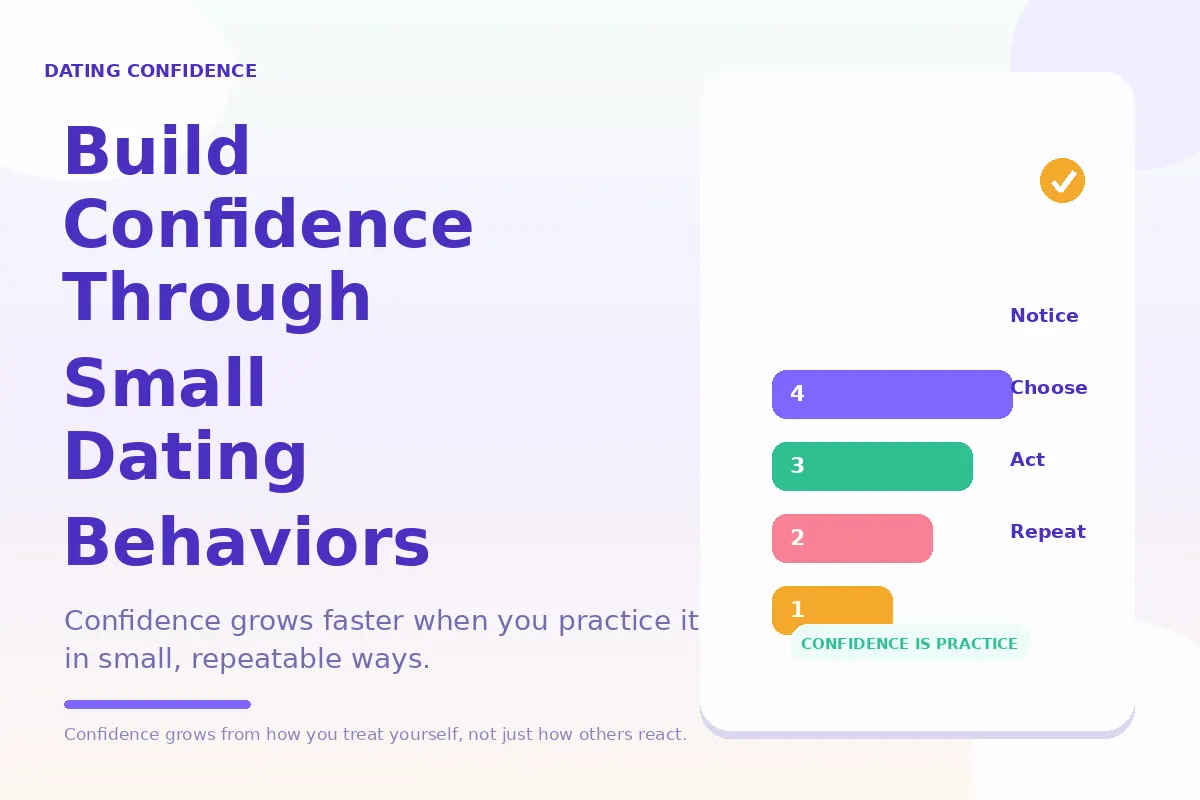
Confidence is easier to build when you treat it as a practice instead of a feeling you are waiting to receive. Small actions teach your brain that you can handle dating without abandoning yourself. That might mean sending a thoughtful first message without overthinking it, ending a conversation that feels disrespectful, asking for clarity, or going on a date even though you feel a little nervous.
Each action creates evidence. You learn that you can survive silence. You can recover from awkwardness. You can express interest without losing dignity. You can say no and still be okay. Over time, these experiences become more convincing than generic positive affirmations because they are based on behavior you actually lived.
Start small enough that the action feels possible. Confidence does not need a dramatic breakthrough. It often grows through repetition: notice the fear, choose a self-respecting action, do it, and let the result teach you something.
Confidence Lets You Want Connection Without Needing Approval
The healthiest form of dating confidence does not make you independent from everyone. You can still want affection, intimacy, sex, romance, partnership, and attention. The difference is that you stop asking those things to prove you deserve to exist comfortably in your own skin.
That creates a more balanced dating life. You can be excited about someone without making him the center of your self-esteem. You can be rejected without deciding you are broken. You can enjoy being desired without becoming addicted to reassurance. And you can choose relationships because they fit, not because they temporarily silence insecurity.
Gay dating confidence is not about never doubting yourself. It is about returning to yourself faster when doubt appears. Build standards you trust. Treat rejection accurately. Keep a life outside dating. Practice choices that respect you. When your self-esteem stops depending on constant validation, dating becomes lighter, clearer, and much more honest.