
Online dating has become the number one way LGBTQ+ people meet — for friendship, romance, and everything in between. But being visible online also comes with real risks: catfishing, scams, outing, and unsafe meetups. The good news? Almost every risk can be managed with a few smart habits. This complete guide walks you through 15 essential gay dating safety tips — from the moment you create your profile to your first in-person date — so you can focus on the fun part: meeting great people.
Whether you’re brand new to gay dating apps or a seasoned swiper, these tips apply to every platform and every kind of connection — whether you’re looking for new gay friends or hoping to find a serious boyfriend.
In this article
Why Online Dating Safety Matters More for the LGBTQ+ Community
Everyone who dates online should think about safety — but LGBTQ+ daters often carry extra considerations. Some of us aren’t out to family, coworkers, or hometown communities. Some live in or travel to places where being openly gay carries legal or social risk. And unfortunately, scammers know that fear of being outed can be used as leverage.
That’s why digital privacy experts recommend that LGBTQ+ daters start with a personal security plan: think about who you want to see your information, what could happen if the wrong person saw it, and how much you’re willing to share at each stage of getting to know someone. This approach — often called threat modeling — sounds technical, but it really just means being intentional instead of automatic.
The core principle behind every tip in this article is simple: share progressively. Reveal more about yourself only as trust is earned — never all at once, and never because someone pressures you.
Before You Match: Setting Up a Safe Dating Profile

Safety starts before your first conversation. Your profile is public-facing, which means anyone — matches, exes, coworkers, or bad actors — might see it. Here’s how to build an attractive profile that doesn’t overshare:
- Tip 1 — Use photos that don’t appear elsewhere online. If your dating photo is also your LinkedIn or Instagram photo, a reverse image search can connect your profile to your full identity in seconds. Take fresh photos just for dating.
- Tip 2 — Keep identifying details out of your bio. Skip your workplace, school, specific neighborhood, and daily routine. “Marketing guy in Bangkok” is fine; the name of your company is not.
- Tip 3 — Check what’s in the background of your photos. Street signs, building names, uniforms, and even reflections can reveal where you live or work.
- Tip 4 — Strip location metadata from images. Photos taken on your phone can contain GPS coordinates in their EXIF data. Most apps strip this on upload, but if you send photos directly in chat, send them through a messenger that removes metadata first.
- Tip 5 — Review your app’s location settings. Distance-based features are convenient, but consider fuzzing your location or turning off precise distance if you’re not out or live in a small community.
A well-designed platform helps here too. Apps built for the community — like Quicky, a free gay app made by Thai LGBTQ+ people for the community — are designed with privacy-first defaults and no intrusive ads that track you across the web.
Chatting Safely: How to Vet Your Matches
Once you match, the goal is to figure out whether the person on the other side is real, honest, and respectful — before you invest emotionally or agree to meet.
- Tip 6 — Do a quick reverse image search. Save one of their photos and run it through Google Images or TinEye. If the same photo appears under different names, or belongs to a model or influencer, you’ve likely found a catfish.
- Tip 7 — Ask for a short video chat before meeting. This is the single most effective anti-catfish tool. A genuine person will usually be happy to hop on a two-minute video call. Repeated excuses — broken camera, bad signal, “I’m shy” — are a classic warning sign.
- Tip 8 — Keep conversations inside the app at first. Dating apps have moderation, blocking, and reporting tools. The moment someone rushes you to move to another messenger, ask yourself why. Scammers do this to escape platform safety systems.
- Tip 9 — Never send money. Ever. No matter how compelling the story — a sick relative, a plane ticket to visit you, a “small investment opportunity” — requests for money, gift cards, or crypto are the defining feature of romance scams. This rule has no exceptions.
- Tip 10 — Be thoughtful about intimate photos. If you choose to share them, crop out your face and identifying features like tattoos, and never let anyone pressure you. Blackmail using intimate images (sextortion) specifically targets people who fear being outed.
Red Flags: A Quick Reference Table
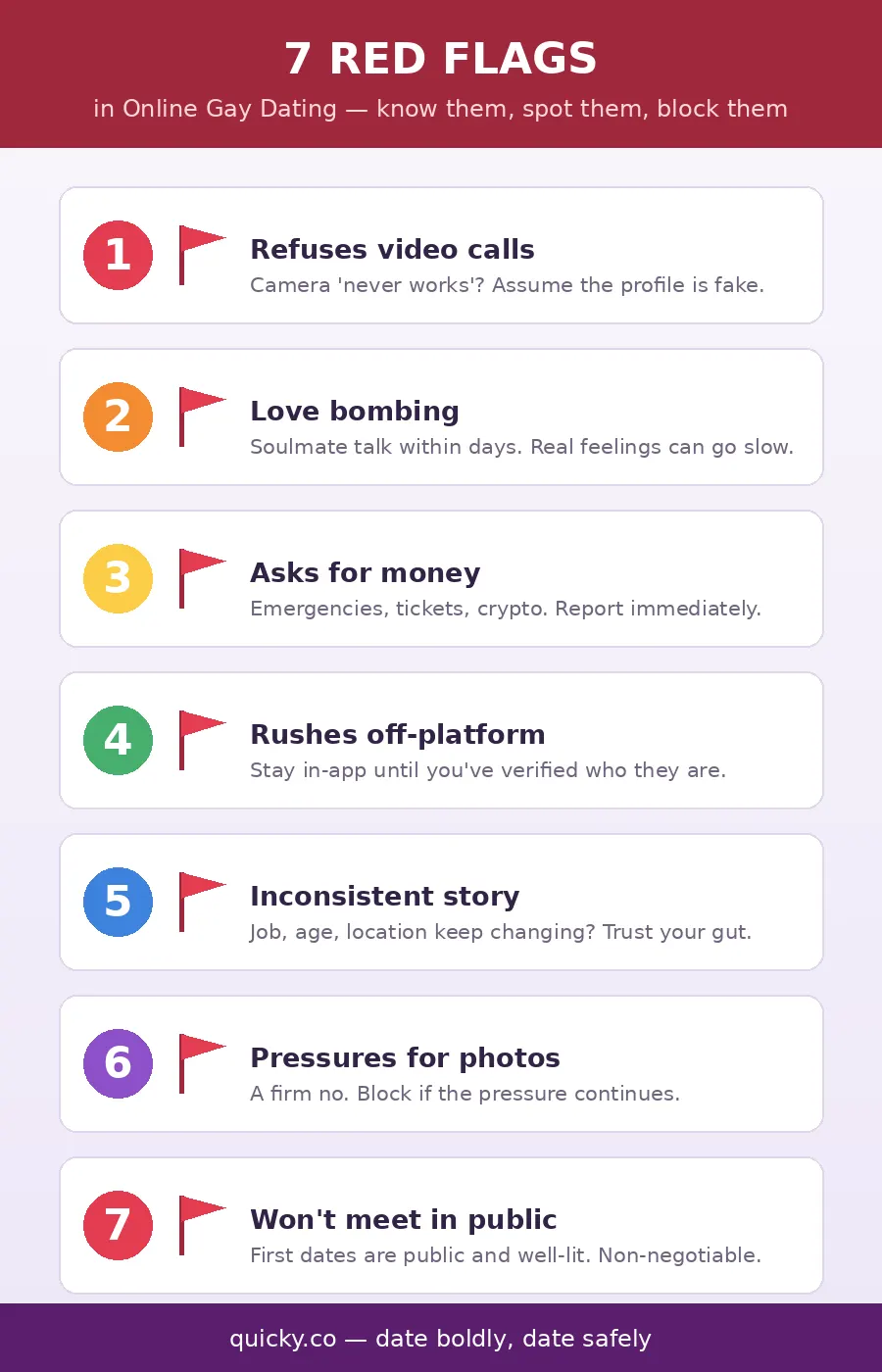
Some warning signs are subtle, and in the excitement of a new connection it’s easy to explain them away. Use this table as a reality check:
| 🚩 Red Flag | What It Looks Like | What To Do |
|---|---|---|
| Refuses video calls | Always has an excuse; camera “never works” | Assume the profile may be fake; don’t meet until verified |
| Love bombing | Declares intense feelings within days; “you’re my soulmate” | Slow down; genuine feelings survive a slower pace |
| Money talk | Emergencies, tickets, investments, gift cards | Stop contact and report the profile immediately |
| Rushes off-platform | “Add me on LINE/WhatsApp right now” | Stay in-app until you’ve verified who they are |
| Inconsistent story | Details about job, age, or location keep changing | Ask casual follow-up questions; trust your gut |
| Pressures for photos | Demands intimate pictures early; sulks when refused | Firm no; block if pressure continues |
| Won’t meet in public | Insists first meeting is at their place or yours | Decline; public first dates are non-negotiable |
Meeting In Person: Your First-Date Safety Checklist
You’ve chatted, video-called, and the vibe is great. Time to meet! An in-person date should be exciting, not stressful — and a little preparation keeps it that way.
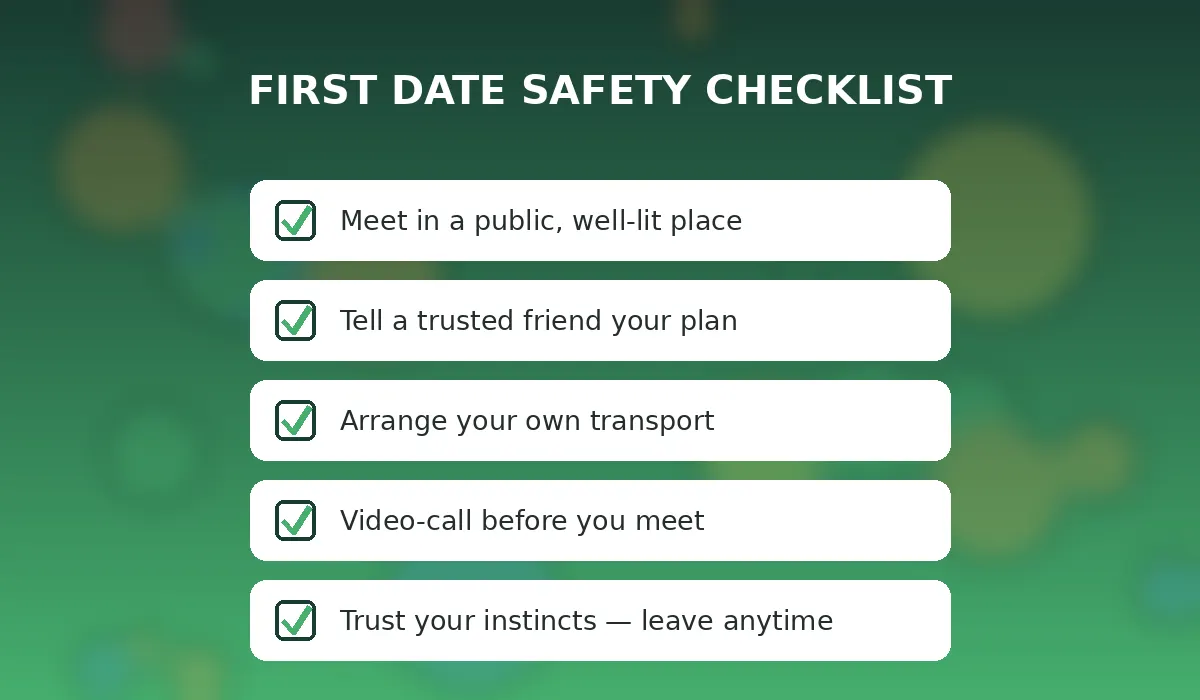
- Tip 11 — Meet in a public, busy, well-lit place. A café, a mall, a popular bar. Safety experts consistently recommend keeping the first few dates in familiar public venues — and never accepting a first meeting at a private home, theirs or yours.
- Tip 12 — Tell a trusted friend your plan. Share who you’re meeting (screenshot the profile), where, and when. Set a check-in time. Location-sharing apps or a simple “text me at 9pm” arrangement work great. Some daters even bring a friend to sit elsewhere in the venue for the first meeting.
- Tip 13 — Control your own transportation. Arrive and leave on your own — your car, a taxi, or public transport. Don’t let a first date pick you up at home, and never leave your drink unattended.
And two final tips that cover everything else:
- Tip 14 — Trust your instincts, and leave whenever you want. You don’t owe anyone an explanation, a second drink, or a “fair chance.” If something feels off, it probably is. Being “rude” is always better than being unsafe.
- Tip 15 — Talk about sexual health openly. If a date might lead somewhere more intimate, consent and health are part of safety too. Know your status, get tested regularly for HIV and STIs, and discuss protection and PrEP like the normal, mature topics they are. A partner who reacts badly to a health conversation is showing you a red flag.
Digital Privacy After You Start Dating Someone
Safety doesn’t end after a successful first date. As a relationship (or situationship!) develops, keep these habits:
- Update your privacy settings periodically — apps change defaults after updates.
- Keep sensitive conversations in end-to-end encrypted messengers.
- Don’t share passwords, PINs, or device access, no matter how close you feel.
- If you break up, review what they have access to: shared locations, tagged photos, linked accounts.
- Report and block abusive users — reporting protects the next person too.
Remember that the platform you choose matters. A community-built app with active moderation, a clear reporting system, and a free, ad-free matching experience like Quicky gives you better tools to stay in control than platforms that treat safety as an afterthought.
How Romance Scams Actually Work: The Four-Stage Playbook
Understanding how scammers operate makes them dramatically easier to spot. Nearly every romance scam — regardless of platform or country — follows the same four-stage playbook:
- Stage 1: The perfect profile. Attractive photos (usually stolen), a successful but vague career such as “engineer on an offshore rig” or “military doctor abroad,” and a backstory designed to explain why they can never meet or video call.
- Stage 2: Accelerated intimacy. Within days you’re their “everything.” They message constantly, mirror your interests, and talk about a shared future. This manufactured closeness is the actual product — it’s what makes the next stage work.
- Stage 3: The crisis. A sudden emergency appears: a frozen bank account, a customs fee, a medical bill, a plane ticket to finally visit you. The amount usually starts small to test your willingness.
- Stage 4: Escalation. Once you pay anything, requests grow larger and more frequent. Some scams pivot to “investment opportunities” in crypto — a variant so common it has its own name: pig butchering.
The defense is refreshingly simple. Because every stage depends on avoiding verification, the tools from earlier in this guide — reverse image search, an early video call, and an absolute no-money rule — break the playbook at every step. Scammers work at volume; the moment you become slow, skeptical, and expensive to deceive, they move on.
Dating While Traveling: Extra Precautions Abroad
Meeting locals through a dating app can be one of the best parts of traveling — and it deserves its own safety layer. Laws and social attitudes toward LGBTQ+ people vary enormously between countries, and even between regions of the same country. Before you swipe abroad:
- Research local laws and culture first. In some destinations, same-sex relationships are criminalized or apps are monitored. Know the situation before you arrive, and consider whether using a dating app there is worth the risk at all.
- Be extra cautious with location features. Distance-based discovery has been abused in some countries to target LGBTQ+ people. Disable precise location where the risk is real.
- Meet near your accommodation’s public areas — not inside your room. Hotel lobbies, busy cafés, and well-reviewed venues keep the first meeting on neutral, visible ground.
- Watch your valuables and your drink. Tourist-targeted robbery through dating apps is a known pattern in nightlife districts worldwide. Keep possessions close and never leave a drink unattended.
- Keep a lifeline at home. Time zones make check-ins harder, not less important. Tell someone your plans and set a message schedule.
None of this means you shouldn’t date while traveling — it means arriving informed. Local community apps and venues often have the best real-time knowledge of what’s safe, so lean on the community wherever you go.
Frequently Asked Questions (FAQ)
How can I tell if a gay dating profile is fake?
Combine three checks: reverse image search their photos, request a short video call, and watch for inconsistencies in their story. A profile that fails two of the three should be treated as fake. Model-quality photos with an empty bio and immediate declarations of love are the classic catfish combination.
Is it safe to use gay dating apps if I’m not out?
Yes — with precautions. Use photos that don’t appear on your other social media, avoid identifying details in your bio, limit precise location sharing, and only reveal your identity progressively as trust builds. Choose apps with strong privacy controls and blocking tools.
What should I do if someone threatens to out me or share my photos?
Don’t pay — payment almost never stops blackmail; it signals you’ll pay again. Stop responding, screenshot everything, report the account to the platform, and report the incident to local police or your country’s online safety authority. If intimate images were shared without consent, image-based abuse reporting services can help get them taken down.
When is the right time to meet someone in person?
There’s no fixed timeline, but a good rule is: after at least one video call, after your basic questions have consistent answers, and when you feel ready — not when they pressure you. If someone pushes hard to meet immediately or refuses public venues, that urgency itself is a red flag.
Conclusion: Date Boldly, Date Safely
Online dating should expand your world, not shrink it. The 15 tips in this guide come down to three habits: protect your identity until trust is earned, verify before you invest, and keep first meetings public and planned. None of these steps make dating less fun — they make it more fun, because confidence comes from knowing you’ve got the basics covered.
The LGBTQ+ community has always looked out for one another, and that spirit extends online. Choose platforms built with our safety in mind, look out for your friends, report bad actors, and share these tips with someone who’s just starting their dating journey. Ready to meet great people in a space designed for you? Download Quicky free and start connecting — safely.
References
- Electronic Frontier Foundation — Security Tips for Online LGBTQ+ Dating
- Australian eSafety Commissioner — Meeting for a Date or Hook Up (LGBTIQ+ Safety)
- Garbo — The Top 10 Queer Dating Safety Tips