
Location privacy is easy to underestimate on dating apps because it often feels less personal than your full name, your phone number, or your face photos. In reality, location can be one of the fastest ways for a stranger to piece together where you live, where you work, where you spend time, and how predictable your daily routine may be. In gay dating, that risk can feel even more important because privacy, visibility, and safety do not always carry the same stakes for everyone.
If you want the broader privacy foundation behind this topic, start with Gay Dating Privacy: How to Protect Your Identity, Photos and Location. This article goes deeper into one specific part of that bigger issue: how to protect your location on gay dating apps without making dating feel stiff, secretive, or impossible to enjoy.
Whether you are using Quicky casually, seriously, or somewhere in between, location safety usually comes down to habits. The goal is not to hide everything forever. The goal is to control timing and detail. When you learn what your profile reveals, which app features are worth limiting, and how to share meet-up information more carefully, you reduce risk while keeping the conversation natural.
In this article
Why Location Privacy Matters More Than It Seems
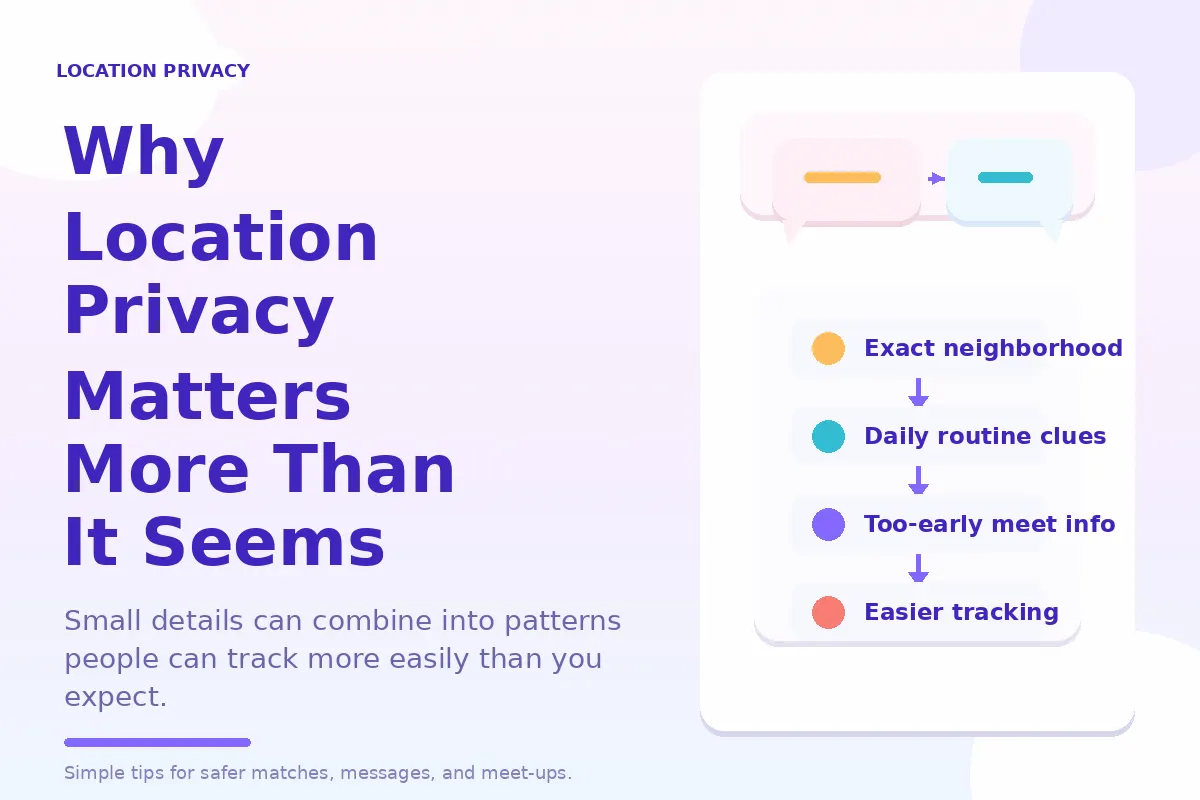
Many people only worry about location safety when a situation already feels suspicious. The problem is that privacy risks often start before anything looks openly wrong. A stranger does not need your exact home address to learn a lot about you. A few hints about your neighborhood, your gym, your commute, or your usual café can gradually narrow things down enough to make you more traceable than you intended.
That matters because dating conversations build familiarity quickly. If someone already knows your general distance, your usual area, and the places you mention naturally in conversation, he may be able to form a much clearer map of your life than you realize. Even when nothing dangerous happens, oversharing location details too early can leave you feeling exposed, boxed in, or more visible than you wanted.
For some people, this is mainly about comfort. For others, it intersects with being selectively out, living in a smaller community, or protecting their routine from unwanted attention. In all of these cases, privacy is not paranoia. It is control.
Decide What Your Profile Reveals Before You Match
Good location privacy starts before the first message. Your profile often reveals more than you think, not only through stated details but through small clues in photos and descriptions. If your bio names your district, your workplace area, or your daily hangout, those details can become location markers. The same goes for photos that show building views, gym branding, transit stops, or easily recognizable landmarks.
The best approach is to stay interesting without becoming overly specific. You can mention that you like local cafés, early morning runs, or city walks without naming the exact places where you do them. You can share your vibe, your personality, and what you are looking for without handing strangers a reliable map of your offline life.
This is also a good moment to review what your app itself displays. If distance features are turned on, ask whether the amount of precision shown still feels right for your comfort level. Privacy works best when you think about exposure before conversation makes you relaxed enough to stop noticing it.
Turn Off Precision Sharing and Avoid Routine Clues
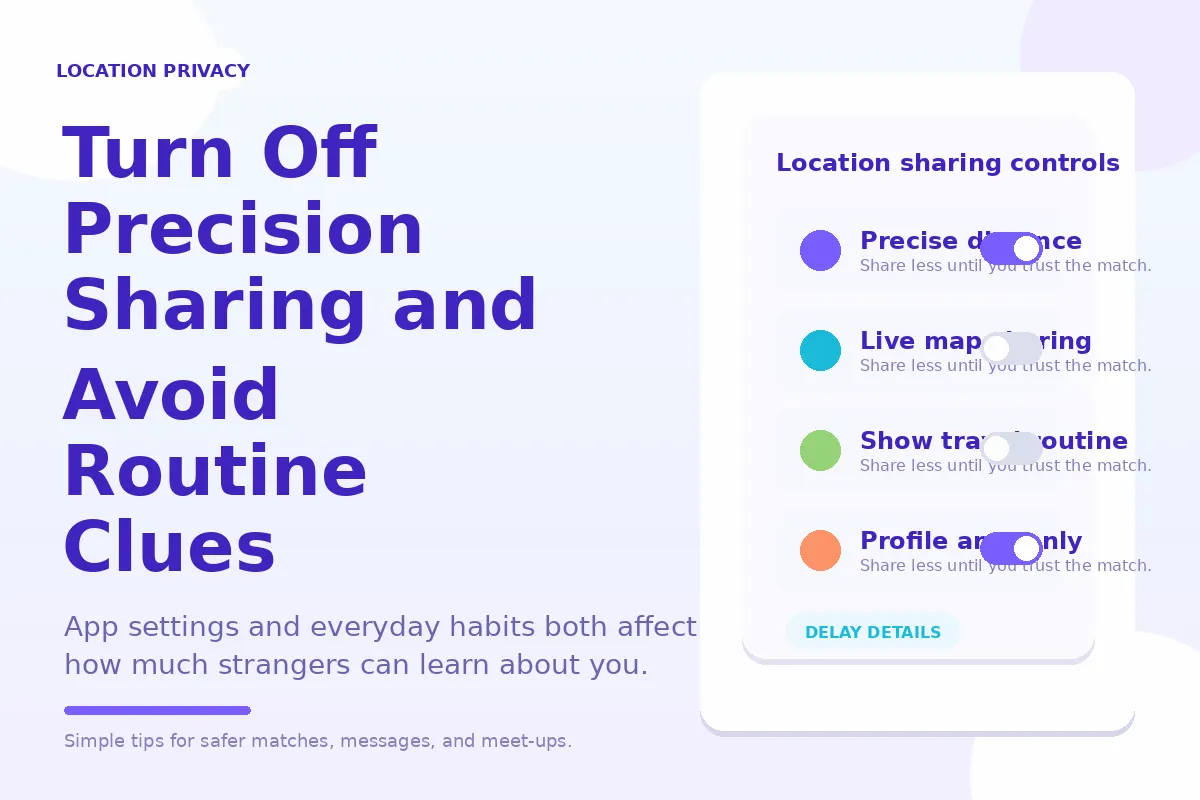
One of the simplest safety moves is reducing how precisely your location is shared. Some apps reveal distance in a way that feels harmless, but repeated use can make your routine easier to read. If you appear in the same place at the same time often enough, someone may start to infer where you live, where you work, or when you are most likely to be nearby.
That is why precision settings matter. If the app gives you ways to limit distance detail, broad area sharing, or other location-based features, consider using them. The best setting is the one that lets you date comfortably without giving strangers more exact information than they need.
Routine clues matter too. Even if you never send an address, you can still reveal a lot by repeating the same details: “I’m at my usual gym,” “I’m leaving the office,” or “I always walk the river path after dinner.” These seem casual, but together they create a pattern. It is often smarter to stay general early on and save the specifics for later, once trust exists.
- Use broader location settings when possible.
- Avoid repeatedly naming the same daily places.
- Be cautious with real-time updates about where you are.
- Think about patterns, not only single details.
Share Meet-Up Details in Stages, Not All at Once
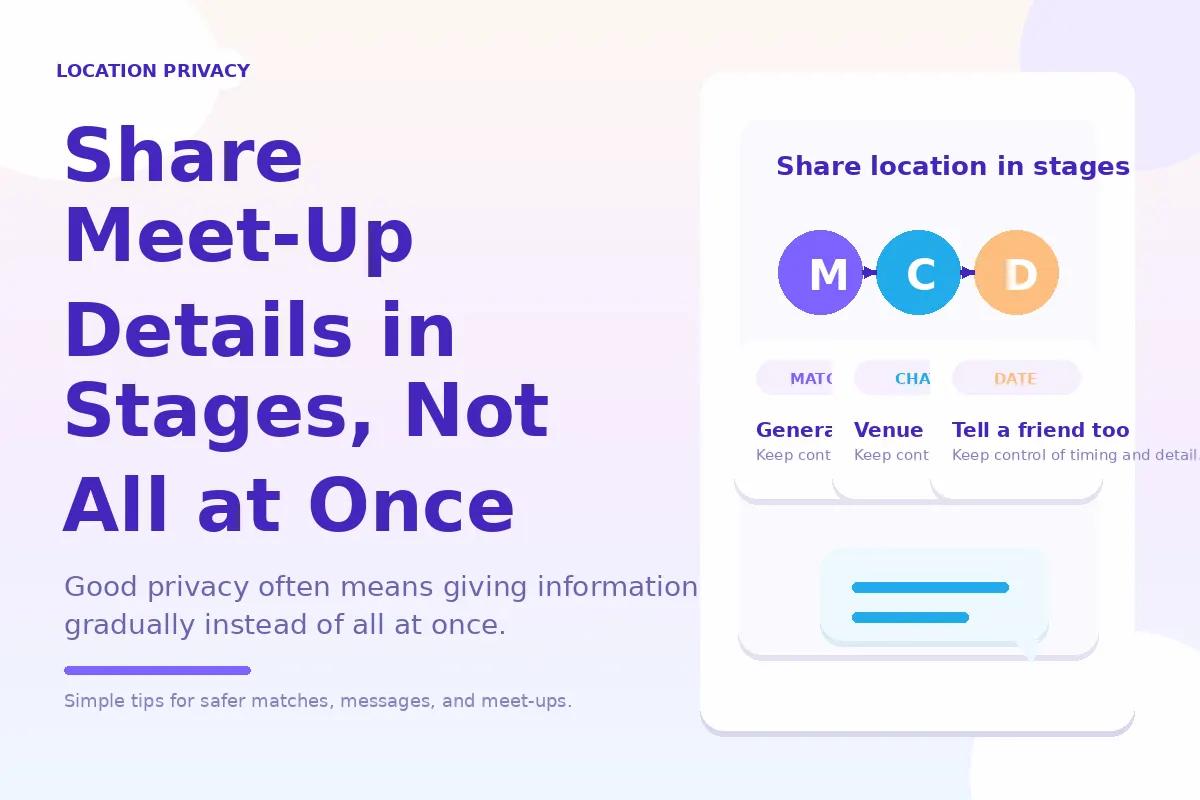
When a chat goes well, it is normal to move toward a date. The mistake many people make is sharing meet-up information as though emotional momentum automatically equals trust. It does not. Good privacy often means sharing details in stages. Early on, a general area is enough. Once the plan becomes real, the venue can be shared. More personal details can wait until the interaction has actually proven itself safe and respectful.
This slower progression protects you without blocking connection. It means the other person still knows enough to make a plan, but not enough to map your whole routine or assume unrestricted access to where you are. It also helps if the conversation changes direction. When you have only shared what was necessary for that stage, it is easier to pull back comfortably.
Staged sharing is especially useful if someone tries to rush things. A respectful match can handle “Let’s confirm the place later” or “I’ll send the venue once I’m on the way.” Pressure for more detail than needed is often worth noticing, because safe people usually understand reasonable caution.
Keep First Dates Public and Separate From Home
Location privacy is closely tied to first-date safety. Meeting in a public place gives you more control than moving straight into private space. A café, restaurant, bar, or other open venue lets you observe the person in a more neutral setting and leave more easily if something feels off. It also prevents you from giving away your home address too early.
For the same reason, managing your own transportation can help. If possible, avoid a first situation where the other person picks you up from home or learns exactly where you live just because it seems more convenient. Convenience is nice, but it is not always the same thing as safety. A little independence at the start keeps more choices in your hands.
This does not mean every date is dangerous. It means early access should be earned, not assumed. The easier it is to enter and leave a situation on your own terms, the more comfortable and protected you are likely to feel.
Watch for Pressure, Guilt, and Location Probing
Sometimes location privacy becomes difficult not because you forgot a safety habit, but because someone pushes against it. He may ask for your exact area too quickly, act offended when you stay general, or frame caution as a lack of trust. In some cases, the pressure sounds playful. In others, it sounds intense or overly personal very fast. Either way, it is worth paying attention.
People who respect boundaries usually do not need constant explanations. If you say you prefer to share the venue later or that you do not give out your exact area early, a healthy response is simple respect. Guilt-tripping, repeated probing, or attempts to make you feel dramatic for being careful are signs that the other person may not value your privacy the way you do.
Fast trust can be flattering, but it is not always safe. A person can seem warm, funny, and engaging while still feeling too entitled to your information. Staying alert to that difference helps you protect both your location and your peace of mind.
| Safer response | Riskier pattern | What it tells you |
|---|---|---|
| “A general area is fine for now.” | Demanding your exact address early | He may not respect normal privacy boundaries. |
| Sharing the venue when plans are confirmed | Pushing for live updates all day | He wants more access than the stage requires. |
| Respecting your pace | Guilt-tripping you for being careful | He may value convenience over your comfort. |
| Meeting publicly first | Insisting on home pickup or private meet right away | He may be skipping normal safety boundaries. |
Use Public First Dates and Backup Safety Habits
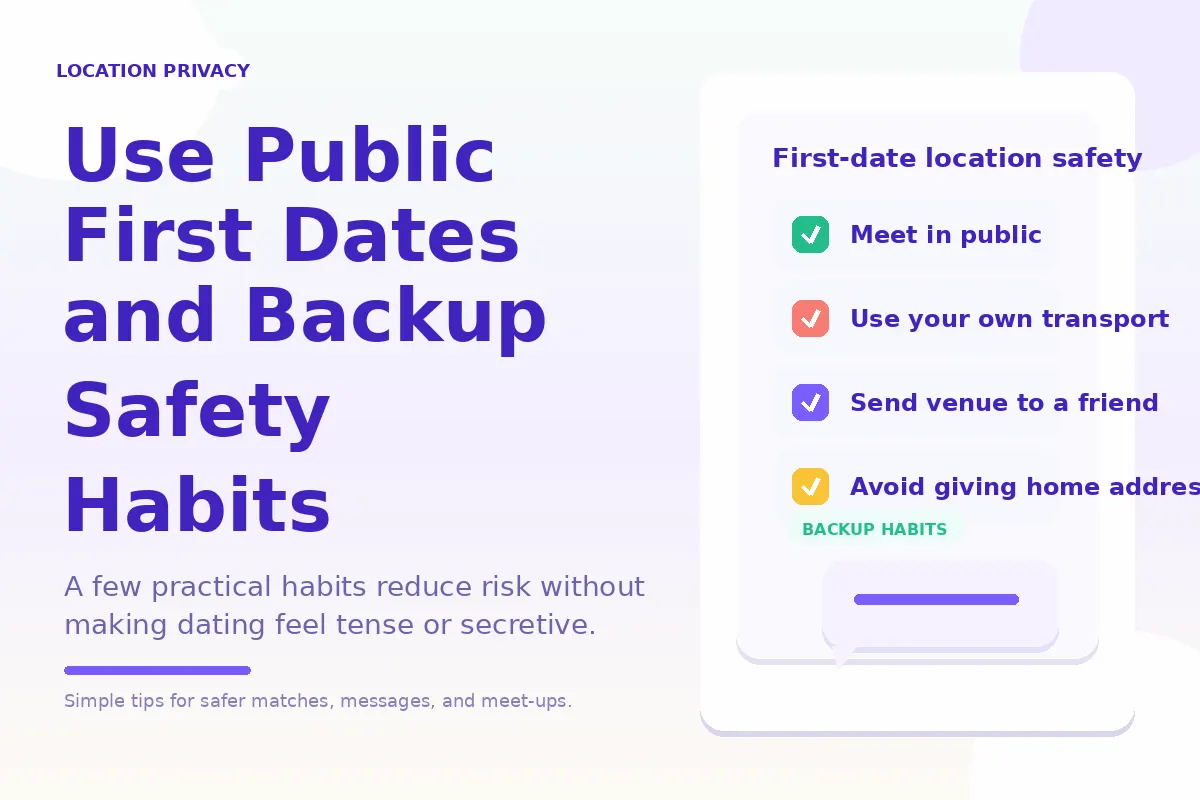
A few backup habits make location safety much easier. One of the best is telling a trusted friend where you are going, who you are meeting, and when you expect to be back. This is simple, low effort, and very useful. It creates a basic safety net without interfering with the date itself.
Another useful habit is keeping control of how you arrive and leave. Meeting in public, using your own transport, and avoiding over-disclosing your movement in real time all support the same goal: you stay in charge of access. If the date goes well, great. If it does not, you have protected your exit options.
You can also keep post-date privacy in mind. Just because a first meeting was pleasant does not mean all location boundaries should disappear instantly. Trust grows best when it is reinforced by behavior over time. You can still pace how much of your routine, neighborhood, and home life becomes visible.
- Tell a friend the plan before you go.
- Meet publicly before sharing private spaces.
- Use your own route and transport when possible.
- Keep control of when your home address becomes known.
Protecting Your Location Should Feel Practical, Not Paranoid
A lot of people stop themselves from using good privacy habits because they worry it will seem overly cautious. In reality, most of these habits are normal, practical, and easy to integrate. They do not make you unfriendly. They make you intentional. The right person usually respects that because he also understands that comfort and trust are part of a good dating experience.
Location privacy becomes simpler when you stop seeing it as a dramatic safety plan and start seeing it as basic digital hygiene. You review what your profile reveals. You limit precision where possible. You delay unnecessary detail. You stay alert to pressure. You use public first meets and trusted backups. None of this is extreme. It is just good judgment applied early enough to matter.
How to protect your location on gay dating apps is really a question of pacing access. The less you rush visibility, the more control you keep. And the more control you keep, the easier it is to enjoy dating with less stress and more confidence.