

The day we have been waiting for has finally arrived! As laws and society become more inclusive, love is no longer confined by traditional gender boundaries, and building a family is no longer just a dream for LGBTQ+ couples. But where do you begin with gay marriage registration? Some people may still be unsure about which documents are required or whether the process is complicated. Don’t worry! We have put together a complete A-Z guide to preparing gay marriage documents, with everything you need in one place. Once you’ve read it, you’ll be ready to head to the district office with your partner and complete the marriage registration process with confidence and ease!
“Love is Love, and everyone should have an equal right to build a family.”
In this article
Why Is Gay Marriage Registration Important for Couples?
Many people may think that love is simply between two people—as long as you love and understand each other, why go through the trouble for a piece of paper? In reality, however, legal gay marriage provides important “rights” and “security” for your relationship that simply living together cannot offer. Just imagine these situations…
- Medical Emergencies: Subject to applicable laws and medical regulations, you may be able to participate in medical decisions or provide necessary consent for your spouse without having to rely entirely on other family members who may live far away or may not be close to your partner.
- Building a Life Together: As legally recognized spouses, you may be able to apply jointly for a home or condominium loan, subject to the bank’s requirements. Your marital status may be considered when assessing your combined income and finances, but approval still depends on the lender’s criteria, income, credit history, and repayment capacity.
- Planning for the Future: Legal rights related to inheritance and estate management, as well as the ability to jointly adopt a child under the law, can provide greater security and help complete your vision of a “family.”
A Major Milestone: The Journey to Legal Gay Marriage
Before couples could proudly walk hand in hand into a district office and legally register a same-sex marriage today, LGBTQ+ communities in Thailand and around the world went through years of advocacy, campaigning, and efforts to achieve legal change. Gay marriage is therefore more than a matter between two people—it is also a powerful symbol of equality and equal human rights.
Looking back, same-sex couples faced many limitations, including unequal access to certain public benefits, a lack of legal recognition as “family” during unexpected or emergency situations, and the painful reality of being treated as legal “outsiders.” The passage of marriage equality legislation therefore broke down a major barrier of inequality, allowing different forms of love and relationships to receive official legal recognition.
Registering a same-sex marriage today is therefore a celebration of the freedom to love. It also reaffirms that, regardless of sexual orientation, everyone has the right to love, build a family, and receive equal legal protection just like any other married couple.
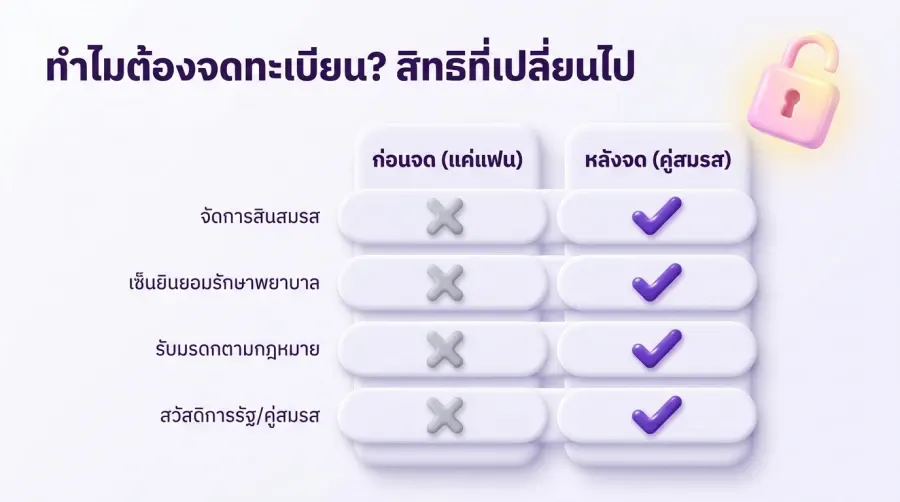
Updated Rights and Benefits After Gay Marriage That LGBTQ+ Couples Should Know
| Benefits / Category | Before Marriage Registration (Dating / Partners Only) | After Marriage Registration (Legally Recognized Spouses) |
|---|---|---|
| Joint Property Management | Generally Treated as Separate Property, Making Division More Difficult After a Breakup | Treated as “Marital Property,” Managed and Divided According to Law |
| Medical Decision-Making | No Automatic Rights as a Spouse (Decisions May Require a Legal Relative or an Authorized Person) | May participate in medical decisions as a legal spouse and provide medical consent on the spouse’s behalf, subject to applicable laws and medical regulations |
| Legal and Court Rights | Generally Cannot Take Legal Action on the Partner’s Behalf as a Spouse | May Initiate Certain Criminal Proceedings on Behalf of a Spouse Where Permitted by Law |
| Inheritance Rights | No Automatic Inheritance Rights (Unless Clearly Specified in a Will) | Recognized as a Legal Heir with Inheritance Rights Under the Law |
| Government / Private-Sector Benefits | Not Eligible to Claim Benefits | Eligible for Spousal Medical and Other Benefits (Subject to Applicable Conditions) |
A-Z Guide to Preparing Documents for Gay Marriage Registration
Documents for Thai Citizens
For Thai couples, preparation is very simple. You only need the basic documents you normally already have. It is recommended to bring both the original documents and photocopies, just in case.
- Thai National ID Card: Bring the original, valid and unexpired card. This is one of the most important documents and must not be forgotten.
- House Registration (Tabien Baan): Bring the original and a copy to verify your registered residence.
- 2 Witnesses: They must be legal adults aged 20 or older and should bring their original ID cards. Consider asking close friends or family members to be your witnesses—they can also help take photos of your special day!
- Additional Documents (If Applicable):
- Name/Surname Change Certificate (If You Have Changed Your Name)
- Divorce Certificate (If Previously Married)
- Death Certificate of a Former Spouse (If Previously Married and the Spouse Has Passed Away)ใบมรณบัตรของอดีตคู่สมรส (กรณีเคยสมรสแล้วคู่สมรสเสียชีวิต)
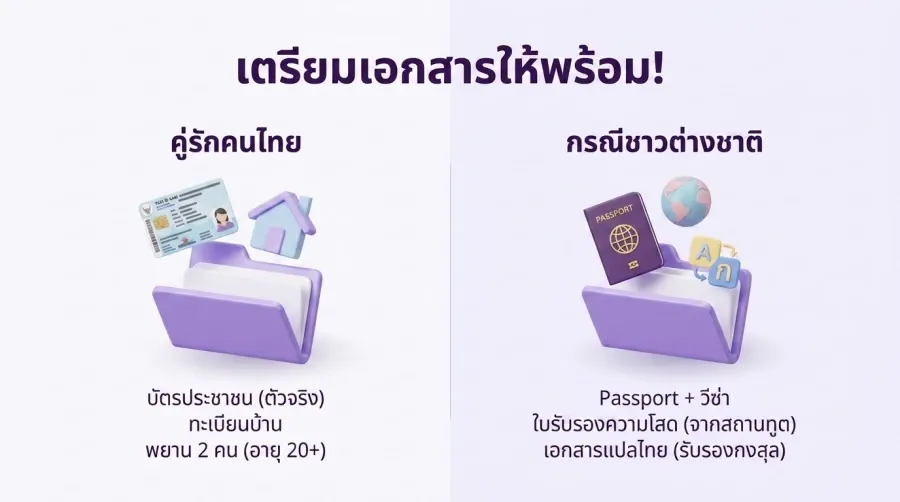
Documents for Foreigners Registering a Same-Sex Marriage in Thailand
If your partner is a foreigner—whether from a Western country, Korea, Japan, or elsewhere—or an expat living in Thailand, the process may be a little more complicated, but it is definitely manageable with the right preparation!
- Passport: Bring the original passport along with a copy of the page showing the Thai visa or entry stamp.
- Certificate of Marital Status / Freedom to Marry: Issued by the relevant country’s embassy in Thailand (Very Important!)
- Translated Documents: The marital status certificate must be translated into Thai and authenticated by the Department of Consular Affairs, Ministry of Foreign Affairs of Thailand, before it can be submitted to the district office.
🏳️🌈 Read More – Same-Sex Marriage with a Foreigner: How Can a Thai Gay Person Marry a Foreigner?
Is a Prenuptial Agreement Necessary Before Registering a Gay Marriage?
When a relationship reaches the point where legal matters become involved, “assets” and “debts” are issues that cannot be ignored. Before you and your partner register your marriage, one important step that many couples may overlook is considering a “prenuptial agreement.”
What Is a Prenuptial Agreement?
A prenuptial agreement, or prenup, is a legal agreement made between a couple “before” registering their marriage. It sets out how assets, debts, and business interests will be owned and managed, including which property remains “separate property” and which will be treated as “marital property” after the marriage takes legal effect.
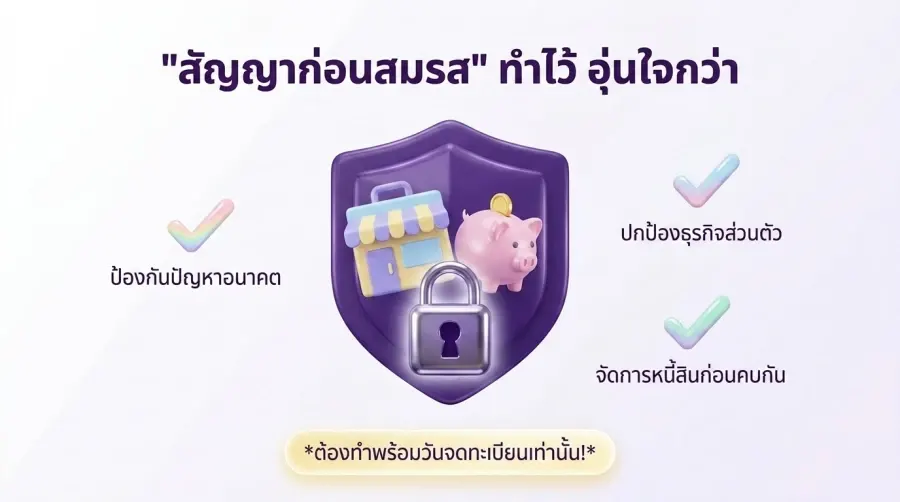
Why Should LGBTQ+ Couples Consider a Prenuptial Agreement?
- Prevent Future Problems
- No one wants a relationship to end, but if that day ever comes, a prenuptial agreement can help both parties divide their assets according to terms agreed in advance, reducing disputes and potentially avoiding the time, expense, and emotional stress of court proceedings.
- Protect Your Personal Business
- For gay couples who own businesses, a prenuptial agreement can help clearly distinguish business-related income and assets from family or marital property and define how those assets will be owned and managed.
- Debt Management
- If one partner has significant debt before the marriage, a prenuptial agreement can help clarify who is responsible for that debt and reduce the risk of disputes or liability for the other spouse after marriage. However, the actual legal responsibility will depend on applicable law and the nature of the debt.
Tip: If you decide to make a prenuptial agreement, it should be completed before the marriage registration and declared or registered with the registrar at the time the marriage is registered. A prenup cannot be added retroactively after the marriage has been registered. An agreement made after marriage is considered an agreement concerning property between spouses during marriage, which is subject to different legal rules and effects.
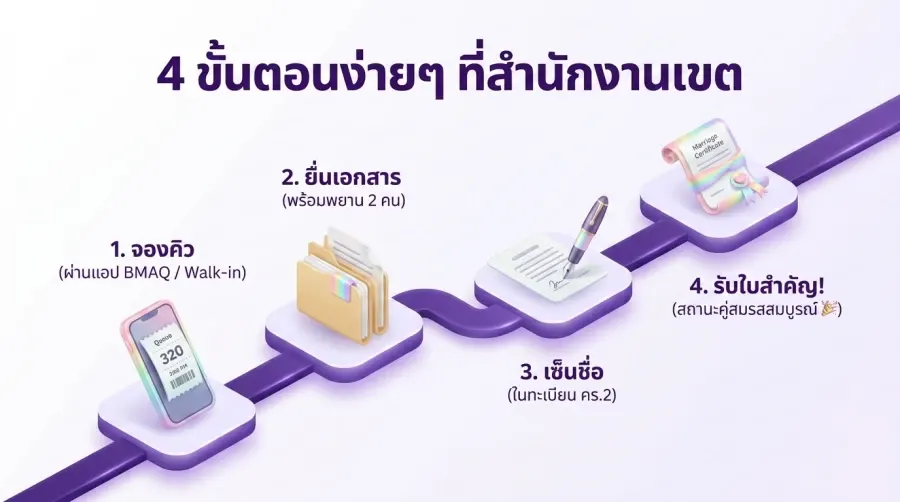
Steps and Process for Registering a Gay Marriage at a District Office
Once your documents, both partners, and witnesses are ready, it’s time to go! The process for registering a gay marriage at a district office is essentially the same as a standard marriage registration. There is no separate registration process simply because you are a same-sex couple. Just prepare the required documents and proceed with the registrar.
Step 1: Prepare and Book an Appointment in Advance
To make the process smoother and avoid long waiting times, it is recommended to check the appointment system of your chosen registration office in advance. In Bangkok, you can check whether BMAQ supports marriage-registration appointments at your preferred district office and select an available date and time. In other provinces, you can contact the relevant district office (Amphoe) in advance to ask whether an appointment is required or whether walk-ins are accepted.
- Tip: Some district offices have beautiful photo spots or special backdrops for couples. Try searching for reviews of popular marriage registration offices, such as Bang Rak or Pom Prap Sattru Phai District Office in Bangkok, to find the perfect place for your special day!
Step 2: What Do You Need to Do on the Day of Marriage Registration?
- Arrive Early: Allow extra time to find parking and get prepared.
- Get a Queue Number and Submit Your Documents: Submit all required documents, including the witnesses’ ID cards, to the officer for verification.
- Initial Interview: The registrar may ask a few basic questions to verify that the information is correct. (No need to be nervous—just answer truthfully.)
- Sign the Marriage Register (คร.2): The big moment! Both partners sign the marriage registration document, along with the signatures of the two witnesses.
- Receive the Marriage Certificate (คร.3): The officer will provide each spouse with one copy of the marriage certificate. Once this step is complete, you are officially recognized as legal spouses! 🎉
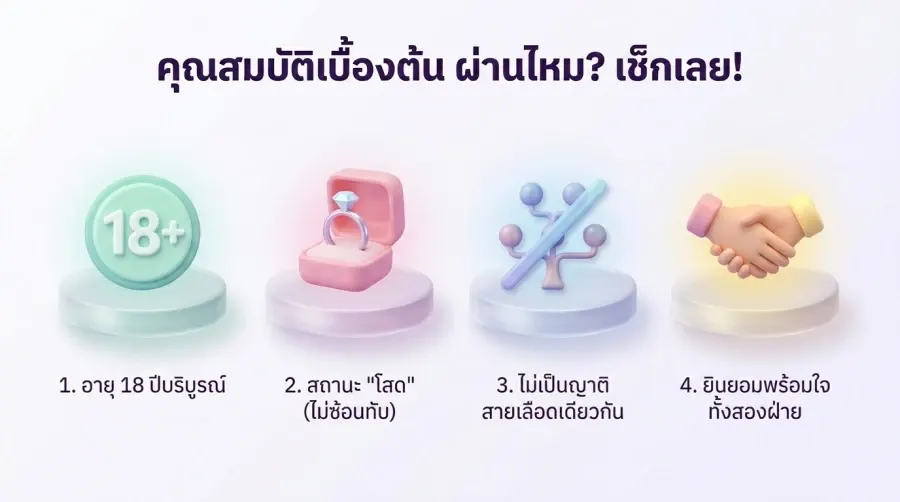
Eligibility Requirements for Gay Marriage Registration
Before preparing the documents, take a moment to check whether you and your partner meet the basic legal requirements. This will help ensure that your same-sex marriage registration is legally valid and proceeds smoothly.
- Age: Both partners should generally be at least 18 years old. For anyone under 18, eligibility to marry and any requirement for parental, guardian, or court consent will depend on current Thai law.
- Blood Relationship: The couple must not be close blood relatives prohibited from marrying by law, such as direct-line relatives or siblings.
- Marital Status: Neither partner may already be legally married to another person at the time of registration. Thai law prohibits bigamy, so a person with an existing legal spouse cannot register another marriage.
- Consent: The marriage must be based on the free and mutual consent of both parties, without coercion, threats, or deception.
Rights, Benefits, and Married Life Management After Same-Sex Marriage
Once you have received that meaningful marriage certificate, the next step is managing your married life together. Legal marriage opens the door to easier management of many aspects of life as a couple.
Property Management and Inheritance Rights
| Certain property acquired after marriage registration may be considered “marital property” under Thai law, although its classification depends on factors such as how the property was acquired and any valid prenuptial agreement. If one spouse passes away, the surviving spouse generally has inheritance rights as a legal heir, so inheritance does not depend solely on having a will. |
Medical Decision-Making Rights After Same-Sex Marriage Registration
| This is one of the important rights LGBTQ+ couples have long advocated for. Once your marriage is legally recognized, your status as a spouse is clearer in medical matters. Subject to applicable medical rules and the circumstances, you may be able to participate in medical decisions or provide relevant consent on behalf of a spouse who is unable to make decisions for themselves, rather than being treated as a legal “outsider” simply because you are not related by blood. |
Tax and Welfare Benefits
| Subject to Thai tax rules, legally married spouses may use the applicable personal income tax filing options and may qualify for spouse-related tax allowances in certain circumstances. In addition, benefits provided by government programs, social security schemes, or employer group insurance that cover legal spouses may be claimed according to the specific eligibility rules of each program. |
The Next Step After Same-Sex Marriage: Financial Planning and Life Insurance
Once you have your marriage certificate, the next important step as newlyweds is to build a stable future together. The legal status and rights that come with marriage registration can help you plan your finances and future more effectively, including:
Joint Bank Accounts and Co-Borrowing
As legally married spouses, you may apply for a joint loan subject to the bank or financial institution’s requirements. For mortgages and other loans, lenders may consider both spouses’ income, debts, credit profiles, and repayment capacity, which could increase the amount you are eligible to borrow, although approval is not guaranteed. You may also open a joint bank account, subject to the bank’s rules, to manage household expenses, shared savings, or retirement funds more clearly.
Naming a Life Insurance Beneficiary
This is an important change. In the past, some insurers may have had different requirements for naming someone who was not a blood relative as a beneficiary. With same-sex marriage now legally recognized, you can generally name your legal spouse as a beneficiary on life insurance policies, subject to the insurer’s rules. For health and accident insurance, coverage and benefit eligibility depend on the specific policy terms, helping couples plan more confidently for unexpected events.
🏳️🌈 Read More – Gay Adoption: A New Step Toward Building a Complete Gay Family
Joint Tax Planning
Under current Thai tax rules, married couples may have different options for filing personal income tax, depending on their types of income and applicable conditions. Spouse-related tax allowances may also be available when the relevant requirements are met, such as when one spouse has no taxable income. The most tax-efficient approach depends on each partner’s income and available deductions, so consulting a tax professional or financial planner can help you choose the most suitable option for your family.
How to Cope and Prepare Yourself When Your Family Still Has Barriers Around Gay Marriage
Although the law and society as a whole have become more accepting of gay marriage, we have to recognize that “not every family” will be ready to understand and celebrate it immediately. For some couples, the biggest challenge before walking into the district office may not be the paperwork, but “the feelings of family members.” If your parents or older relatives are still struggling to accept your marriage, here are a few suggestions that may help you maintain your relationships with one another:
- Let Time Be the Proof
- Understanding between different generations takes time. Avoid pushing or pressuring your family to accept everything immediately. Instead, let your consistent care, respect, and commitment to each other show them that your relationship is genuine, stable, and natural.
- Communicate with Empathy
- Explain that marriage registration is not simply about publicly defining your relationship. It also provides practical legal protections and a clearer legal status in situations such as illness, accidents, or other emergencies. Framing the conversation around safety and caring for one another may help your family better understand why this decision matters to you.
- Protect Your Rights While Preserving Your Relationships
- Remember that if you have reached the legal age for marriage and meet the applicable legal requirements, you have the right to decide to enter a same-sex marriage without needing your family’s consent. At the same time, you can give your family time and space to understand and adjust, rather than ending the relationship simply because they may not understand your decision today.
Ultimately, the new family you are building with the person you love can become one of your most important safe spaces. Hold on to each other and move through this chapter together.
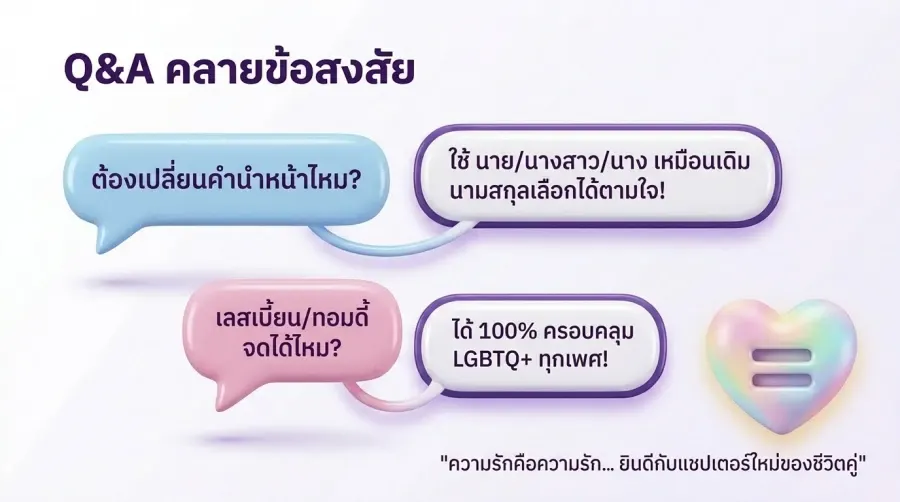
Q&A: Frequently Asked Questions About Gay Marriage Registration
Q: After registering the marriage, do I have to change my title or surname?
A: Under current Thai law, personal titles continue to be used according to the existing legal rules. As for surnames, after marriage you may legally choose to keep your original surname, use your spouse’s surname, or make other surname arrangements permitted under Thai law.
Q: Can lesbian couples also use this gay marriage registration guide?
A: Absolutely! In this context, “gay marriage” includes LGBTQ+ couples who meet Thailand’s legal requirements for marriage. The basic legal framework and registration requirements are the same, although specific documents may vary depending on individual circumstances or nationality.
Q: Which District Office Is Best for Marriage Registration?
A: From a legal perspective, a marriage has the same legal effect regardless of which authorized registration office you choose. For a more memorable and symbolic experience, however, many couples choose districts with auspicious or romantic names, such as Bang Rak, Thawi Watthana, or Samphanthawong. Some also register on Valentine’s Day or on each other’s birthdays to make the occasion even more romantic!
Q: What Should We Do If We Decide to Separate?
A: Just as starting a marriage involves legal procedures, ending one must also be handled properly under the law. If the relationship can no longer continue, you will need to legally register the divorce to end your marital status and handle matters such as the division of marital property according to applicable law. (Of course, we wish every couple a long and happy relationship!)
Conclusion
Marriage registration is not simply a trend or something to follow because it is fashionable. It is about building a stable foundation for life together and affirming the fundamental rights that two people who love each other deserve. Marriage equality and the legal recognition of same-sex marriage provide important protections for you and the person you love during life’s most vulnerable moments. They also represent a legal commitment that confirms, “We are a family.”
We hope this A–Z guide to preparing documents for same-sex marriage registration from Quicky helps every LGBTQ+ couple planning to build a future together understand the overall process and prepare more easily. Wishing everyone happiness in this new chapter of married life, with love, joy, and equal rights for every couple! 🏳️🌈✨
Got all your marriage documents ready… but still missing someone to register with? 👀🏳️🌈
Still single? Let Quicky, the hot gay dating app, help you find “the one” to build a future and family with. Download it for free, log in easily, and start matching today!