
Jealousy is one of those feelings that can make a calm relationship conversation turn tense very quickly. You notice your partner talking closely with someone, liking an ex’s photos, going out without you, or receiving attention on a dating or social app. The feeling arrives before you have decided what it means. The challenge is that jealousy often contains several things at once: fear of losing the relationship, insecurity, anger, comparison, old betrayal, or a genuine concern about a boundary. Talking about it is healthy. Trying to control another adult because you feel it is not. The useful skill is learning how to describe the trigger and ask for what you need without turning fear into surveillance, accusations, or restrictions.
In this article
Jealousy Is a Feeling; Control Is a Behavior
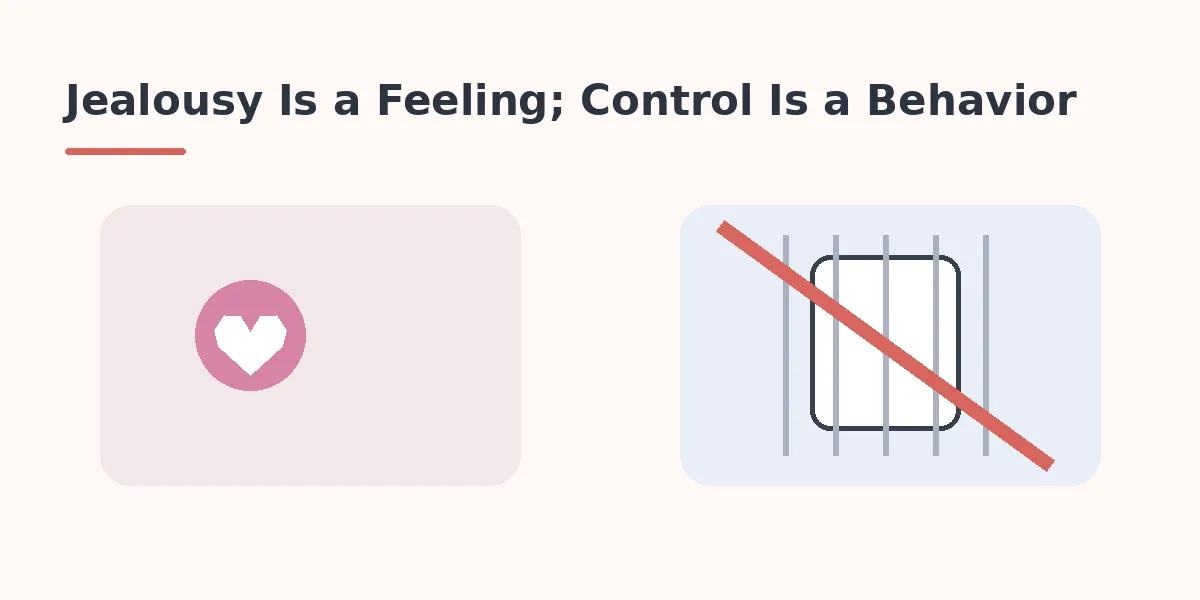
Jealousy is not automatically toxic. Relationship research describes it as a cluster of feelings, thoughts, beliefs, actions, and reactions that can range from ordinary relational vulnerability to extreme or obsessive behavior. The feeling itself can signal that something matters to you or that a situation has activated fear. What happens next determines whether the conversation becomes constructive or damaging.
Control is different. Checking a partner’s phone without consent, demanding passwords, telling him who he can see, monitoring his location, dictating clothing, threatening to leave unless he cuts someone off, or making accusations until he gives up normal freedom are behaviors. Jealousy may explain why those urges appear, but it does not justify acting on them.
Start With What Happened, Not With What You Think It Proves
A jealousy conversation goes badly when interpretation is presented as fact. “You were flirting with him because you want someone better” gives your partner almost no room to respond except by defending himself. Instead, begin with the observable trigger: “When I saw how close you two were at the party, I felt jealous and insecure.” That sentence is still vulnerable, but it does not pretend you can read his mind.
This is a core part of healthy gay relationship communication, trust, and conflict repair. Facts create a shared starting point. Interpretations can be explored afterward. If you reverse that order, the entire conversation may become a fight over whether your accusation is true rather than a conversation about what made you feel unsafe.
Ask for Reassurance Instead of Surveillance
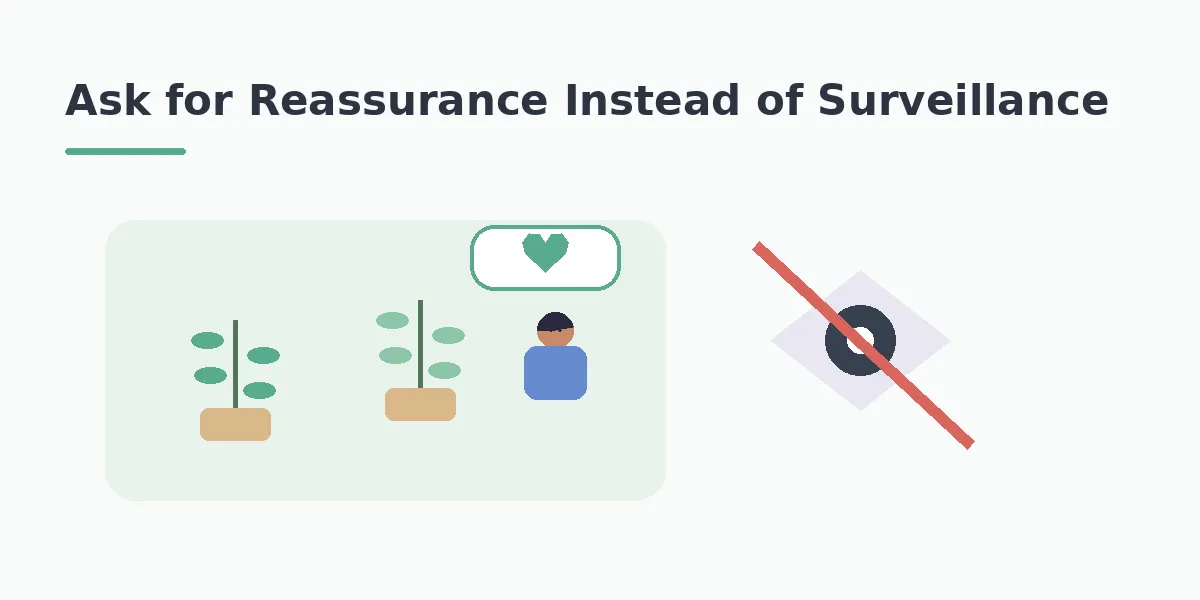
Jealousy often creates a craving for certainty. That is where controlling behavior can start. You want to see the messages, know exactly who was there, check when he got home, or make him prove that nothing happened. The problem is that surveillance rarely creates stable security. It teaches both people that anxiety must be solved by giving one partner more access and the other partner less privacy.
Try asking for reassurance instead. Reassurance can sound like, “Can you remind me where we stand?” or “I know this is my insecurity talking, but I need a little closeness right now.” You can also ask for reasonable transparency around an agreed boundary. The difference is that reassurance supports connection, while surveillance attempts to remove uncertainty by controlling the other person.
Separate an Insecurity Trigger From a Broken Agreement
Not every jealous feeling means a boundary was crossed. If your partner talks to an attractive man at a party, your discomfort may come from comparison rather than betrayal. On the other hand, if you both agreed not to flirt with exes privately and he is doing that, the issue is no longer only internal insecurity. A relationship agreement may need attention.
Ask yourself which problem you are dealing with. “I felt threatened by something allowed” requires emotional regulation and reassurance. “We agreed this would not happen, and it happened” requires an accountability conversation. Mixing those categories is dangerous because it can make every uncomfortable feeling look like proof of wrongdoing. Clear agreements help couples tell the difference.
Use a Jealousy Sentence That Names the Trigger, Feeling, and Request
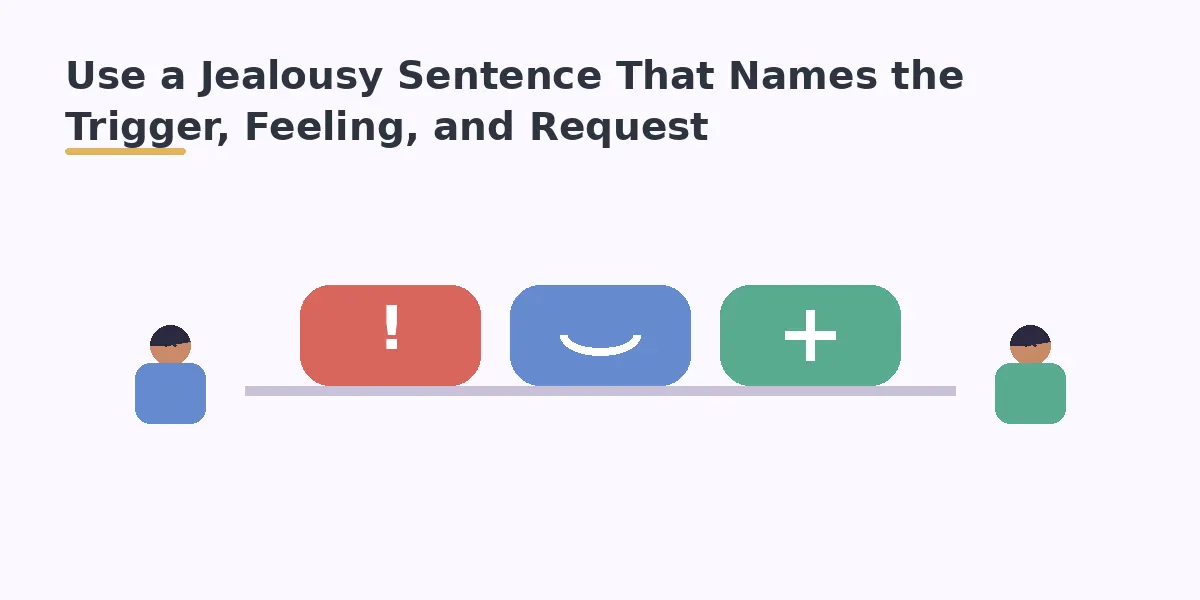
A simple structure can keep the conversation grounded: trigger → feeling → meaning → request. For example: “When you disappeared with him for most of the party, I felt jealous and left out. I started telling myself I was less important. Can we talk about what happened and what would help us both feel okay at events like that?”
The request is the important part. A request leaves room for discussion. A demand closes it. “Can we agree to check in once during long nights out?” can be negotiated. “You are never allowed to go out without me again” is control. The same jealous feeling can lead to two very different relationship outcomes depending on how the request is framed.
Do Not Use Jealousy to Make Your Partner Prove Love
Some couples fall into a cycle where jealousy becomes a test. One person threatens to withdraw, compares himself to others, or creates dramatic conflict until the partner proves loyalty with extra attention. Other people intentionally provoke jealousy to test whether their partner cares. Research has linked jealousy-inducing behavior with conflict, controlling dynamics, and other harmful relationship patterns.
Avoid building reassurance through crisis. If you need affection, ask for affection. If you need clarity about exclusivity, ask about exclusivity. If you need to know whether the relationship is still serious, have that conversation directly. Making the other person anxious in order to feel chosen may work briefly, but it trains the relationship to use insecurity as a bonding tool.
When Jealousy Is Connected to Past Betrayal
Sometimes the trigger is current, but the intensity comes from an older wound. You may have been cheated on, lied to, abandoned, or kept in a relationship where your instincts were repeatedly dismissed. When something similar appears now, your body can react as if the entire old story is happening again.
Naming that history can help: “This situation is bringing back what happened in my last relationship, and I know you are not the same person.” That sentence does not mean your current partner gets a free pass. It means you are separating present evidence from past fear. Research and clinical frameworks on jealousy often emphasize distinguishing what belongs to the present relationship from meanings imported from earlier experiences.
Use a Jealousy Reality Check Before You Make a Demand
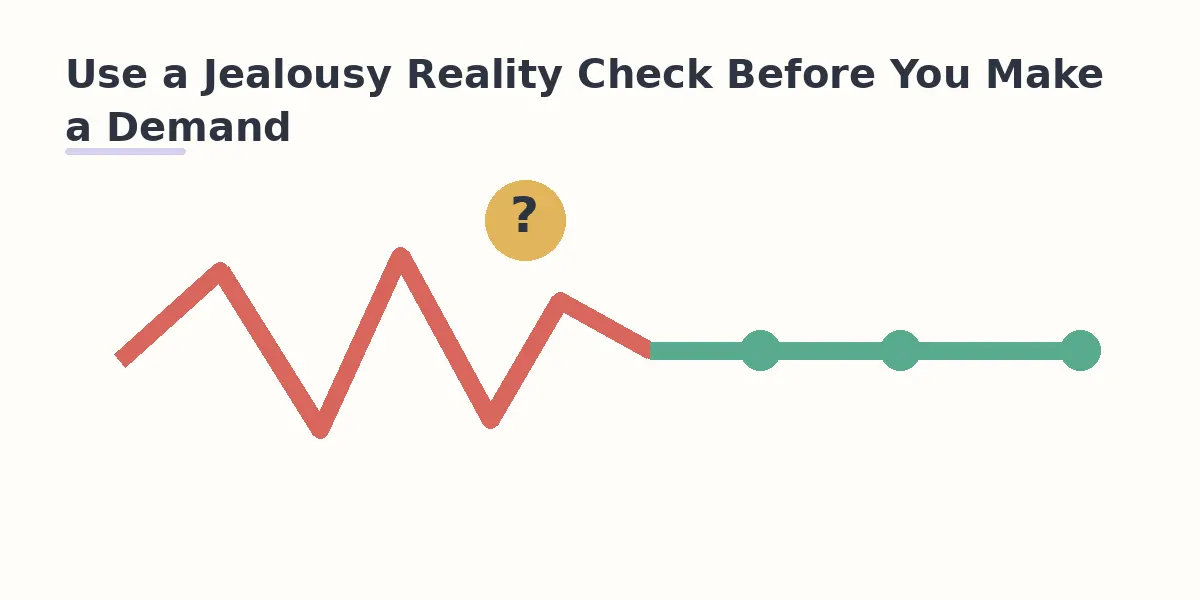
Before asking your partner to change behavior, slow the situation down.
| Question | Why it matters | Better next step |
|---|---|---|
| What exactly happened? | Separates facts from interpretation | Describe the observable trigger |
| Was an agreement broken? | Distinguishes insecurity from accountability | Discuss the specific agreement if needed |
| What am I afraid this means? | Reveals the vulnerability underneath | Name the fear without calling it fact |
| What reassurance would actually help? | Prevents vague demands | Ask for one concrete form of connection |
| Am I asking for access or control? | Protects privacy and autonomy | Choose a request that both people can negotiate |
| Is this a repeating pattern? | One incident and chronic instability are different | Respond to the pattern, not only the moment |
| Would I accept the same rule applied to me? | Tests fairness | Adjust any one-sided boundary |
The table helps move jealousy from impulse to information.
Know the Difference Between a Boundary and a Restriction
A boundary describes what you will do to protect your wellbeing. A restriction tells another adult what he is allowed to do. “I cannot stay in a relationship where we hide sexual conversations with exes” is a boundary. “You are forbidden from speaking to any ex” is a restriction. Couples can still agree on limits together, but agreement matters.
This distinction becomes especially important when jealousy is intense. A recent systematic review of intimate partner violence research found that jealousy, distrust, dominance, need for control, destructive communication, and emotion dysregulation can interact in harmful ways. That does not mean ordinary jealousy predicts violence in every relationship. It does mean controlling behavior should not be romanticized as proof of care.
If Jealousy Keeps Returning, Look Underneath the Trigger
Repeated jealousy often points to a deeper issue. Maybe the relationship agreements are unclear. Maybe one partner is genuinely inconsistent. Maybe previous betrayal was never repaired. Maybe self-esteem is low. Maybe social media constantly feeds comparison. Or maybe the couple has very different expectations around flirting, friendships, exes, open relationships, or privacy.
If the same fight keeps happening, stop arguing only about the latest person or message. Ask what the recurring fear is and what structure would address it. Some couples benefit from clearer agreements. Others need more trust-building behavior. Some need individual or couples therapy because reassurance no longer changes the cycle. The goal is to solve the pattern rather than prosecute every new trigger.
Talking About Jealousy Should Create More Honesty, Not Less Freedom
A good jealousy conversation does not end with one partner becoming smaller. It ends with more information: what happened, what the feeling means, whether a boundary was crossed, and what kind of reassurance or agreement would help. Both people should leave with more clarity, not with one person newly monitored.
Jealousy can be discussed without shame and without control. Name the trigger. Own the feeling. Ask instead of accuse. Separate broken agreements from internal fear. Protect privacy while still allowing reasonable transparency. The goal is not to eliminate jealousy completely. It is to keep jealousy from becoming the person who writes the rules of the relationship.
References
- PubMed — Disarming jealousy in couples relationships: Clinical framework describing jealousy as a multidimensional relational experience and emphasizing vulnerability, escalation, and present-versus-past meanings.
- PubMed — Understanding mechanisms linking insecure attachment and intimate partner violence: Recent meta-analytic review identifying jealousy, distrust, dominance, need for control, destructive communication, and emotion dysregulation as relevant mediating factors.