

Have you ever felt this way? Even though you’ve already accepted being gay and can openly tell others, deep down you may still think, “If I were more like what society considers a ‘real man,’ maybe life would be easier.” Or perhaps you sometimes catch yourself judging other gay men who are more feminine, thinking that the way they express themselves is somehow “inappropriate.”
If thoughts like these have ever crossed your mind, they are not uncommon, and you are not alone in experiencing them. This psychological phenomenon is often called Internalized Homophobia. It happens when negative social attitudes, stigma, or prejudice toward homosexuality become internalized, potentially shaping how someone feels about their own sexual orientation, identity, or other members of the LGBTQ+ community.
This article will help you understand these feelings more deeply and give you space to reflect on your own experiences. Most importantly, we’ll explore ways to cope with these internal conflicts, develop greater self-acceptance, and gradually learn to embrace yourself more fully.
In this article
What Is Internalized Homophobia? Why Does Gay Self-Hatred Develop?
Internalized Homophobia refers to the process in which LGBTQ+ people absorb prejudice, negative attitudes, and discrimination toward sexual minorities from the society around them, and gradually turn those beliefs inward—judging, devaluing, or rejecting themselves.
Imagine growing up in Thai society and repeatedly being exposed, from childhood to adulthood, to certain beliefs and stereotypes such as:
- “Gay people are supposed to be funny.”
- “Being gay is a punishment for past karma,” or
- “Only heterosexual men and women are considered normal.”
When we hear these messages repeatedly, we may gradually internalize those prejudices and false beliefs until they become our own inner critical voice. Over time, this can lead to rejection or negative feelings toward our own gay identity—what is known as Internalized Homophobia.
“Feeling this way doesn’t mean you’ve done anything wrong. That critical voice in your head
may actually come from social prejudice you’ve carried and internalized since childhood.”

Many people may wonder, “If I’m gay myself, why would I ever dislike or reject who I am?” The answer is that we aren’t born with this kind of self-directed negativity. Instead, it can develop from messages, expectations, and prejudice that society exposes us to from childhood into adulthood.
So where does Internalized Homophobia usually come from? Let’s explore some of its common roots.
- Family and Expectations: Home should be a safe space, but for many LGBTQ+ people, it can become the starting point of pressure. Statements like, “You can be whatever you want, as long as you’re a good person,” may sound accepting, but in some contexts they can carry an underlying message that being gay is somehow a “flaw” that needs to be compensated for by being good.
- School Systems and Bullying: Growing up in a school that enforces specific short hairstyles, requires uniforms based on sex assigned at birth, or allows students to be mocked with discriminatory language can gradually make young people feel ashamed of their gender expression or sexual orientation and believe they need to hide who they are.
- Stereotypes in Media and Social Media: Although BL series are thriving today, gay characters in older Thai media were often portrayed as “comic relief,” “deviant,” or destined for a tragic ending. Repeated exposure to these negative portrayals can shape our subconscious, making us want to distance ourselves from identities that society has depicted in such a negative way.
- Religion and Beliefs: In Thai society, some religious interpretations and traditional beliefs may still portray sexually and gender-diverse people as “sinful” or “unnatural.” Being repeatedly exposed to these messages can create an internal conflict between a person’s faith and their authentic identity, sometimes leading to guilt or difficulty with self-acceptance.
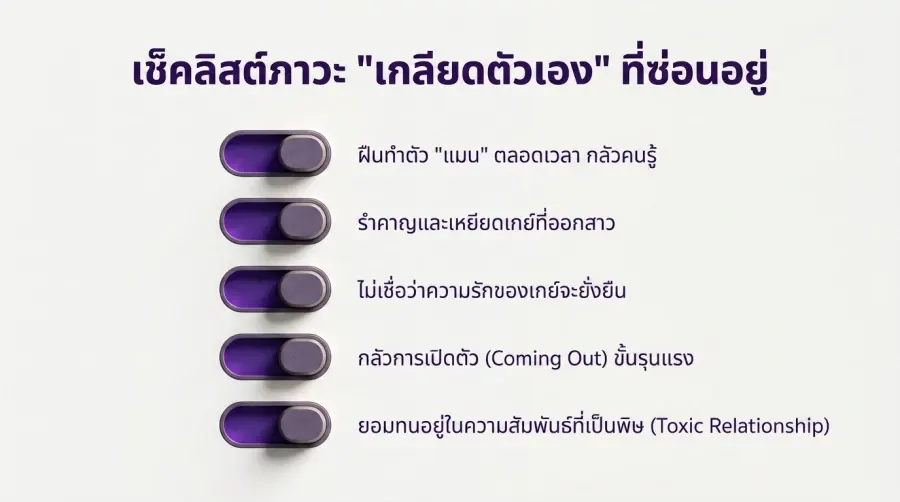
Warning Signs: Could You Be Experiencing Internalized Homophobia?
Many people may experience this without realizing it. Take a look at the behaviors and thoughts below and see how many of them feel familiar to you.
- Trying to Act as “Masculine” as Possible: Feeling embarrassed or constantly monitoring yourself around others, suppressing your natural personality because you’re afraid people might realize you’re gay.
- Judging Other Gay Men: Feeling uncomfortable with or annoyed by gay men who express themselves more visibly, such as being feminine or dressing boldly, and often saying, “I’m gay, but I don’t act like them.”
- Believing Gay Relationships Can’t Last: Holding a deep belief that relationships between men are only about sex, that gay people are somehow undeserving of romantic love, or that you’ll never be able to build a warm and loving family of your own.
- Intense Fear of Coming Out: This goes beyond simply waiting until you feel ready. It may involve rejecting your own identity or feeling intense disgust or shame toward yourself when someone suspects that you’re gay.
- Staying in a Toxic Relationship: Deep down, you may think, “I’m gay, so I should just be grateful that someone loves me,” leading you to tolerate emotional mistreatment from a partner.
🏳️🌈 Read More – Gay Relationships: Can They Survive a Toxic Partner?
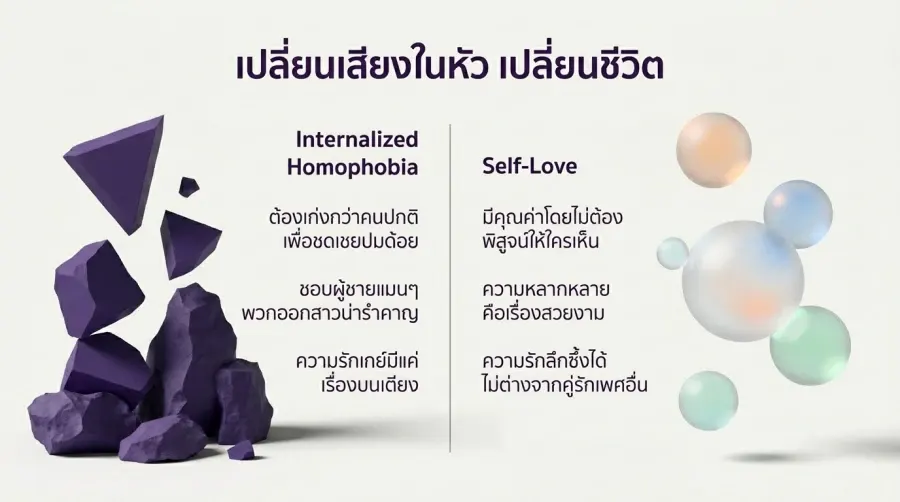
Mindset Comparison: Stop Hating Yourself VS Learn to Love Yourself
| Gay Self-Hating Mindset | A Mindset of Self-Love and Pride |
|---|---|
| “If I’m attracted to men, I have to prove that I’m better than ‘normal’ people to make up for what I see as my shortcomings.” | “I have value just as I am. I don’t need to prove myself to anyone, and my sexual orientation is not a flaw.” |
| “I only like masculine guys. Feminine gay men annoy me.” | “Everyone has the right to express themselves in their own way. Diversity is beautiful.” |
| “Gay relationships are just about sex. True love doesn’t really exist.” | “Love between two men can be just as meaningful and deeply fulfilling as love between any other couple.” |
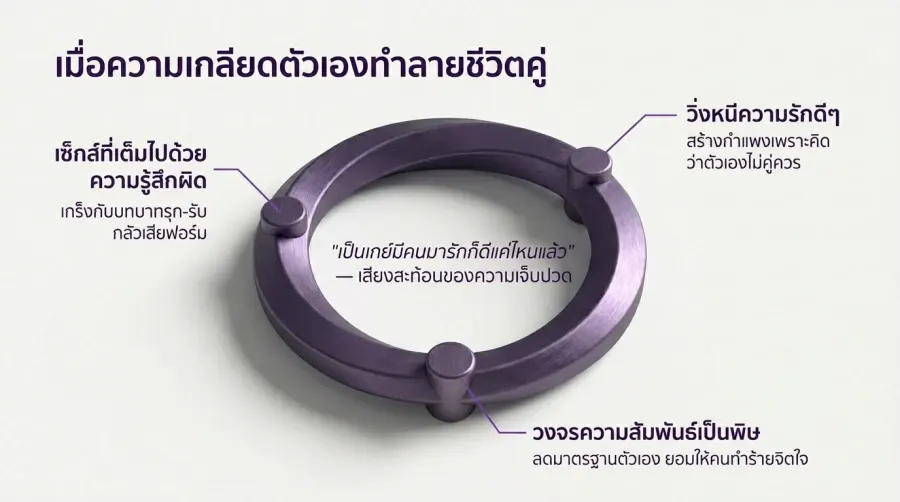
When Self-Hatred Slowly Damages Your Relationship
Gay self-hatred doesn’t only affect your personal mental health—it can also gradually erode your romantic relationships and life with your partner. Some of the most noticeable signs often appear in the following ways:
Running Away from True Love
When deep down you believe, “I don’t deserve a healthy, loving relationship,” you may unconsciously build emotional walls around yourself. When someone genuinely cares for and loves you, you might feel uncomfortable and push them away—while finding yourself chasing people who are unable or unwilling to give you the love you want.
The Cycle of Toxic Relationships
One of the most harmful effects of Internalized Homophobia is that it can make us unconsciously “lower our standards.” Some people may tolerate cheating, physical abuse, or remain in an undefined relationship simply because an inner voice tells them, “I’m gay—I should just be grateful that someone wants me at all.”
Sex Filled with Guilt
Some gay men may enjoy sexual intimacy but feel disgusted with themselves or experience guilt afterward. Others may become overly concerned with Top/Bottom roles and avoid exploring new experiences because they fear it could undermine their image of being a “masculine man.”
“Learning to love others begins with recognizing your own worth.
If you still hate yourself, it can be difficult to fully receive the love others give you.”
6 Ways to Cope When You Hate Yourself for Being Gay
1. Acknowledge and Question Your “Inner Voice”
Whenever you feel negatively about yourself or catch yourself judging other gay men, pause and ask: “Is this really my own belief, or am I repeating something society taught me?” Becoming aware of your thoughts is the first step toward change.
2. Find a Safe Zone and a Supportive Community
Your environment can have a major impact on how you feel. If you’re constantly around people who make discriminatory jokes about gender or sexual orientation, it may make you feel worse about yourself. Try spending time in Gay-Friendly spaces or using inclusive apps like Quicky to meet friends, talk, and exchange perspectives.
3. Consume Media with Positive Gay Representation
Today, more BL series and films portray relationships between men in deeper and more positive ways. Seeing this kind of representation can help reinforce the idea that “our love can be beautiful and completely natural too.” However, be careful not to become overly attached to idealized portrayals in series, as comparing them with real-life relationships can create unnecessary pressure.
🏳️🌈 Read More – Gay Life in Thailand 2026: Life, Love, and a Changing Society in the Digital Age
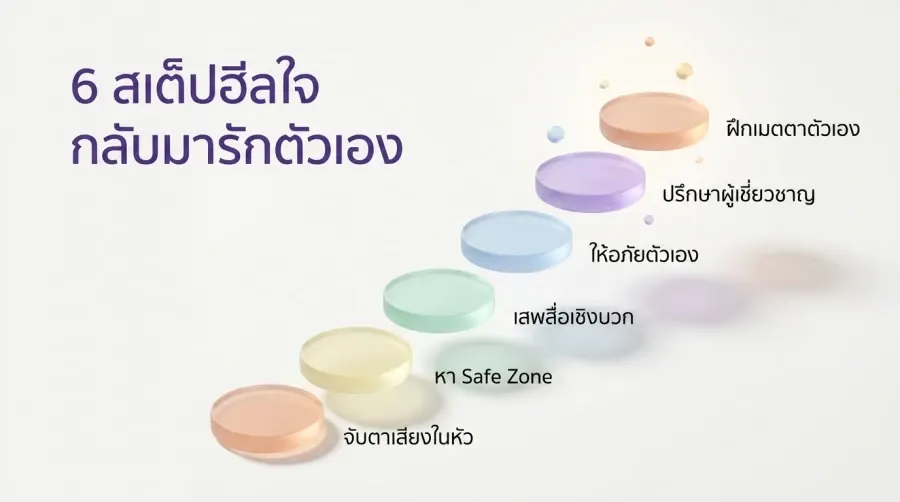
4. Forgive Yourself for Judging Yourself or Others in the Past
Many people, once they realize they’ve internalized self-rejection, start criticizing themselves all over again: “Why am I like this?” Try not to punish yourself for it. Some of your past thoughts or behaviors may have been ways of protecting yourself in an environment filled with pressure and prejudice. Give yourself understanding and forgiveness, then allow yourself to learn and grow from here.
5. Talk to a Mental Health Professional
If self-rejection related to being gay becomes deeply rooted and starts affecting your daily life or relationships, or is accompanied by persistent depressive feelings, there is no shame in talking to a psychologist or psychiatrist. Today, Thailand has a growing number of mental health professionals who understand sexual and gender diversity and provide LGBTQ+ Affirmative Therapy.
🏳️🌈 Read More – Gay Mental Health: How to Cope with Stress and Build a Stronger Mind
6. Try “Self-Compassion Journaling”
Changing your mindset is important, but taking action to support your emotional healing matters too. Grab a notebook, set aside 10 minutes each day, and answer these questions as honestly as you can:
- Question 1: Did I say anything unkind to myself or have negative thoughts about being gay today? (For example, thinking I’m not handsome enough or not masculine enough.)
- Question 2: If my close friend were going through the same thing, what would I say to comfort them?
- Question 3: How can I offer those same comforting words to myself?
Practicing this repeatedly can help you shift from being your own “harsh judge” to becoming a supportive “best friend” to yourself. This skill is called Self-Compassion—the ability to treat yourself with kindness and understanding—which can help reduce self-criticism and ease feelings of self-hatred over time.
Can a Changing Society Help Heal Emotional Wounds?
The good news is that by 2026, Thai society has made significant progress toward marriage equality. Marriage equality is more than just a law on paper—it represents legal recognition that same-sex couples deserve equal marriage and family rights. Your love has equal value and deserves equal protection under the law.
These structural changes can play an important role in reducing shame and self-rejection among younger gay people. They can grow up in a more equal society where same-sex couples can marry, build families, plan a home and future together, and receive legal recognition and protections as partners.
These changes can feel like a light at the end of the tunnel, reminding us that there is nothing inherently wrong with being gay. What needed to change were the prejudice and inequalities within society—and those attitudes and systems are gradually becoming more inclusive and equal.

FAQ: Frequently Asked Questions About Internalized Homophobia
Q: I don’t hate gay people—I just prefer masculine men. Does that mean I have Internalized Homophobia?
A: There’s a line between personal preference and prejudice. There’s nothing wrong with being attracted to masculine men. However, if that preference comes with disgust, rejection, or demeaning comments toward feminine gay men, it could be a sign of Internalized Homophobia.
Q: Can Gay Self-Hatred Go Away Completely?
A: It can improve to the point where it no longer significantly affects your daily life. Understanding yourself, reshaping negative beliefs, and spending time in environments that accept and respect diversity can all help. Sometimes, hurtful comments or prejudice may bring old feelings back, but over time, you can become better equipped to recognize and cope with them.
Q: How Should I Tell My Partner That I’m Struggling with Self-Acceptance?
A: Start with honesty. You might say, “Lately, I’ve been feeling confused and under pressure about this part of myself. It’s not because of you—it’s something I’m working through internally.” Open communication can help your partner understand what you’re going through and create a safer, more supportive space for you.
Conclusion: You Deserve Love, Especially “Love from Yourself”
Breaking free from the feeling of hating yourself for being gay isn’t a 100-meter sprint—it’s more like a marathon. It takes time to gradually peel away the layers of prejudice and negative beliefs that may have built up inside you over the years.
Always remember: your sexual orientation is not something abnormal, it is not something to be ashamed of, and it is not a flaw you need to compensate for by proving how talented or successful you are. You are a whole human being with the right to love and the right to be yourself.
Most importantly—you have every right to be proud of being gay.