
Relationship check-ins give couples a regular place to talk about how the relationship is actually feeling, not only what needs to be done this week. They can be ten minutes over coffee, a monthly conversation at home, or a longer discussion when life has changed. The point is not to create a formal performance review for your partner. It is to make important topics easier to raise before frustration has been building for months. Gay couples do not need a completely different relationship system from everyone else, but some topics may deserve deliberate space: family acceptance, public and private comfort, chosen family, relationship agreements, community life, and how outside stress affects the couple. A good check-in creates more information, more responsiveness, and fewer assumptions.
In this article
Relationship Check-Ins Are Maintenance, Not a Crisis Meeting
Many couples only schedule a serious conversation after something has already gone wrong. By then, the emotional stakes are higher and both people may arrive ready to defend themselves. A regular check-in changes the timing. You can discuss small disconnections while they are still small and also notice what is working before the relationship becomes defined only by problems.
The American Psychological Association recommends that healthy couples make time to check in regularly and discuss deeper or more personal topics, not only household management. Research on partner responsiveness also shows that feeling understood and responded to is closely connected with intimacy and relationship quality. A check-in supports that process when it becomes a place to signal needs clearly and listen for the needs behind your partner’s words.
Decide on a Rhythm You Can Actually Keep
There is no correct schedule. Some couples benefit from a short weekly check-in because work, caregiving, travel, or parenting changes quickly. Others find that every two weeks or once a month is enough. The best rhythm is frequent enough that important topics have a predictable place but not so frequent that the conversation becomes an obligation with nothing meaningful to discuss.
Keep the structure proportional to your life. A fifteen-minute Sunday conversation may be enough during a stable period. A longer monthly check-in may make sense if you are planning a move, opening or closing a relationship, combining finances, or dealing with family pressure. You can also skip a scheduled check-in when both people genuinely feel connected. Regular does not have to mean rigid.
Start With Connection Before You Start Solving Problems
Do not begin with a list of complaints. Start by asking what has felt good lately. What did your partner do that made you feel supported? When did you feel close? What have you appreciated that you did not say out loud? This is not fake positivity. It reminds both of you that the relationship is more than the issue you are about to discuss.
Then ask about disconnection. “Was there a moment this week when you felt alone with something?” often opens more useful conversation than “What did I do wrong?” You can also ask whether either of you has been carrying stress that has spilled into the relationship. This order supports the broader habits of gay relationship communication, trust, and conflict repair because it encourages openness before defensiveness takes over.
Ask About Communication Before the Next Argument
A check-in is a good time to discuss conflict when you are not currently fighting. Ask whether each person feels heard during disagreements. Does one of you interrupt? Does one withdraw for too long? Are there topics that feel impossible to raise? Does “taking space” have a clear return time, or does it turn into disappearing?
The APA notes that destructive patterns such as yelling, personal criticism, and withdrawing are associated with worse relationship outcomes, while constructive strategies include listening and trying to understand a partner’s feelings. Use your check-in to identify one communication habit to improve rather than attempting to redesign every argument. Specific changes are easier to notice: “If I need a break, I’ll tell you when I can return” is more useful than “I’ll communicate better.”
Check In on Affection, Sex, and Relationship Agreements
Affection and sex often change with stress, health, work, travel, medication, sleep, body image, and the stage of the relationship. A lower-frequency period does not automatically mean something is wrong, but avoiding the subject can make both partners invent explanations. Ask whether each of you currently feels desired, affectionate, pressured, disconnected, or satisfied.
If you have agreements around monogamy, non-monogamy, flirting, dating apps, sexual health, or privacy, revisit them before resentment becomes the first sign that something changed. Agreements should describe the relationship you are actually living, not a version both of you accepted years ago and never discussed again. The goal is not constant renegotiation. It is making sure consent and expectations remain current.
Questions About Home, Money, and Practical Life
Emotional connection can be strong while practical resentment quietly grows. Check-ins create space to ask whether chores, money, planning, social obligations, and household responsibilities still feel fair. “Fair” does not always mean equal. One person may earn more while the other handles more domestic work. One may be supporting family members. One may have less energy during a difficult work period.
Ask what currently feels heavy. Are there expenses neither person wants to raise? Does one partner always organize dates or travel? Are friends or relatives taking more time than expected? If you live separately, does the relationship still have enough space in both homes and schedules? Practical problems often become emotional problems when couples assume the other person should already know what is unfair.
Questions Gay Couples May Need to Revisit
Not every gay couple deals with the same pressures, but these questions can be useful when they fit your situation.
- Do we feel equally acknowledged in public and private? One partner may be more open at work, with family, or online than the other.
- Are family or chosen-family obligations affecting us differently? Holidays, caregiving, and social expectations can create uneven pressure.
- Do we feel connected to community in the way we want? One person may value LGBTQ+ events or nightlife more than the other.
- Are our relationship agreements still working? Revisit boundaries rather than relying on assumptions made earlier.
- Is outside discrimination or stress changing how we treat each other? External pressure can enter the relationship even when neither partner caused it.
- Are we making room for different identities and experiences? Age, culture, race, disability, gender expression, and other differences can shape how each partner moves through the world.
- Do both of us feel safe bringing up topics that challenge the relationship? A check-in only works if honesty is allowed to create discussion rather than punishment.
Use a Simple Relationship Check-In Agenda
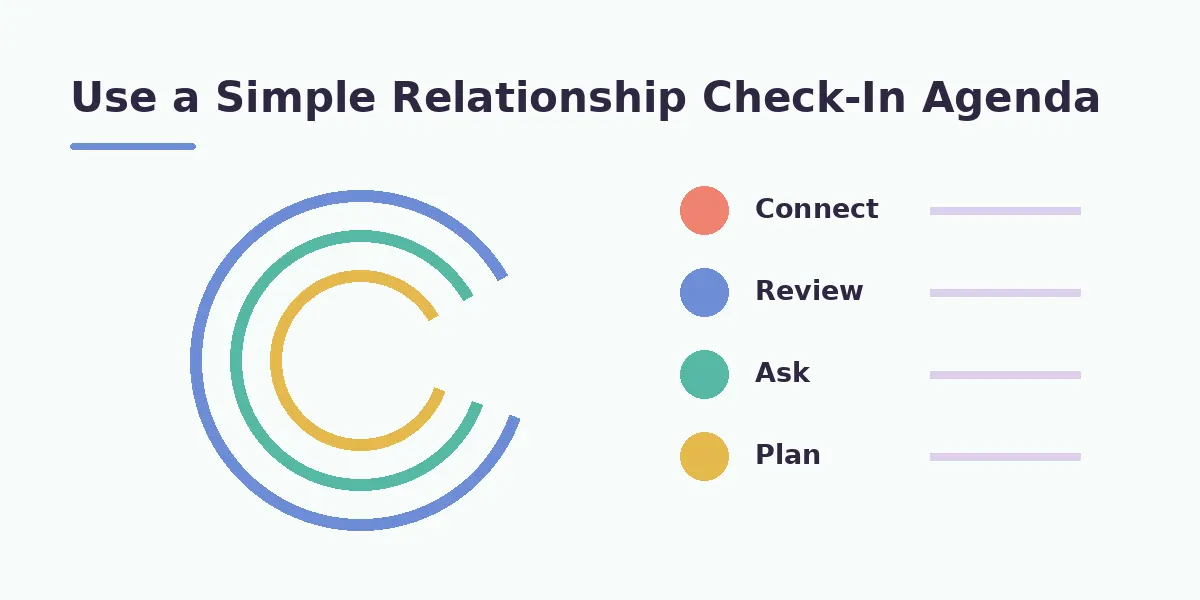
A consistent order can make the conversation easier to start.
| Step | Question | Purpose |
|---|---|---|
| Connect | What has felt good between us lately? | Start with the relationship’s strengths |
| Appreciate | What did you notice or value in me? | Make positive effort visible |
| Review | Has anything felt disconnected, unfair, or unresolved? | Surface concerns before resentment grows |
| Ask | Is there something you need more or less of right now? | Turn frustration into a concrete need |
| Practical | Are money, home, sex, family, or schedules creating pressure? | Catch recurring life friction |
| Plan | What is one change we want to try before the next check-in? | Create an observable next step |
| Close | What are we looking forward to together? | End with shared direction rather than only problems |
You do not need to answer every question every time. Use the agenda as a doorway, not a script.
What Relationship Check-Ins Should Not Become
A check-in should not be a surprise courtroom where one person has collected complaints for a month. It should not be used to force immediate answers to emotionally loaded topics. It also should not become a way to monitor your partner’s loyalty, phone use, friendships, body, or mood under the label of “communication.”
Watch the tone as much as the questions. If one partner always leaves the conversation feeling graded, cornered, or responsible for fixing everything, the format needs to change. You may need shorter conversations, one topic at a time, or clearer rules about taking breaks. A useful check-in should increase honesty and understanding. It should not make both people dread the next scheduled date.
When the Same Problem Keeps Returning
Some issues need more than a better list of questions. If every check-in returns to the same fight about trust, sex, money, family, jealousy, substance use, or commitment and nothing changes between conversations, the problem may require a different level of support.
The APA notes that repeated versions of the same conflict can be a sign that professional help may be useful. Couples therapy is not only for relationships at the point of breaking up. It can help couples identify patterns, communicate needs more clearly, and experiment with different responses. If there is fear, coercion, or abuse, the priority is safety rather than improving the check-in format.
Regular Questions Make Honesty Easier to Practice
Relationship check-ins work because they give important topics a normal place to exist. You do not have to wait until you are angry enough to force a conversation. You can ask about connection, sex, money, family, stress, community, and future plans while both of you still have enough emotional space to listen.
Keep the rhythm realistic. Start with what is working. Ask specific questions. Turn concerns into requests where possible, and choose one or two changes you can actually observe. The goal is not to eliminate conflict or make the relationship perfectly transparent. It is to make honesty, responsiveness, and course correction ordinary parts of being a couple.
References
- American Psychological Association — Happy couples: How to keep your relationship healthy: Practical guidance on regular check-ins, communication, constructive conflict, and when recurring problems may benefit from professional help.
- PubMed — An attachment perspective on couple interaction: Research examining how clearly signaling needs and responding appropriately can improve couple interaction and emotional experience.