

When love knows no borders, the rainbow can finally shine beautifully across Thailand! The long-awaited marriage equality law has opened the door for LGBTQ+ couples to begin their married lives with full legal recognition. But for those with a foreign partner, one question may come to mind: “What do we need to do if we want to register our marriage with a foreign boyfriend?”
In this article, Quicky takes an in-depth look at same-sex marriage with a foreigner, including the documents Thai gay couples need to prepare, whether the process is complicated, and what special points to watch out for, so you and your partner can move toward marriage as smoothly as possible.
“Love is a fundamental human right, and marriage equality affirms that every form of love has value and deserves equal protection under the law.” 🏳️🌈
In this article
Legal Update: What Is the Current Status of Same-Sex Marriage with Foreigners in Thailand?
Before preparing the documents, it is important to understand the overall legal framework first. Following Thailand’s passage of the marriage equality law, LGBTQ+ couples—including gay, lesbian, transgender, and queer couples—have the right to marry on an equal legal basis with opposite-sex couples. This also covers marriage registration between Thai citizens and foreign nationals!
Therefore, if you are a Thai gay person marrying a foreigner, you may also receive the legal rights and benefits associated with marriage, such as:
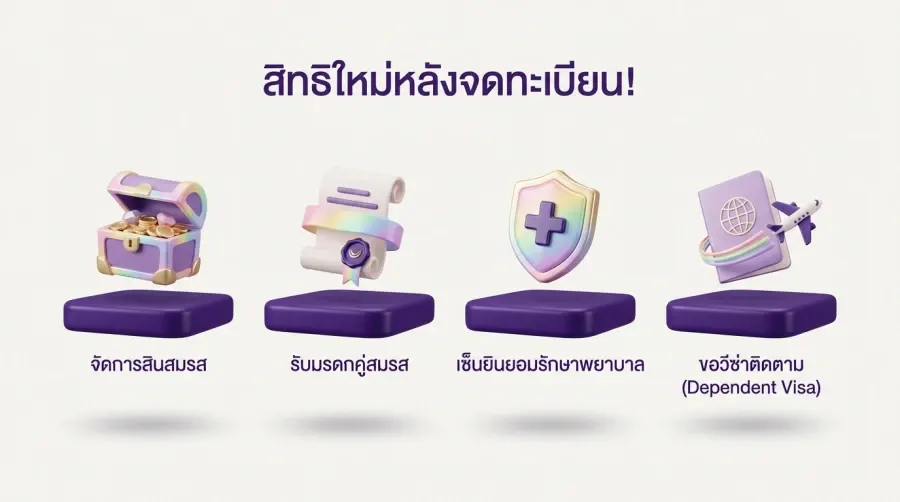
- The Right to Jointly Manage Marital Property
- The Right to Inherit as a Legal Heir
- The Right to Give Consent for Emergency Medical Treatment
- The Right to Apply for a Spouse Dependent Visa or Marriage Visa
This change marks an important milestone, allowing international LGBTQ+ couples to settle down and build a family together in Thailand with greater stability and security.
🏳️🌈 Read More – Where to Meet and Date Gay Foreigners in Thailand and How to Stay Safe in 2026
Checklist! What Documents Are Needed for Same-Sex Marriage with a Foreigner?
The key part of registering a marriage with a foreigner is “document preparation,” as the paperwork is generally more complex than marriage registration between two Thai citizens. To make things easier to understand, we have divided the required documents into two sides, as shown in the table below.
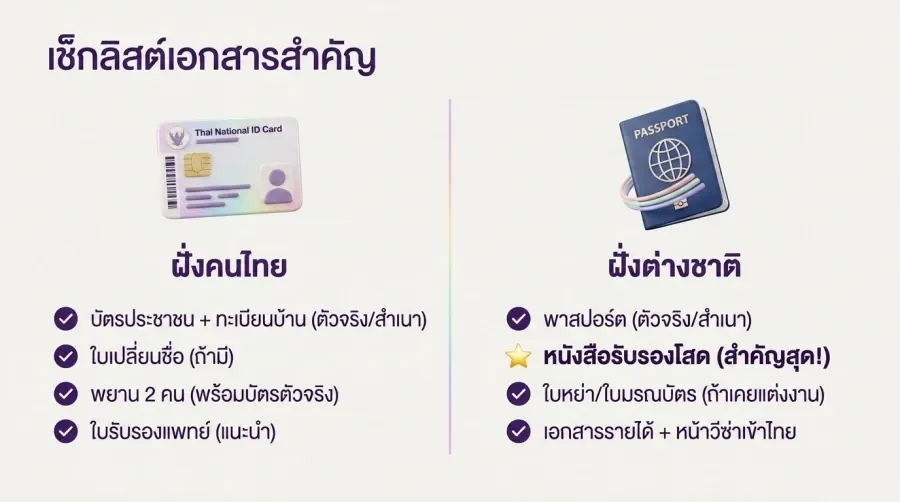
Summary Table of Required Documents
| Thai Partner (Thai LGBTQ+ Partner) | Foreign Partner |
|---|---|
| Thai National ID Card (Original and Copy) | Passport (Original and Copy) |
| House Registration (Original and Copy) | Affidavit of Freedom to Marry |
| Name or Surname Change Certificate (If Applicable) | Divorce Certificate / Former Spouse’s Death Certificate (If Previously Married) |
| 2 Witnesses (Must Bring Their Original ID Cards) | Proof of Income / Employment Certificate (Required for Some Nationalities) |
| Medical Certificate (If You Choose to Have a Premarital Health Check – Not Mandatory) | Copy of Visa or Immigration Entry Stamp |
A Closer Look at Documents Required for the Foreign Partner (Important Precautions!)
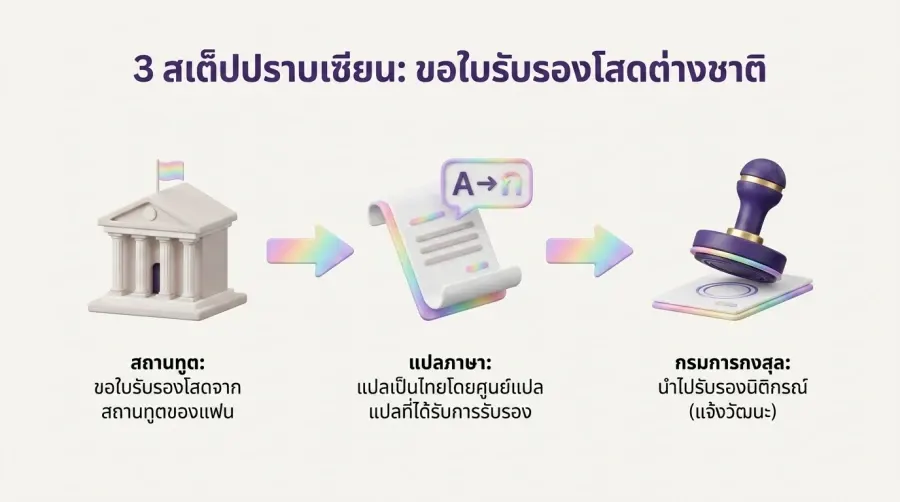
For a Thai gay person marrying a foreigner, the most challenging part is often the foreign partner’s documentation, especially the “Affidavit of Freedom to Marry” or “Certificate of No Impediment.” This document is very important because Thai law does not permit bigamy. Obtaining it usually involves several steps, as follows:
- Obtain it from the foreign partner’s embassy: Your partner needs to contact their country’s embassy in Thailand to request a certificate confirming their freedom to marry.
- Translation: Once the certificate of freedom to marry has been obtained (usually in English or the official language of that country), it must be translated into Thai by a recognized translation service.
- Legalization: Take the translated documents to the Department of Consular Affairs, Ministry of Foreign Affairs at Chaeng Watthana, or an authorized consular service office, for legalization to confirm that the documents and translations meet the applicable legal requirements.
💡 Tip: Each embassy has different requirements for obtaining a certificate of freedom to marry. Some may require appointments to be booked weeks or even months in advance, so make sure to check the specific requirements with your partner’s embassy beforehand!
Step-by-Step Guide to Registering a Same-Sex Marriage with a Foreigner
Once all the required documents are fully prepared, it’s time to head together to register your marriage. The process for registering a same-sex marriage with a foreigner generally involves the following steps:
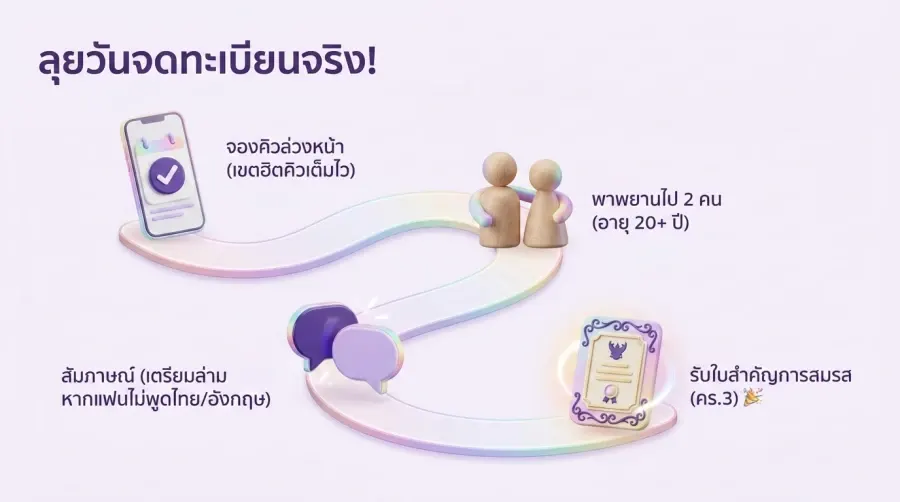
- Check Appointment Availability and Contact the District Office
- It is recommended to call your preferred district office in advance, as some offices may limit the number of marriage registrations involving foreign nationals each day. For popular locations such as Bang Rak, or districts with many foreign residents, booking an appointment in advance is advisable.
- Bring 2 Witnesses
- When registering a marriage with a foreign national, district offices may have specific requirements regarding witnesses. You should bring 2 adults who are at least 20 years old and know you and your partner well. The witnesses should also bring their original identification cards.
- Processo de registro de casamento igualitário com estrangeiro
- The registrar may conduct a brief interview to make sure that both partners are entering the marriage voluntarily, without coercion, and can communicate with each other. If your partner cannot communicate in Thai or English at all, you may need to arrange for an interpreter to accompany you.
- Sign and Receive the Marriage Certificate
- Once the documents have been reviewed and the interview is complete, both partners and the witnesses will sign the marriage register. You will then receive 2 copies of the Marriage Certificate (Kor Ror 3), one for each spouse. With that, the registration is complete and you are officially legally married! 🎉
Can a Thai Gay Person and Foreign Spouse Buy a House After Marriage?
Another important issue that comes after marriage registration is finances and building a home together. For couples who are both Thai, things may be less complicated. However, in a same-sex marriage involving a foreigner, Thai laws still impose restrictions on foreign ownership of real estate. Thai people marrying foreign partners therefore need to understand these rules and plan carefully.
1. Buying Property in Thailand (House, Condominium, or Land)
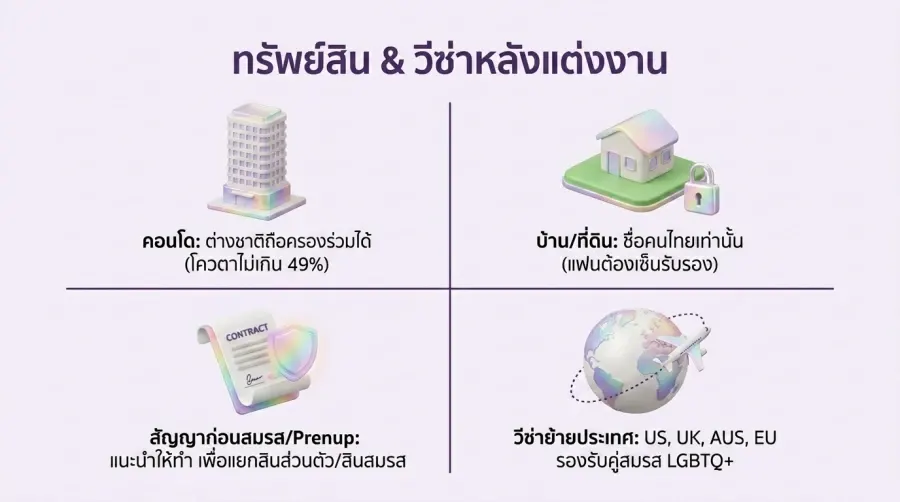
Even if you are legally married, the restrictions on foreign ownership of land in Thailand remain unchanged.
- Condominium
- A foreign national can co-own a condominium with a Thai citizen, provided that foreign ownership in the condominium project does not exceed the 49% legal limit. Therefore, you and your partner may be able to apply for a joint loan and register both names as co-owners of the condominium, subject to applicable legal and lender requirements.
- House and Land
- Under Thai law, foreigners generally cannot own land. Therefore, if a Thai gay person married to a foreigner wants to purchase a house with land, the land title generally must be registered in the Thai spouse’s name. The foreign spouse may also be required to sign a Letter of Confirmation stating that the funds used to purchase the land are the Thai spouse’s separate property, helping prevent nominee ownership arrangements.
2. Is a Prenuptial Agreement Necessary?
For international couples, having a “prenuptial agreement” or prenup has become increasingly common. It is not necessarily about a lack of trust, but rather about establishing a clear understanding of financial and property arrangements from the beginning. This can be especially useful if the foreign partner owns assets or a business in their home country, or if you own a business in Thailand. A prenup can clearly define what is “separate property” owned before marriage and what is “marital property” acquired together after marriage.
“Talking about money before marriage is nothing to be ashamed of. It is a shared responsibility that helps build your relationship on a foundation of stability and genuine understanding.”
Can a Thai Gay Person Move Abroad After Marrying a Foreigner? A Guide to Visas After Marriage
For many couples, the goal after registering their marriage is to move to the foreign partner’s country and build a family together. The good news is that with marriage equality in Thailand, a legally registered same-sex marriage can serve as formal proof of marriage when applying for a Spouse Visa or Partner Visa. However, visa eligibility and requirements still depend on the immigration laws of the destination country. Let’s take a look at the general requirements for some popular destinations.
🏳️🌈 Read More – Can a Gay Long-Distance Relationship Last? Tips from Real Couples
Comparison of Marriage Visas in 4 Popular Countries for LGBTQ+ Couples
| Destination Country | Relevant Visa Type | Difficulty Level / Waiting Time | What Thai Gay Couples Marrying Foreigners Should Know |
|---|---|---|---|
| United States (USA) | CR-1 / IR-1 Visa | Moderate (Approximately 1–2 Years) | The United States recognizes same-sex marriage at the federal level. If the marriage is legally registered in Thailand and meets U.S. immigration requirements, the foreign spouse can apply for a Green Card based on the marriage. |
| United Kingdom (UK) | Spouse / Partner Visa | Moderate to Difficult (Extensive Documentation Required) | The British partner must meet the minimum income requirement set by the UK government (Financial Requirement) to demonstrate that the financial requirements for the spouse visa are satisfied. |
| Australia | Partner Visa (Subclass 309/100) | Moderate (Relatively High Application Fees) | You need to provide strong relationship evidence, such as photos together, joint accounts, and chat or message records. |
| European Union (EU) Countries | Varies by Country | Depends on the Laws of Each Country | Germany, France, the Netherlands, and Spain recognize same-sex marriage, so a legally registered marriage can be used as the basis for applying for a spouse or family reunification visa. |
Note: Visa requirements may change. For the most accurate and up-to-date information, it is recommended to consult an immigration lawyer or check directly with the relevant embassy’s official website.
Building a Family Through International Same-Sex Marriage: Can a Thai Gay Person Married to a Foreigner Adopt a Child?
For many couples, one of their dreams after marriage is to become “two dads” or “two moms” and have a child growing up in their home. With Thailand’s marriage equality law now in effect, Thai gay people married to foreign partners also have the legal right to jointly adopt a child!
Basic Requirements for LGBTQ+ Married Couples to Adopt a Child
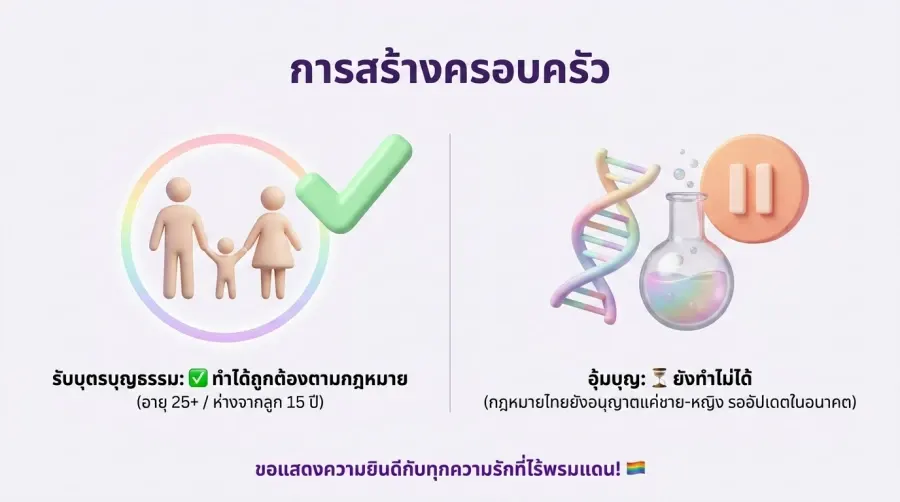
- Age of the Adopter: The adopter must be at least 25 years old and at least 15 years older than the adopted child.
- Family Readiness: The Child Adoption Center will conduct a thorough assessment, including the home environment, financial situation, mental well-being, and readiness to raise a child, with the best interests of the child as the primary consideration.
- Consent: If the child is 15 years old or older, the child must personally consent to the adoption.
🏳️🌈 Read More – Gay Couples and Adoption: New Rights After Marriage Equality
Important Considerations Regarding Surrogacy
Currently, surrogacy in Thailand is subject to specific legal restrictions under the law governing children born through assisted reproductive technology. LGBTQ+ couples, including international same-sex married couples, should therefore carefully check the current legal requirements before considering surrogacy in Thailand. The rules may change in the future, so it is important to follow official updates from Thai authorities.
Frequently Asked Questions (FAQ) About Thai Gay Marriage with a Foreigner
Q: What Visa Can You Apply for After Registering a Same-Sex Marriage with a Foreigner?
= After registering the marriage in Thailand, if your foreign partner wishes to live in Thailand long term, they may be able to apply for a Non-Immigrant O visa or an extension of stay based on marriage to a Thai national, depending on their circumstances. If approved, the permission to stay can generally be granted for up to one year and may be renewed. Applicants must also meet the financial requirements set by Thai Immigration, such as maintaining at least THB 400,000 in a Thai bank account for the required period before applying.
Q: If My Foreign Partner’s Country Does Not Recognize Same-Sex Marriage, Can We Still Register Our Marriage in Thailand?
= Yes! As long as you meet the requirements under Thai law and complete the marriage registration process in Thailand, your marriage will be legally valid under Thai law. However, if your partner’s country does not recognize same-sex marriage, the marriage may not receive the same legal recognition there. This could affect rights such as spouse visas or family reunification, so you may need to consider another visa category and check the specific rules of that country.
Q: Is the Marriage Registration Fee Expensive?
= Marriage registration at a district office or local administrative office during official working hours is generally free of charge. However, you may still have expenses related to document preparation, such as obtaining a certificate of freedom to marry from the embassy, document translation, and legalization or authentication fees. The total cost will vary depending on the foreign partner’s nationality, embassy fees, the number of documents, and the translation service you choose.
Q: Can I Use My Foreign Spouse’s Surname After a Same-Sex Marriage?
= Yes. Under Thailand’s current marriage and name laws, spouses may choose to keep their existing surname or legally adopt the other spouse’s surname. Using a combined or alternative form of both surnames may be subject to Thailand’s name-registration rules and approval requirements. If a Thai gay person married to a foreigner wishes to adopt the foreign spouse’s surname, the change can be processed through the relevant registration authority. The marriage and name-change documents can then be used to update the Thai national ID card and passport.
Q: How Should Taxes Be Handled After Marriage?
= After registering the marriage, personal income tax filing should follow Thailand’s current tax rules, with the appropriate filing method depending on each spouse’s income and circumstances. If the foreign spouse works in Thailand and is subject to Thai income tax, the marriage may also affect eligibility for certain tax allowances. For example, if one spouse has no assessable income, the other spouse may qualify for a spouse allowance, subject to the applicable requirements. The exact filing method and eligibility should be checked against the latest rules from the Thai Revenue Department.
Love Without Borders: Same-Sex Marriage with a Foreigner Is Easier Than You Think
The successful passage of Thailand’s marriage equality law marks an important step toward equality for LGBTQ+ couples in the country. Although marrying a foreign national may involve more paperwork than usual, particularly when dealing with embassies and document translations, the process can be much smoother with good preparation, advance planning, and a careful document checklist. Thai gay people marrying foreign partners, as well as other international LGBTQ+ couples, can move forward with their marriage registration with greater confidence. Quicky supports every kind of love and would like to congratulate all couples preparing to begin a new chapter of life together. May your love remain beautiful, strong, and lasting.