
Finding a fake dating profile that uses your photos can be disturbing because you do not know what the person has said, who they have contacted, or what story they are telling under your face. The fastest useful response is usually practical rather than confrontational: preserve evidence, report the impersonation through the dating app, check whether the same photos appear elsewhere, and tighten the privacy around the accounts the images came from. If the fake profile is part of a romance scam, people may also believe they have been talking to you. You cannot control everything an impersonator has already done, but you can create a clear record, reduce further access, and make removal and future reporting easier.
In this article
Save Evidence Before the Fake Profile Disappears
Take screenshots before contacting the account. Capture the full profile, including the displayed name, age, bio, photos, username if visible, location details, and any messages that show impersonation. If someone else found the account, ask them to capture the profile too. Dating profiles can disappear quickly after being reported or blocked, so preserving the information first can make later reporting much easier.
The eSafety Commissioner specifically recommends taking screenshots of impersonation profiles as evidence before reporting them through the app or service. Note the date, platform, and how you discovered it. If the profile is using details beyond your photos—such as your employer, Instagram handle, phone number, or real location—record those separately because they may show how much personal information the impersonator has collected.
Report the Impersonation Through the Dating App
Use the platform’s impersonation, fake account, or safety-reporting process rather than only sending a general support message. Include enough information to identify the profile accurately. Some services allow users to report a profile directly inside the app; others also provide forms for people who are being impersonated.
For example, Tinder’s current impersonation form asks for details of the incident and the exact name, age, and bio shown on the fake profile, and it says screenshots are especially helpful. Procedures differ by platform, so follow the specific instructions you are given. The eSafety Commissioner also advises not sending identity documents unless the service specifically requests them. Avoid uploading sensitive identification to an unverified email address or message.
Do Not Start a Fight With the Fake Account
It can be tempting to message the impersonator and demand an explanation. Sometimes that only tells them you found the profile, giving them time to delete evidence, block you, change usernames, or move to another account. If the account appears to be scamming people, direct confrontation can also expose more of your real contact information.
Preserve evidence and report first. If someone you know is already communicating with the fake account, tell them privately that it is not you and ask them not to send money, personal documents, login codes, or intimate images. You do not need to prove yourself by engaging the impersonator. The platform and any relevant reporting service need clear information more than the impersonator needs a warning.
Tighten Your Accounts After an Impersonation
A fake profile may have been created from photos that were publicly available, but use the incident as a reason to review the wider privacy picture. Check which social accounts show your full name, workplace, location, phone number, birthday, friends list, or other identifying details. Look at whether your dating photos are identical to public profile pictures that are easy to connect to your real identity.
This fits the broader goal of protecting your identity, photos, and location while using dating apps. You do not necessarily need to make every account private. Instead, reduce unnecessary links between a photo and sensitive personal information. Also change passwords if you suspect account access, enable two-factor authentication where available, and review active login sessions for anything unfamiliar.
Search for Other Copies of the Profile
One fake account may not be the only one. Use a reverse-image search on the photos being impersonated and search your name, common variations, usernames, or other details the fake account used. The U.S. Federal Trade Commission recommends reverse-image searching suspicious dating-profile photos because scammers often reuse stolen images under different names.
Searches will not find every private or app-only profile, but they can reveal public copies on social networks, websites, or scam-report discussions. Keep a simple list of what you find instead of repeatedly checking all day. If the same person or group is creating new accounts, a record of dates, usernames, platforms, and screenshots can show a pattern when you report again.
Warn People Only as Widely as You Need To
You may want to post publicly that someone is using your photos. That can be useful if the impersonation is widespread or if friends are likely to be contacted, but it is not always necessary. A large public post can also circulate the fake profile more widely or expose details you would prefer not to amplify.
Start with people who are realistically affected. Tell friends or contacts who received messages, and give them one clear fact: the account is not yours. If scammers are asking for money, tell potential targets not to send anything. The FTC notes that romance scammers commonly create fake profiles using other people’s photos and eventually ask targets for money. If someone has already paid, encourage them to contact the payment provider and report the scam promptly.
If the Profile Is Being Used for Fraud or Harassment
A stolen-photo profile can be simple impersonation, but it may also be part of fraud, stalking, threats, sexual harassment, or image-based abuse. The next step depends on what is happening. If the account is asking people for money, report the scam to the platform and the relevant fraud-reporting authority in your country. In the United States, the FTC directs romance-scam reports to ReportFraud.ftc.gov.
If someone is threatening you, revealing private information, distributing intimate images, or creating repeated accounts to harass you, preserve the evidence and use specialist reporting or support services available where you live. Platform removal is important, but it may not be the only response needed when the behavior extends beyond a fake profile. If there is immediate physical danger, contact local emergency services.
Use a Removal and Monitoring Checklist
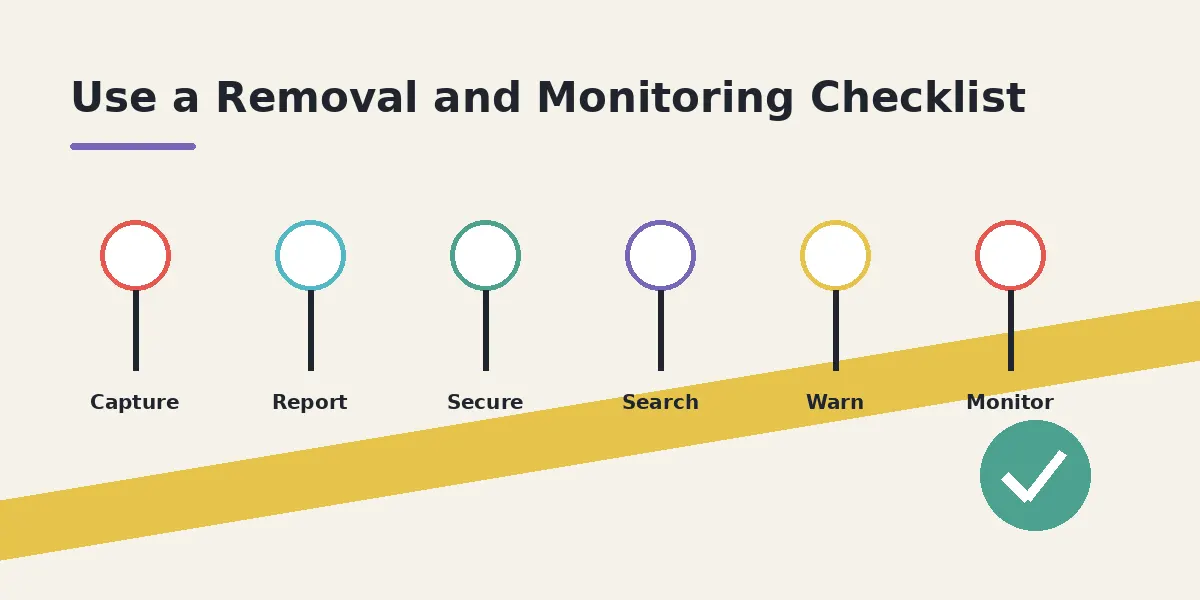
A simple sequence helps when the situation feels chaotic.
| Step | What to do | Why it matters |
|---|---|---|
| Capture | Screenshot profile details and relevant messages | Evidence may disappear after reporting |
| Report | Use the app’s impersonation or fake-account process | Routes the case to the platform’s safety team |
| Secure | Review passwords, 2FA, privacy settings, and sessions | Reduces risk if more than photos were exposed |
| Search | Reverse-image search the stolen photos | May reveal additional copies or names |
| Warn | Tell affected contacts the account is not you | Limits confusion and potential scam losses |
| Record | Keep dates, usernames, case numbers, and screenshots | Helps if impersonation repeats |
| Monitor | Recheck periodically rather than constantly | Lets you notice recurrence without feeding panic |
If a platform asks for follow-up information, keep a copy of what you submit.
What Not to Do While You Are Reporting
Do not send money to someone claiming they will remove the profile. Do not provide login credentials, one-time codes, or identity documents through a random message. Do not ask friends to mass-contact the impersonator, threaten them, or try to expose their identity without evidence. Those steps can escalate the situation or create new privacy problems.
Also avoid assuming you know who created the account based only on suspicion. An ex, acquaintance, stranger, scammer, or automated operation could all potentially reuse public photos. Focus your report on facts you can document. If you later obtain stronger evidence about who is responsible, you can decide whether additional legal or safety advice is appropriate.
After Removal, Reduce Easy Reuse Without Hiding Yourself
You do not need to disappear from the internet because someone misused your photos. Consider making a few changes that reduce easy copying and identity linking. Use different photos across dating and professional accounts. Avoid backgrounds that reveal addresses or work locations. Limit public access to high-resolution personal images if that fits your comfort level.
You can also ask trusted friends to tell you if they see your photos under another name. Do not turn monitoring into a daily search ritual. The goal is to make future impersonation easier to detect and harder to enrich with accurate personal details. Your photos can still be part of your online life without every image functioning as a map to the rest of your identity.
A Fake Dating Profile Needs Evidence, Reporting, and Follow-Through
If someone uses your photos in a fake dating profile, start with actions that preserve options. Capture the profile before it changes. Report it through the dating service. Secure the accounts and personal information connected to the photos. Search for additional copies, and warn people who may actually be affected.
Then document what happens next. Many impersonation cases can be handled through platform reporting, but repeated harassment, fraud, threats, or intimate-image abuse may require additional support. You do not have to solve the impersonator’s identity before taking protective steps. A clear record and a calm sequence of actions make it easier to respond if the fake profile reappears somewhere else.
References
- eSafety Commissioner — Impersonation, catfishing and identity theft: LGBTIQ+-specific guidance on fake accounts, screenshots, platform reporting, and protecting identity information.
- Federal Trade Commission — What To Know About Romance Scams: Guidance on fake dating profiles, stolen photos, romance-scam behavior, reverse-image searches, and reporting fraud.