
One of the most common first-date questions is simple: who pays? In Thailand, the answer is not as rigid as some people expect. There is no single rule that all gay dates follow, and modern dating etiquette is usually more flexible than older social scripts. Still, the bill can feel meaningful because it touches confidence, generosity, fairness, and interest all at once. That is why many people overthink it.
If you want the broader cultural context first, read Gay Dating in Thailand: Culture, Etiquette and Expectations. This article zooms in on one specific issue inside that bigger topic: how payment is often handled on a gay date in Thailand, what people may expect, and how to navigate the moment without making it stiff or awkward.
The useful truth is that payment on a date usually works best when you treat it as part of the overall social rhythm, not as a moral test. On Quicky, and later in person, what people tend to remember is not only who paid, but how the situation was handled. A smooth offer, a relaxed response, and a comfortable tone matter more than blindly following a fixed formula.
In this article
The Most Common Pattern: One Offers, the Other Responds
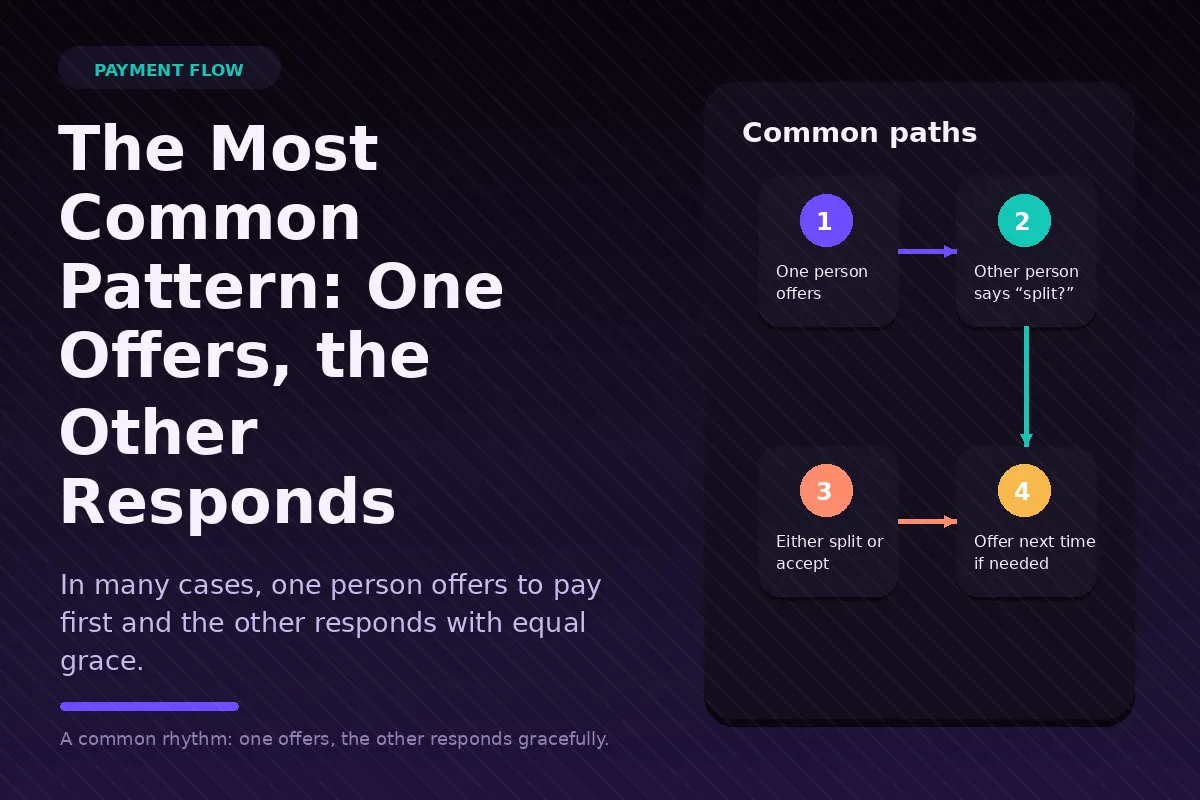
On many dates in Thailand, the most common pattern is simple. One person offers to pay, and the other responds politely. That response may be accepting the offer, suggesting a split, or saying he can cover the next place or the next date. In other words, the moment is often negotiated lightly rather than governed by a strict universal rule.
This is why payment does not need to become a dramatic pause. If you want to pay, offering once in a calm and natural way is often enough. If the other person suggests splitting, that is usually not rude. It may simply reflect his own preference for fairness or independence. If he accepts your offer warmly, that does not automatically mean he expects special treatment afterward. Often it just means the exchange felt socially smooth.
Many people make the moment harder by reading too much into a single action. Payment is part of the date, but it is not the whole date. A relaxed, polite exchange around the bill often says more about compatibility than whether the total was divided exactly in half.
What Shapes Payment Expectations in Thailand
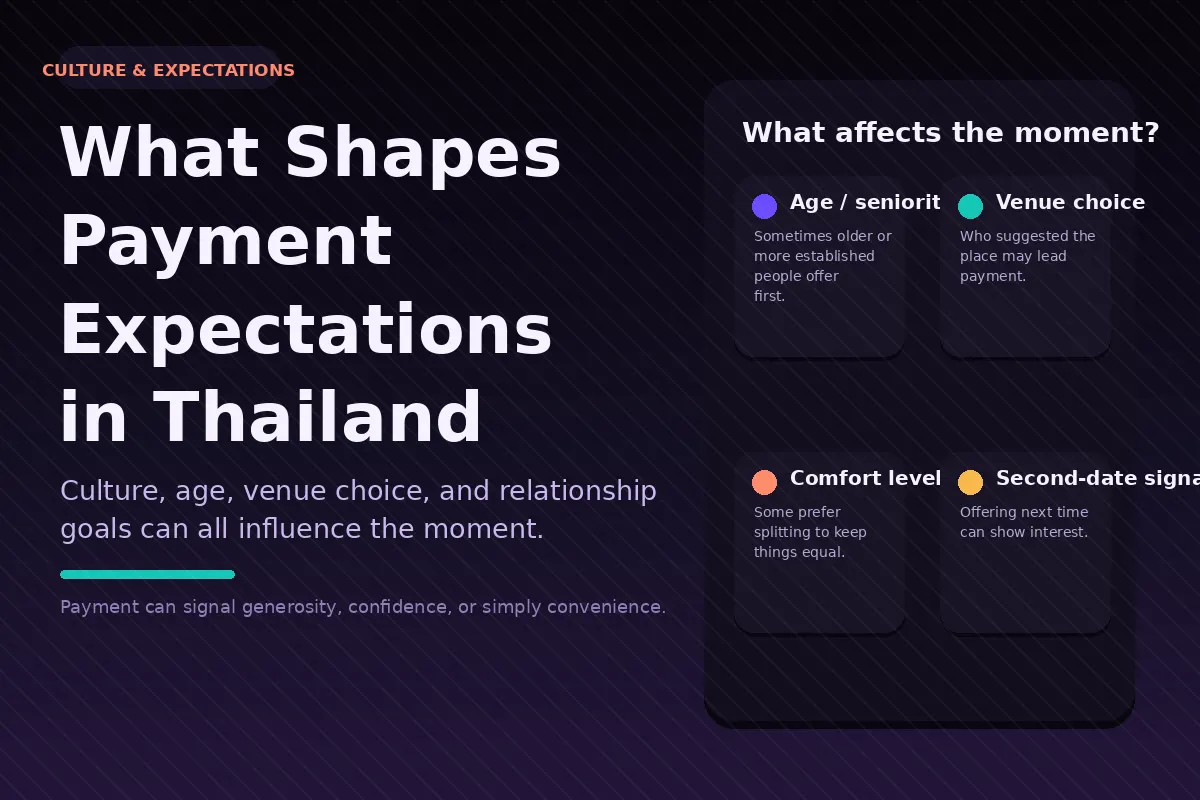
Thai dating etiquette is influenced by several overlapping factors. Age and life stage can matter because, in some situations, the older or more established person may naturally offer first. Venue choice matters too. If one person suggested the place and clearly took the lead in planning, he may feel more inclined to pay. None of this is mandatory, but these patterns do appear often enough to be useful.
Cultural style also plays a role. Thai social interaction often values smoothness and consideration. That means people may try to handle the bill in a way that feels socially graceful rather than overly procedural. For some people, offering to pay signals generosity and confidence. For others, offering to split signals equality and mutual respect. Both can be valid.
Relationship intention matters as well. On a casual date, splitting may feel natural and uncomplicated. On a date where one person wants to show clear interest, paying can sometimes function as a small signal of care or initiative. Even then, context matters more than any single gesture.
- Who planned the date can influence who offers first.
- Age or seniority may shape expectations in some cases.
- Some people prefer equality and feel more comfortable splitting.
- Offering “next time” can quietly signal interest in date two.
How to Handle the Bill Gracefully Without Making It Awkward
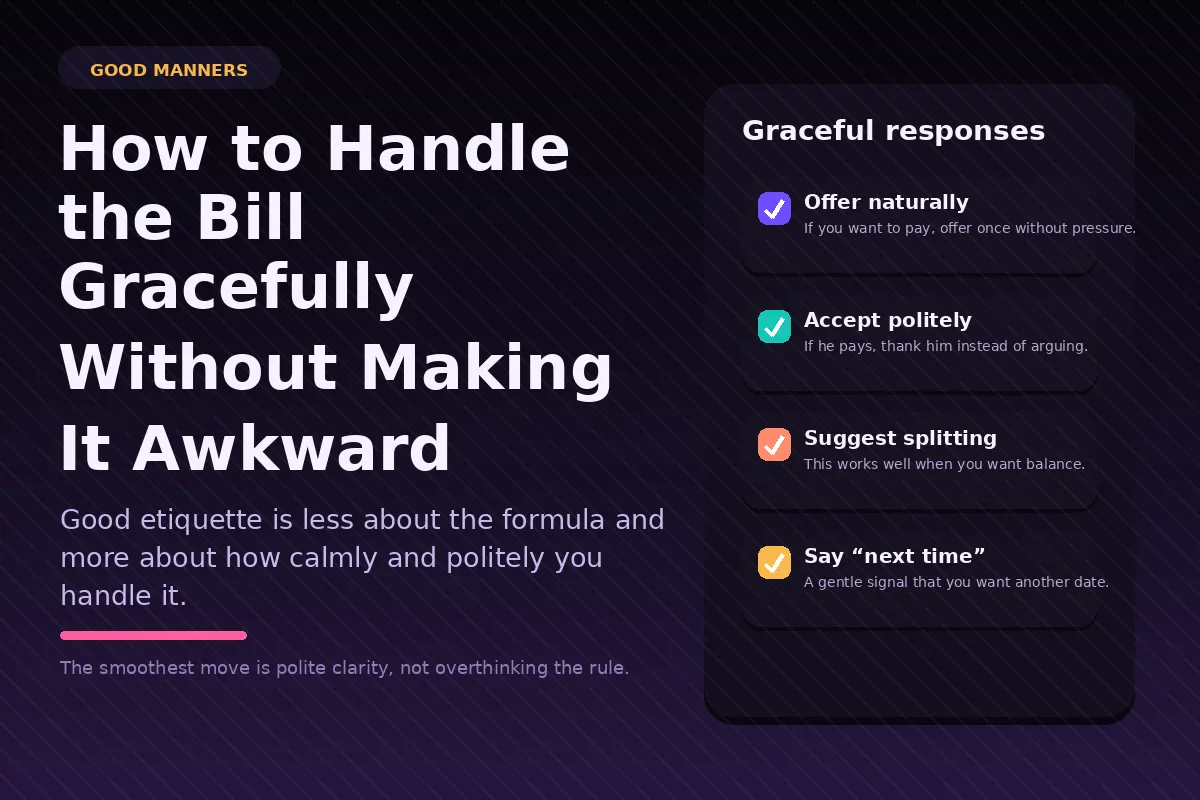
The best approach is usually calm and low drama. If you want to pay, offer simply. You do not need to turn it into a performance. If the other person wants to split, accept that without acting offended. If he pays, a straightforward thank-you is usually better than arguing with him for too long. The goal is not to win a payment debate. The goal is to keep the tone comfortable.
A lot of awkwardness comes from treating the bill like a hidden test. When people start measuring status, dominance, seriousness, or masculinity through payment alone, the moment becomes heavier than it needs to be. Modern dating etiquette works better when both people remember that the bill is just one practical part of the date.
If you genuinely care about equality, suggesting a split is reasonable. If you genuinely like offering, that is reasonable too. What tends to matter most is reading how the other person receives it and staying polite in response. Being rigid can feel more uncomfortable than any particular payment choice.
| Situation | A smooth response | Why it works |
|---|---|---|
| You want to pay | Offer once, calmly | Shows confidence without pressure |
| He wants to split | Say yes easily | Keeps the exchange relaxed |
| He pays | Thank him and offer next time if you want | Shows appreciation and reciprocity |
| You feel unsure | Ask lightly, “Do you want to split?” | Creates clarity without awkward tension |
Why the Bill Matters Less Than the Overall Signal
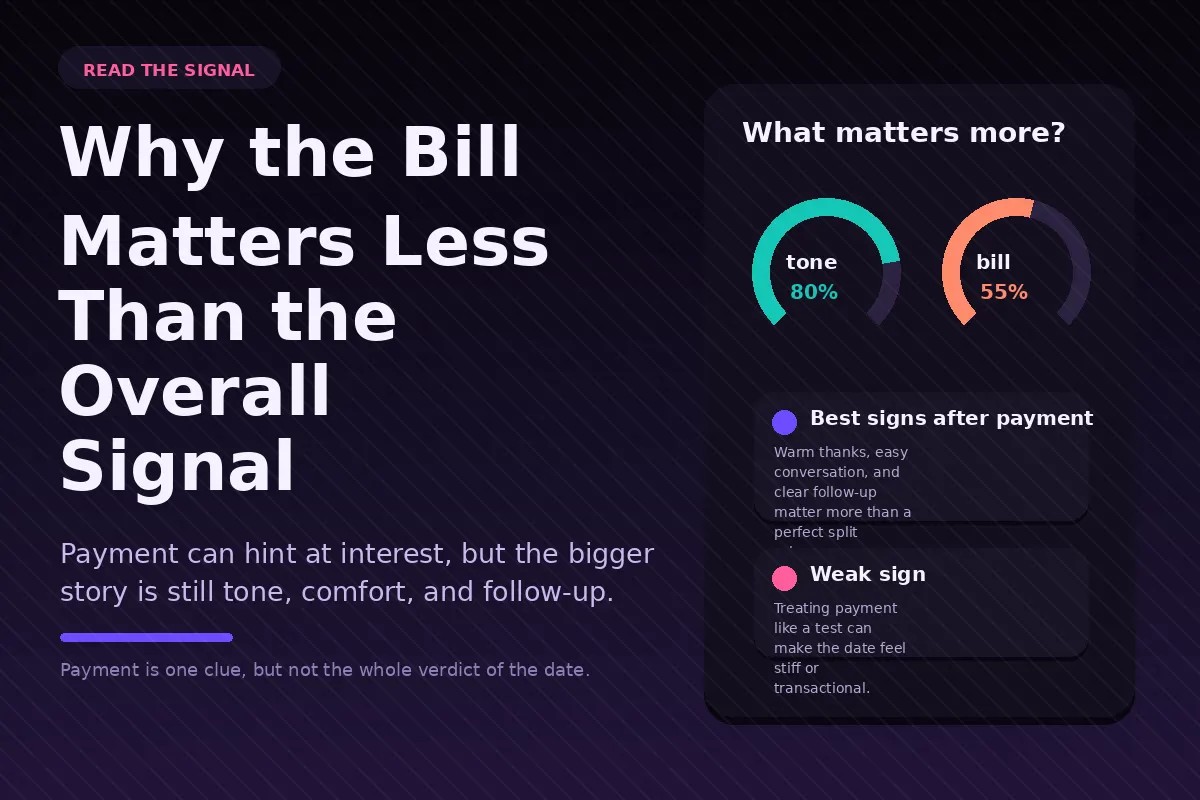
It is natural to wonder whether payment means interest, but the bill is usually only one clue. A better question is what the overall interaction felt like. Was the conversation easy? Did he seem engaged? Did he thank you warmly? Did he mention another meet-up or follow up later with similar energy? Those signs often tell you more than whether he paid, split, or accepted your offer.
For example, someone can split the bill and still be very interested. He may simply prefer independence or balance. Someone else can let you pay and still not want another date. Payment on its own is too small a piece of information to carry the whole meaning of the night.
That is why modern dating etiquette is more useful than rigid tradition. It allows the bill to stay in proportion. Payment may reflect generosity, confidence, fairness, or comfort, but it should not become a substitute for reading the full social reality of the date.
When Paying Can Be a Positive Signal
Paying can still be a positive signal, especially when it is done naturally. Some people use it to show initiative. Some use it to make the date feel smoother. Some simply do it because they invited the other person or because the cost is small enough that it feels easiest to handle it quickly. When payment is offered with lightness rather than control, it can feel generous and attractive.
The same goes for “I’ll get the next one.” This is often one of the most useful phrases in dating because it solves several things at once. It acknowledges the gesture, avoids a long negotiation, and opens the possibility of seeing each other again. That is why it can work well in Thailand, where social smoothness often matters.
Still, the gesture works best when it matches the actual tone of the date. If it feels forced or strategic, people can sense that too.
When Splitting Can Be the Better Choice
Splitting the bill can be the better choice when both people prefer a clear and balanced exchange. It can also help if the date feels more casual, if the venue was mutually chosen, or if one person does not want the payment moment to feel loaded with meaning. For many people, splitting feels clean and modern.
This can be especially true if both men are used to dating in ways that avoid traditional role assumptions. In gay dating, there is often more flexibility because neither person is automatically assigned a fixed script. That freedom can make splitting feel natural rather than unromantic.
The key is to keep the tone warm. Splitting can feel elegant when handled simply, but it can feel tense when framed like a defense against obligation. Delivery matters.
- Splitting often suits casual, balanced, low-pressure dates.
- It can reduce the feeling that one person owes the other something.
- It works best when suggested lightly, not defensively.
- It does not weaken interest if the rest of the date feels good.
Good Etiquette Is More Flexible Than People Think
Who pays on a gay date in Thailand depends on the people, the venue, the tone, and the style of the interaction. Sometimes one pays. Sometimes both split. Sometimes one pays now and the other pays next time. Modern dating etiquette is not really about forcing one correct model. It is about handling the moment with consideration and confidence.
If you remember that payment is part of a wider social exchange, the question becomes much easier. Pay if you want to. Split if that feels better. Offer next time if you want to signal interest. Above all, keep the tone relaxed and respectful. In most cases, that is what makes the best impression.
References
- Thailand Foundation – Feet Low, Head High: A Guide to Thai Etiquettes – A practical guide to Thai etiquette and the values behind polite, socially smooth behavior.
- Tourism Authority of Thailand – Language & Culture – Official context on Thai language, tone, and everyday cultural norms that influence social interaction.