
Body image can become surprisingly intense in dating, especially when apps place dozens of faces, bodies, styles, and signals of desirability in front of you within minutes. You may open an app hoping to meet someone and end up evaluating yourself instead. Someone looks leaner, more muscular, more polished, younger, more masculine, more fashionable, or simply more confident in his photos. Before long, dating starts to feel less like connection and more like a ranking system you never agreed to join.
If you want the broader confidence framework behind this topic, start with Gay Dating Confidence: Build Self-Esteem Without Chasing Validation. This article focuses on one specific piece of that problem: body image and gay dating, and how to stop comparing yourself so aggressively that it drains your confidence.
The goal is not to stop noticing attractive people or pretend appearance never matters. Attraction is part of dating. The healthier goal is to stop turning every attractive guy into evidence that you are lacking. When comparison becomes automatic, you lose contact with your own taste, strengths, and reality. Building better body confidence means learning to notice without collapsing into ranking.
In this article
Why Comparison Becomes So Intense in Gay Dating
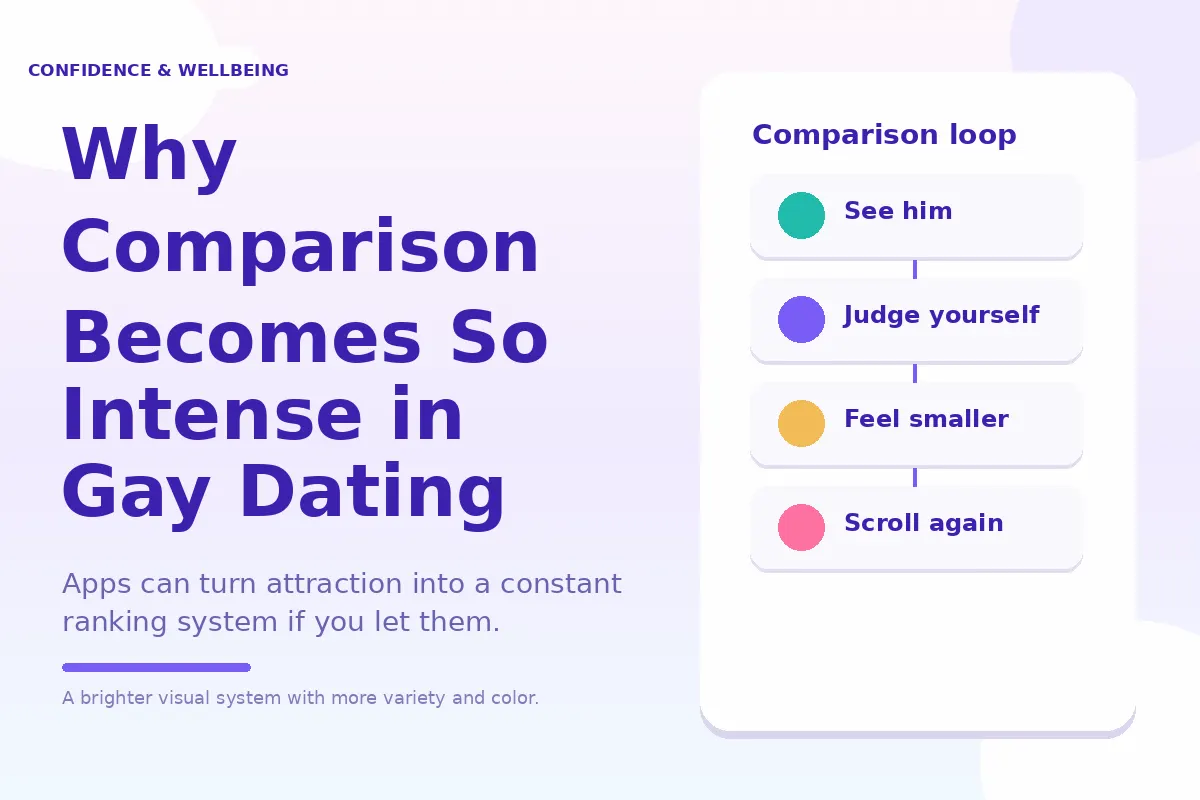
Gay dating can create a particular kind of comparison because the people you are attracted to may also be the people you compare yourself with. You are not only asking, “Do I like him?” You may also be asking, “Do I look as good as him?” or “Would someone choose him over me?” Those two processes can blur together quickly.
Apps intensify that effect by making comparison fast and repetitive. A profile takes seconds to view, but your brain can still create a full judgment. You may compare bodies, age, skin, hair, clothes, social life, travel, or even how relaxed someone looks in a photo. None of these comparisons are especially accurate, yet repeated often enough they can start to feel like objective truth.
The problem is not attraction. It is the hidden ranking system underneath it. Once every attractive person becomes a score against your own body, dating stops being curious and starts becoming punishing.
Notice When Inspiration Turns Into Self-Attack
Comparison is not always harmful. Sometimes seeing someone fit, stylish, or confident can genuinely inspire you. The problem begins when inspiration turns into self-attack. The difference is usually visible in what happens next. Healthy inspiration creates energy: “I like that look” or “I want to take better care of myself.” Unhealthy comparison creates shame: “Why do I not look like that?” or “No one will want me unless I change.”
This distinction matters because self-improvement built on shame tends to be unstable. You may become more obsessive, more critical, and more dependent on external proof. By contrast, improvement built on self-respect can still be ambitious without becoming cruel. You can want to change your body, style, grooming, or fitness while still refusing to treat your current self as a problem that must earn love.
When comparison hits, ask what it is producing. More clarity? More motivation? Or just a smaller version of yourself? That answer can tell you whether the comparison is useful or harmful.
Remember That the Dating App Feed Is a Distorted Sample
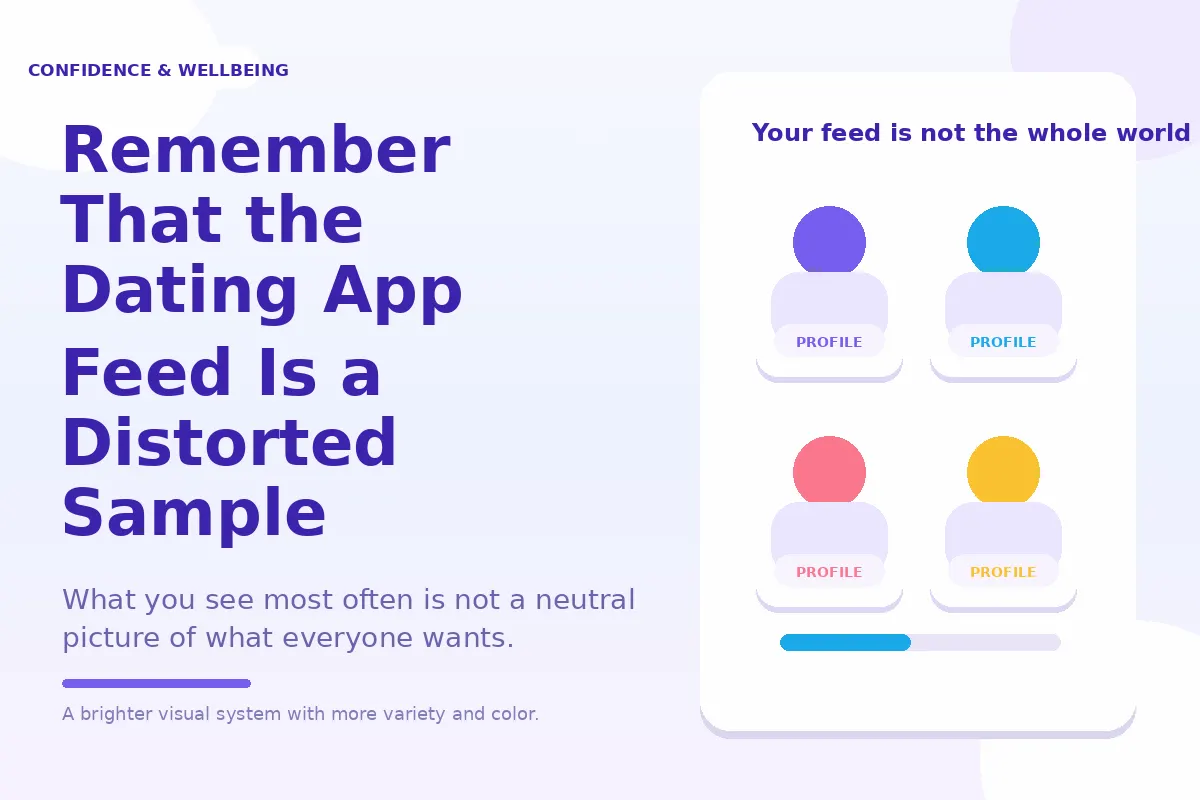
Dating apps do not show you a neutral picture of all gay men or all possible preferences. They show selected profiles, selected photos, and selected moments. People choose images where they feel attractive. Some edit carefully, crop strategically, use ideal lighting, or present a version of their life that is optimized for attention. That is normal, but it means the feed is not reality in raw form.
It is also easy to confuse visibility with desirability. The people you notice most may be the ones whose photos are most polished, whose bodies fit a familiar ideal, or whose presentation catches attention quickly. That does not mean everyone wants the same thing. Attraction in real life is much more varied than a swipe-based feed can make it look.
Reminding yourself of this matters because your brain may treat repeated images as proof of a standard. If you see the same body type often enough, you may assume it is the only body type that succeeds. In reality, people date across far wider preferences than the app interface makes obvious.
Stop Measuring Your Body by Match Numbers
One of the easiest ways to damage body image is using matches, messages, or likes as a measurement tool. If attention is high, you feel attractive. If attention slows down, you start searching for physical flaws. That turns the app into a constantly updating self-esteem meter, and no app is stable enough to deserve that job.
Match numbers reflect too many variables to function as a fair score. Timing, location, profile activity, photos, bio, preferences, distance, app usage, and pure randomness all affect who responds. Even attraction itself is highly personal. One person may love a trait another barely notices.
A stronger standard is asking whether your profile represents you well and whether you are showing up in a way you respect. Those are things you can actually control. Attention is useful information about fit, but it is poor evidence about human worth.
Change the Way You Talk to Yourself About Your Body
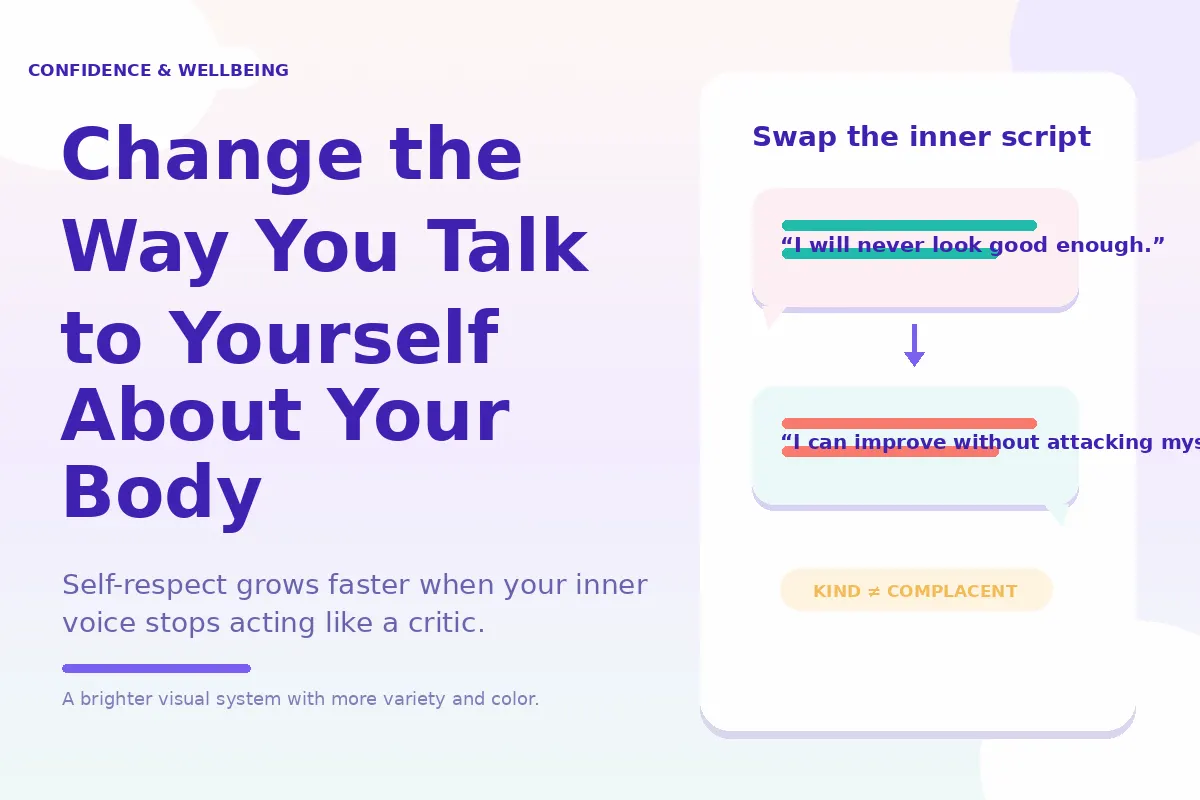
Body confidence is strongly shaped by repetition. If you repeatedly describe yourself as unattractive, too heavy, too thin, too old, too soft, too short, or not masculine enough, those judgments begin to feel factual. The first step is not forcing yourself to believe you are perfect. It is stopping the constant internal attack.
A more useful inner voice can be realistic and kind at the same time. You can say, “I want to get fitter” without saying, “My body is embarrassing.” You can notice a photo you dislike without deciding your whole appearance is a failure. You can care about grooming, clothes, or exercise without making love and dating conditional on reaching a future version of yourself.
Kind self-talk is not complacency. It is a more stable platform for change. People usually make better decisions when they are not fighting themselves all day.
| Self-attack | Healthier replacement | Why it helps |
|---|---|---|
| I will never look good enough. | I do not need to match one ideal to be attractive. | Moves you away from an impossible universal standard. |
| Everyone on the app looks better than me. | I am seeing selected photos, not the full range of real people. | Restores perspective. |
| I need more matches to feel attractive. | Matches measure fit and timing, not my worth. | Reduces dependence on validation. |
| I hate my body. | There are things I want to improve, but I can still treat myself with respect now. | Supports change without shame. |
Build Body Confidence Through Everyday Dating Behaviors
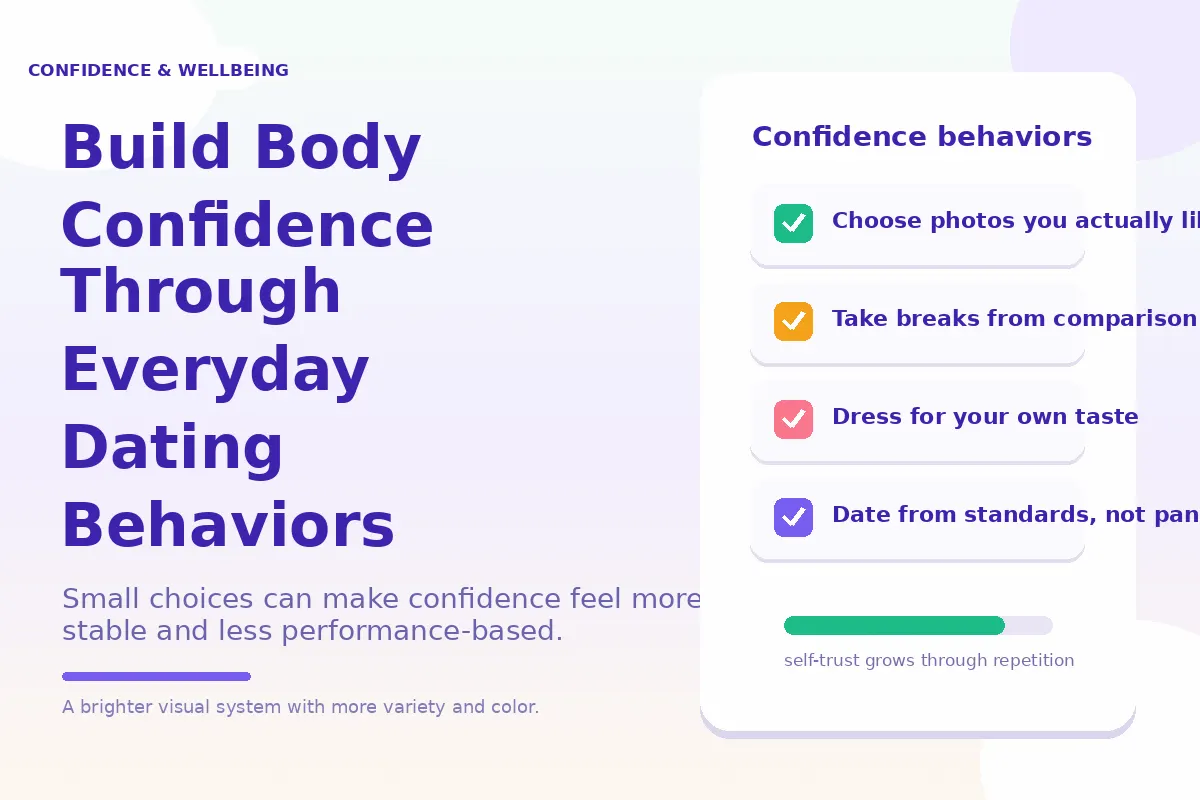
Confidence becomes more believable when you practice it through behavior. Choose photos you genuinely like rather than only the ones you think will perform best. Wear clothes that make you feel like yourself. Take breaks from scrolling when comparison starts rising. Meet people in environments where conversation and personality have room to matter.
These habits sound small, but they change the emotional experience of dating. Instead of asking the app to prove that your body is acceptable, you begin acting from the assumption that you deserve to participate fully already. That does not mean every date will go well. It means your confidence becomes less dependent on constant positive feedback.
You can also widen the sources of confidence in your life. Fitness, friendships, work, hobbies, creativity, style, humor, and competence all contribute to how you feel about yourself. The more dimensions your identity has, the less likely one bad dating day is to collapse your whole self-image.
- Use photos that feel authentic instead of obsessively optimized.
- Step away from the app when comparison becomes compulsive.
- Choose clothes and grooming that reflect your own taste.
- Keep confidence connected to your whole life, not only your body.
Date From Standards Instead of From Body Anxiety
Body insecurity can quietly change how you date. You may accept poor treatment because you feel lucky someone is interested. You may chase people you do not actually like because their attention feels validating. You may overperform, overgive, or avoid expressing needs because you are afraid confidence will make you less desirable.
This is why body image is not only about mirrors and photos. It affects relationship choices too. The stronger your self-respect becomes, the easier it is to ask a different question: “Do I like how this person treats me?” rather than only “Does he like how I look?” That shift changes the power balance inside dating.
You do not need perfect body confidence to have standards. You can still feel insecure sometimes and choose people who are kind, consistent, and genuinely interested. Confidence often grows after you start behaving as though your needs matter.
Stop Trying to Win a Beauty Contest That Does Not Exist
There is no single ranking of gay men that everyone agrees on. The idea that there is one ideal body, face, age, or style may feel real online, but actual attraction is far messier and more personal. Some people prefer lean bodies, some muscular, some soft, some hairy, some smooth, some older, some younger, some understated, some highly styled. You do not need universal approval to have a successful dating life.
The more you accept that, the less pressure comparison has over you. Someone else being attractive does not make you less attractive. Someone else getting attention does not remove attention that could come to you. Dating is not a finite contest where one person’s desirability reduces everyone else’s.
Body image and gay dating become easier when you stop asking, “How do I rank?” and start asking, “Do I feel comfortable enough in myself to meet people honestly?” That is a much healthier goal, and it creates the kind of confidence that can survive ordinary rejection, comparison, and imperfect days.