
Core values are easy to ignore when a new relationship feels exciting. Chemistry is strong, conversation flows, and both people are enjoying the momentum. But when a gay relationship starts becoming serious, attraction is no longer the only question. You also need to know whether the two of you want compatible lives.
If you want the broader compatibility framework first, read Gay Dating Compatibility: How to Choose the Right Partner. This article focuses specifically on the conversations that matter before a relationship becomes more committed: values around commitment, money, work, independence, family, outness, children, and the future.
On Quicky, a promising match can become emotionally important quickly. That makes value conversations even more useful. They are not meant to turn dating into an interview. They are meant to reveal whether the connection has enough alignment to support real life once the early excitement settles down.
In this article
Why Core Values Matter More as the Relationship Gets Serious
Values are the principles that guide everyday choices. They influence how people handle money, loyalty, family, ambition, conflict, freedom, and responsibility. Two people do not need identical personalities, but serious relationships usually become harder when important values point in opposite directions.
The difficult part is that values are not always obvious in early dating. Someone can be kind, attractive, and emotionally engaging while still wanting a completely different relationship structure or future. Those differences do not make either person wrong. They simply create information you need before investing more deeply.
Talking early enough gives both people room to be honest without feeling trapped by expectations. The goal is not perfect agreement. It is enough alignment, plus the ability to discuss differences respectfully.
Define Your Own Core Values Before Comparing Them
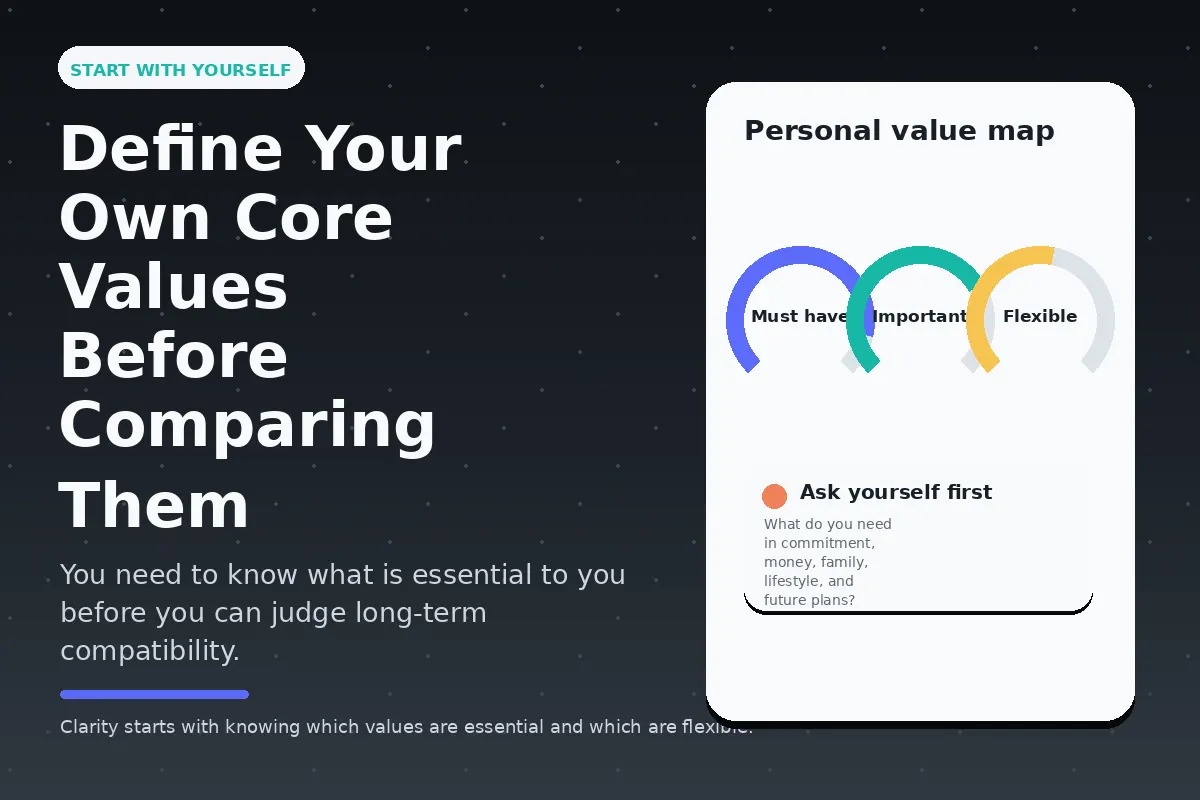
Before asking someone else what he values, it helps to understand your own priorities. Many people know what they dislike, but they have never clearly identified what they actually need in a relationship. That makes compatibility harder to judge because every difference can feel equally important.
Try separating your values into three groups: must-haves, important preferences, and flexible areas. A must-have may be honesty or a compatible relationship structure. An important preference may be similar social habits. A flexible area might be how often you travel or whether you share every hobby.
This distinction matters because long-term dating becomes difficult when everything is treated as non-negotiable. Strong compatibility requires standards, but it also requires knowing where compromise is reasonable.
- Which principles would make you lose trust if they were repeatedly violated?
- Which differences could you genuinely live with?
- What kind of life are you trying to build over the next several years?
- Which values come from you, and which come from pressure or expectation?
Talk About Commitment, Monogamy, and Relationship Structure
Commitment means different things to different people. One person may equate seriousness with monogamy. Another may believe an open relationship can still be deeply committed. Someone else may not yet know what structure he wants. These differences are important enough that assuming agreement can create major problems later.
Talk about what exclusivity means, what boundaries feel important, and how each of you defines emotional and sexual loyalty. If either person is interested in non-monogamy, the conversation should include expectations, disclosure, safer-sex boundaries, and what would feel like betrayal even inside an open structure.
The goal is not to choose the “correct” relationship model. The goal is informed agreement. A structure works better when both people actively choose it rather than when one person quietly accepts something he does not actually want.
Discuss Money, Work, Lifestyle, and Independence
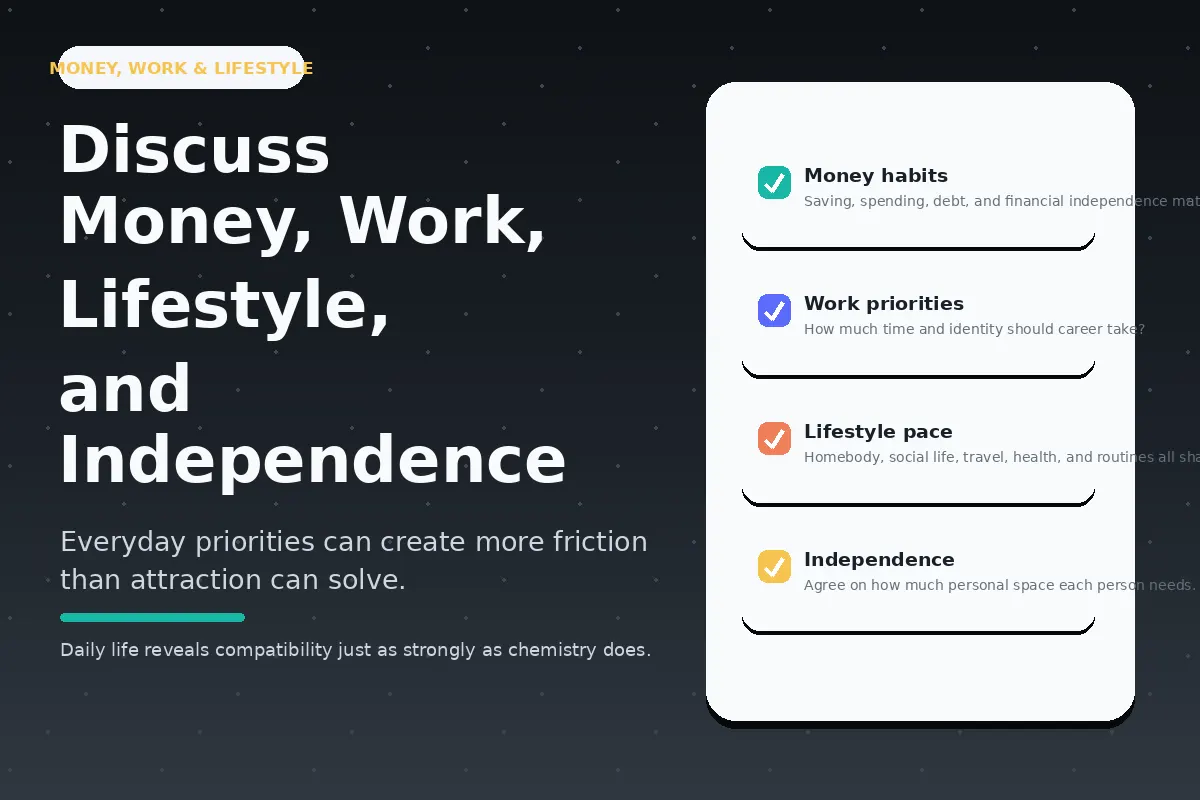
Money may not feel romantic, but it reflects values quickly. You do not need to exchange bank statements in early dating. You do need enough understanding to know whether your approaches to spending, saving, debt, generosity, and financial independence can coexist. Serious relationships eventually make these differences more visible.
Work is another major value area. How ambitious is each person? How much time should work take? Would either of you relocate for a career? What happens when one person earns much more than the other? These questions are not only financial. They affect time, power, lifestyle, and future decisions.
Independence matters too. Some couples want highly integrated lives. Others need more separate time, friendships, and routines. Neither model is automatically healthier. Problems happen when one person experiences closeness as safety while the other experiences the same level of closeness as pressure.
| Value area | Useful question | What it reveals |
|---|---|---|
| Money | “How do you usually think about saving and spending?” | Financial priorities and habits |
| Work | “How important is career growth in the life you want?” | Ambition, time, and future tradeoffs |
| Lifestyle | “What does a good normal week look like to you?” | Daily rhythm and compatibility |
| Independence | “How much separate time feels healthy to you?” | Expectations around space and closeness |
Talk About Family, Outness, Children, and the Future
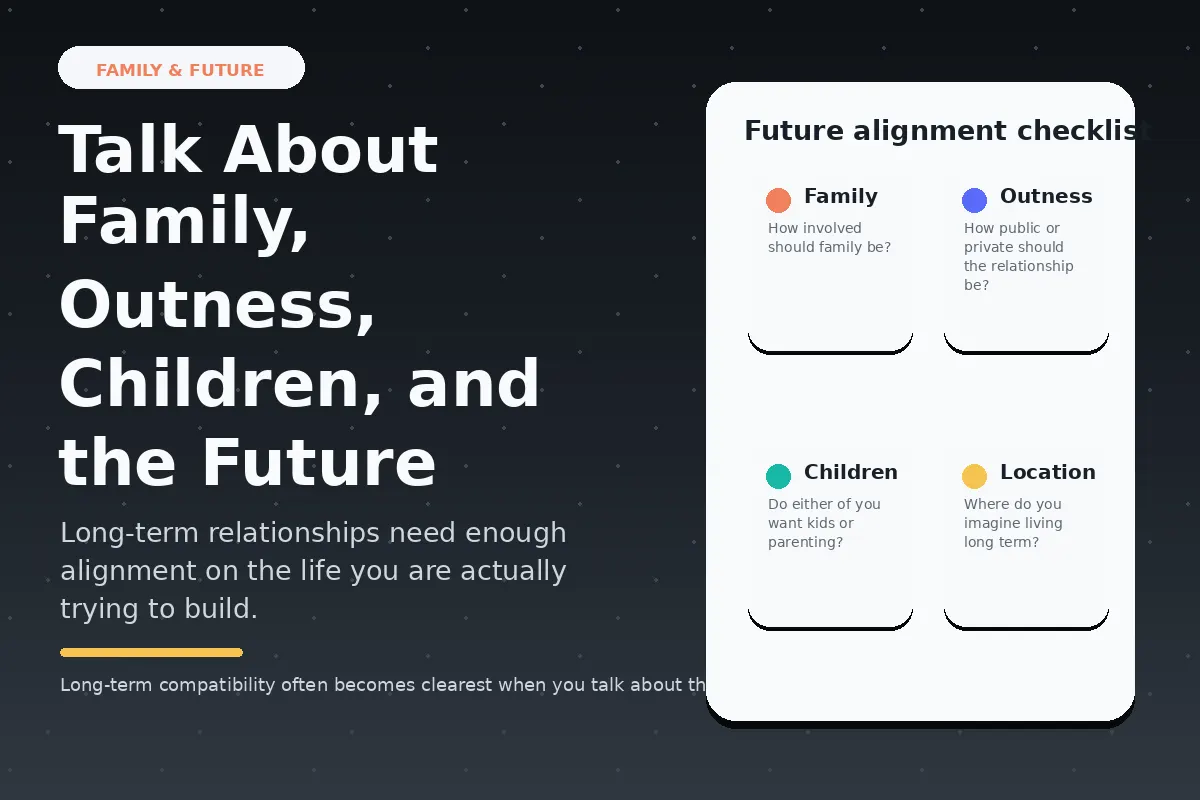
Family can be especially complex in gay relationships because people have very different experiences with acceptance, privacy, culture, and chosen family. One person may have an affirming family and expect a partner to be fully included. Another may keep parts of his personal life private for safety or family reasons. Those differences deserve empathy, but they also deserve honest discussion.
Outness matters for similar reasons. If one partner wants a public relationship while the other needs significant privacy, both people may eventually feel compromised. The question is not whether everyone should be equally open. The question is whether the level of visibility each person can live with is compatible.
Children and long-term location are also important. If one person strongly wants children and the other strongly does not, that is not a minor preference. The same can be true of where you want to live, whether you want marriage, and how you imagine family life later on.
Discuss Conflict, Repair, and What Respect Looks Like
Values are not only about big life decisions. They also appear in conflict. What does respectful disagreement look like to each of you? How do you handle anger? Do you need time alone before talking? What behavior crosses a line even during a difficult argument?
These conversations matter because almost every serious relationship will face conflict. The important difference is whether both people can stay respectful, repair after mistakes, and understand each other’s needs. Someone may share your goals and still be a poor long-term fit if every disagreement becomes contempt, withdrawal, or punishment.
You do not need to predict every argument. You do need enough evidence that both people value fairness, accountability, and repair.
Do Not Confuse Shared Values With Identical Opinions
Compatible values do not require identical views on everything. Two people can disagree about politics, religion, social habits, or spending details while still sharing deeper values such as fairness, honesty, responsibility, or compassion. The important question is whether differences can exist without making either partner feel chronically unseen or disrespected.
Sometimes values are shared even when the behavior looks different. One person may value security through saving. Another may value security through investing in education or property. The surface behavior differs, but the underlying principle may still be similar. Good conversations help uncover that deeper layer.
This is why curiosity is more useful than scoring answers. You are not looking for a clone. You are trying to understand whether the relationship can support both people without constant conflict over the fundamentals.
Core Values Should Make the Future Clearer, Not More Perfect
Discussing core values before a gay relationship gets serious is not about removing all uncertainty. Relationships always involve discovery. The purpose is to reduce preventable surprises around the issues most likely to shape long-term life together.
If you can talk honestly about commitment, money, work, lifestyle, independence, family, outness, children, and future goals, you will have a much clearer picture of compatibility. Differences may still exist, but at least both people understand what they are choosing.
Serious relationships do not need perfect alignment. They need enough shared direction, enough respect for differences, and enough communication to build a life that feels workable for both people.
References
- American Psychological Association – Happy Couples: How to Keep Your Relationship Healthy – Guidance on communication, regular check-ins, and habits that support healthier long-term relationships.
- The Gottman Institute – Create Shared Meaning with a Culture Covenant – A relationship exercise focused on discussing shared values and intentionally defining the culture a couple wants to build together.