
Nobody writes guides for the good part. Falling in love comes with playlists and date ideas; falling apart comes with a phone you can’t stop checking and friends who mean well but don’t quite know what to say. So let’s say the true things first: a breakup is real grief, it hurts because it mattered, and — this is the part that’s impossible to believe in week one — it ends. Research on breakups consistently finds that people come out the other side with more personal growth and life satisfaction than they expected. You will too. This guide is the map for getting there.
What follows isn’t magic; it’s sequence. Stabilize first, protect your healing second, rebuild third, reflect fourth, and re-enter when you’re actually ready — not when the loneliness spikes at 11pm. Here’s each stage, including the parts that are specifically harder in our community.
In this article
First: Let It Be Grief
Sadness, anger, relief, confusion, missing him, being furious at him — sometimes within the same hour. All of it is normal, and therapists are blunt on this point: trying to be tough and skip past your feelings doesn’t work. Pain is a function of healing, not a malfunction. Give yourself real permission to grieve the relationship, the routines, and the future you’d sketched — that future was real to you, and losing it counts as loss.
Grief also isn’t linear. A good Tuesday followed by a terrible Thursday isn’t relapse; it’s the normal shape of the process. Stop grading your healing.
The First Two Weeks: Stabilize

Early days are triage, not transformation. Aim at exactly four things:
- Establish contact rules — with yourself. No-contact (or minimal, logistics-only contact if you share responsibilities) is the closest thing heartbreak has to medicine. Every check-in, every “how are you” text, every story view restarts the clock.
- Mute, don’t monitor. Mute or unfollow him and adjacent accounts — not out of pettiness, but because a curated feed of his life is a wound-reopening machine. If you’re back on dating apps later and his profile appears, the veteran move is simple: block without reading.
- Defend the basics. Sleep at normal hours, eat actual meals, move your body a little every day, and go easy on alcohol — it volunteers as a painkiller and performs as an amplifier. You’re not optimizing; you’re keeping the lights on.
- Tell your people. Reach out to the friends and chosen family who get it. Saying “I’m not okay yet” out loud to someone safe is not weakness; it’s how humans metabolize loss. If nobody nearby fits, LGBTQ+ community centers and online groups exist precisely for this.
The Small-Community Problem (and Its Hidden Gift)
Here’s the part straight advice columns miss: “avoid your ex for several months” is beautiful advice that queer life often makes impossible. Our scenes are small. You share the same bars, the same events, the same group chats, sometimes the same twelve mutual friends. Psychotherapists who work with LGBTQ+ clients acknowledge the bind directly — nobody wants to exile themselves from community spaces exactly when they need community most.
So play it strategically:
- Early on, choose your venues deliberately. You don’t have to quit the scene — but you’re allowed to skip his regular night for a month while you’re still raw. Think rotation, not exile.
- Pre-plan the run-in. You will eventually see him. Decide your move now: a polite nod, a brief “hey, good to see you,” and a graceful return to your friends. No deep talks in week three — you’re too raw for that conversation to go anywhere good, and that’s normal, not fragile.
- Don’t make friends pick custody. Mutual friends stay mutual. The less you require people to choose sides, the faster your social world stabilizes — and the better you look to everyone watching how you handle this.
- The gift: the same tight-knit community that makes breakups awkward is the thing that catches you. Queer chosen family shows up for heartbreak like nobody else. Let it.
The Healing Phases: What to Expect When
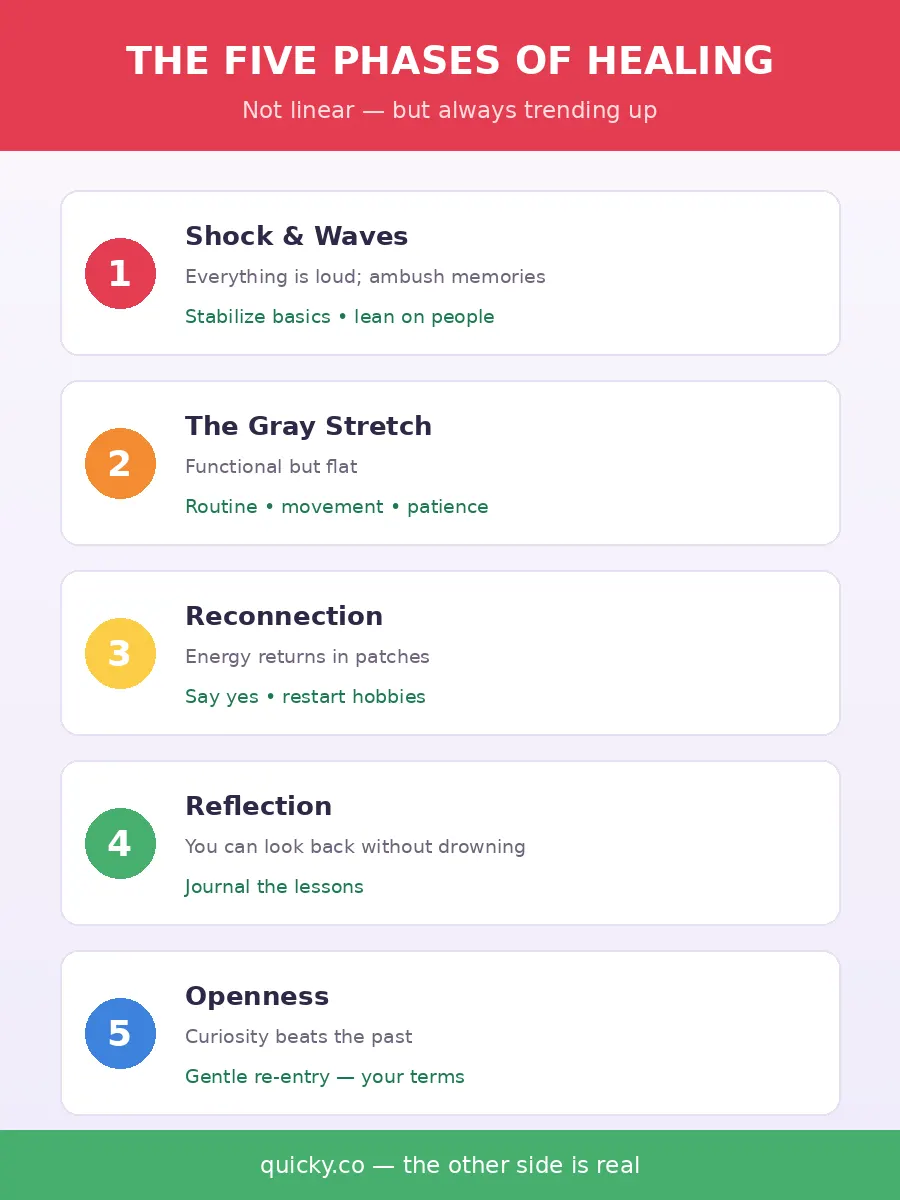
Everyone’s timeline differs — ignore any formula that claims otherwise — but the shape of healing is fairly universal:
| Phase | What It Tends to Feel Like | What Helps Most |
|---|---|---|
| Shock & waves | Everything is loud; missing him arrives in ambushes | Stabilize the basics; lean on people; no big decisions |
| The gray stretch | Functional but flat; life feels like a rerun | Routine, movement, small novelty; patience |
| Reconnection | Energy returns in patches; laughing surprises you | Say yes to invitations; restart hobbies |
| Reflection | You can think about the relationship without drowning | Journal the lessons; extract the gold, leave the rest |
| Openness | Curiosity about the future outweighs the past | Gentle re-entry to dating — on your terms |
Rebuild: The Best Revenge Is a Full Calendar

Once you’re stable, healing accelerates through addition, not just subtraction:
- Shake the patterns. An idle mind replays memories on loop, and stuck routines keep old associations alive. New workout class, rearranged apartment, different coffee shop, a hobby you postponed — small changes genuinely shift perspective.
- Invest in friendship like it’s your job. Breakups often reveal we’d let friendships coast. Reconnect with people you drifted from; deepen the ones who showed up. If the breakup cost you social circles — joint custody of friends isn’t always granted — join an LGBTQ+ sports team, club, or class and build circles that are wholly yours. (Our guide to making gay friends is a good companion here.)
- Do the solo things. Dinner alone, a museum afternoon, even a short solo trip. Rediscovering that your own company is good company is the quiet milestone that everything else builds on.
- Update the sexual health plan. Practical and unglamorous: if you’re newly single, it’s the natural moment to get tested, review PrEP, and restock — future-you handles this calmly now instead of awkwardly later.
The Classic Mistakes (Signed, Everyone Who’s Made Them)
- The 2am message. Write it in your notes app, never in the chat. Morning-you always agrees.
- The instant rebound-as-anesthetic. Casual dating when you’re ready is great; using a stranger as a painkiller in week two mostly delays the wave and adds a confused third party. Distraction covers the wound — it doesn’t close it.
- The investigation. Checking his profile, decoding his posts, asking friends for intel. Every data point costs you days of progress and buys you nothing.
- The bitterness broadcast. Venting to your closest people: healthy. Public campaigns in group chats and comment sections: a bad look that outlives the sadness.
- The relationship rewrite. Memory turns exes into either saints or monsters. Both edits block the useful step — seeing clearly what worked, what didn’t, and what you’ll choose differently.
Reflect: Extract the Lessons, Leave the Rest
Somewhere in the reflection phase, the relationship becomes data instead of just pain. Useful prompts — journal them, voice-note them, or talk them through:
- What did this relationship teach me about what I actually need — not want, need?
- What did I tolerate that I won’t tolerate again? (Our Gay dating red flags: warning signs is useful equipment for the next chapter.)
- What was genuinely good — and therefore worth looking for again?
- What was my part? Not blame — patterns. The one question that turns heartbreak into growth.
And a word on extra support: if weeks pass and the floor isn’t rising — sleep stays broken, work stays impossible, the flatness deepens instead of lifting — talking to a professional, ideally one who’s LGBTQ+-affirming, is a genuinely strong move. Therapy isn’t the emergency exit; for a lot of us it’s the upgrade.
Ready Again? The Signs — and the Gentle Re-Entry
There’s no official waiting period. The honest indicators that you’re ready to date again:
- You’re curious about new people rather than hunting a replacement or an audience for the comeback story.
- You can mention your ex without a spike — he’s become a chapter, not the plot.
- You want to add someone to a life that already works, not fill a crater with a person.
- The idea of a first date sounds fun, not like a performance review.
When those land, re-enter gently: refresh your photos and bio (the profile guide makes it painless), keep early dates light and public, and let chemistry build at whatever pace feels good. When you’re ready to meet someone new, Quicky is free, ad-free, and built for the Thai LGBTQ+ community — and this time you’ll arrive knowing more about what you’re looking for.
If You’re the One Who Ended It
Breakup guides quietly assume you were left. But being the leaver is its own strange grief — and it deserves a section, because guilt heals differently than rejection does.
- Ending it was allowed. You don’t need a courtroom-grade justification to leave a relationship that wasn’t right. “I wasn’t happy and couldn’t fix it there” is a complete reason. Staying out of guilt helps no one — it just delays two people’s next chapters.
- Expect the doubt wave. Around the time the loneliness hits, your memory will present a highlight reel and ask if you made a terrible mistake. Doubt after a breakup is near-universal and is not evidence. Re-read the honest reasons you left — writing them down on day one is a gift to week-four you.
- Kindness has limits. You can care about his healing without managing it. Checking in “as a friend” in week two usually feeds hope rather than comfort. The kindest version of leaving is clarity plus distance — even when distance feels cold.
- You still get to grieve. Leavers lose the same routines, the same future sketches, the same person. Guilt often blocks leavers from admitting they’re sad too. You’re allowed both: certain about the decision and heartbroken about the ending. Most honest leavers are.

Frequently Asked Questions (FAQ)
How long does it take to get over a breakup?
There’s no formula — length of relationship, how it ended, and how much your lives intertwined all matter more than any pop-culture math. What research does show: the pain reliably fades, and most people land in a better place than they predicted. Measure progress in weeks-over-weeks trend, not day-to-day mood.
Should I stay friends with my ex?
Eventually, maybe — immediately, almost never. Real friendship with an ex requires both people to be fully un-romantically attached, which takes months of distance to even test honestly. “Instant friendship” is usually one person quietly hoping and the other quietly managing guilt. Take the space first; revisit later if it still appeals.
How do I handle seeing my ex at community events?
Decide your script before you go: friendly nod or brief hello, then rejoin your people — no relationship post-mortems at the bar. Early on, you’re allowed to skip his regular venues for a few weeks without it meaning exile. With time, sharing space gets unremarkable; the first run-in is the hardest one.
Is it a rebound if I start dating quickly?
The calendar matters less than the motive. Dating to explore and enjoy — fine at almost any point. Dating to anesthetize pain, prove something to your ex, or outsource your self-worth — that’s the rebound trap, whenever it happens. The test: would this date still appeal if your ex could never find out about it?
Conclusion: The Other Side Is Real
Right now the breakup is the biggest thing in the room. It won’t stay that way. Stabilize, protect your healing from the 2am impulses, let your community catch you, rebuild a calendar that’s fully yours, take the lessons, and re-enter when curiosity beats loneliness. One unremarkable morning you’ll notice the weight didn’t wake up with you — and that ordinary moment is the finish line. It’s closer than week-one-you believes. Keep going.
References
- Emen8 — Nothing Breaks Like a Gay Heart: Getting Through a Gay Breakup
- Philadelphia Gay News — The Queer Breakup: How to Heal and What Not to Do
- HomoCulture — 11 Steps to Bounce Back After a Bad Split