
Here’s an uncomfortable truth about dating apps: most profiles are invisible. Not because the people behind them are boring or unattractive, but because their profiles sound exactly like everyone else’s. “Love to travel, good vibes only, looking for something real” — phrases so overused they’ve become dating app white noise. When someone is scrolling through dozens of profiles in a few minutes, generic means invisible.
The good news? Standing out doesn’t require being extraordinary. It requires being specific. This guide walks you through everything that makes a gay dating profile actually work in 2026 — the photo lineup, the bio formula, the profile killers to delete tonight, and the openers that turn matches into conversations. Whether you’re on a gay app looking for someone special or just hoping to expand your circle of gay friends, the same principles apply.
In this article
The 3-Second Rule: How People Actually Read Your Profile
Before writing a single word, understand what your profile is competing against. Research on online dating behavior consistently shows that users make their first judgment in seconds — a quick scan of the main photo, a glance at the first line of the bio, swipe. Your profile isn’t a résumé that gets read top to bottom. It’s a storefront window.
That means your profile has exactly three jobs:
- Stop the scroll. Your main photo and first bio line must create a reason to pause.
- Create a hook. Give people something specific to message you about — a conversation starter built into the profile itself.
- Filter for fit. A great profile doesn’t attract everyone. It attracts the right people and quietly filters out the wrong ones.
Every recommendation in this guide serves one of those three jobs. If an element of your profile isn’t stopping the scroll, creating a hook, or filtering for fit — it’s dead weight.
Photo Strategy: Building a Lineup That Works

Photos carry most of the first impression, and the biggest mistake is treating them as five versions of the same thing. Five gym mirror selfies tell one story, five times. A strong lineup is a portfolio — each photo answers a different question about who you are. Dating platform research backs this up: photos showing an activity or hobby consistently outperform static posed shots, because they give viewers something to imagine doing with you.
Here’s the five-photo framework that covers all the bases:
| # | Photo Type | Why It Works | Pro Tip |
|---|---|---|---|
| 1 | Clear headshot | Face visible, genuine smile — builds instant trust | Natural light beats any filter; golden hour is free |
| 2 | Full-body shot | Answers a question people will wonder about anyway | Candid beats posed; mid-laugh beats mid-flex |
| 3 | Activity photo | Shows your life, creates a message hook | Cooking, hiking, gaming, café-hopping — anything real |
| 4 | Social photo | Signals you have a life and people who like you | Max one group shot — and be identifiable in it |
| 5 | Personality wildcard | The photo that makes someone smile | Your dog, your worst karaoke moment, your plant empire |
And a few photo rules that apply across the board:
- Recent means recent. Photos should be from the last year. Showing up to a date looking different from your photos starts everything with a small betrayal.
- Skip heavy filters. Light editing is fine; face-morphing filters read as insecurity and set up the same in-person disappointment as old photos.
- Use dating-only photos. For privacy, avoid photos that also appear on your public social media — reverse image search can connect your dating profile to your full identity. This matters extra if you’re not fully out; our complete gay dating safety guide covers this in depth.
- Sunglasses and hats: one photo maximum. Hiding your eyes in every shot reads as hiding, full stop.
The Bio Formula: Specific Beats Impressive
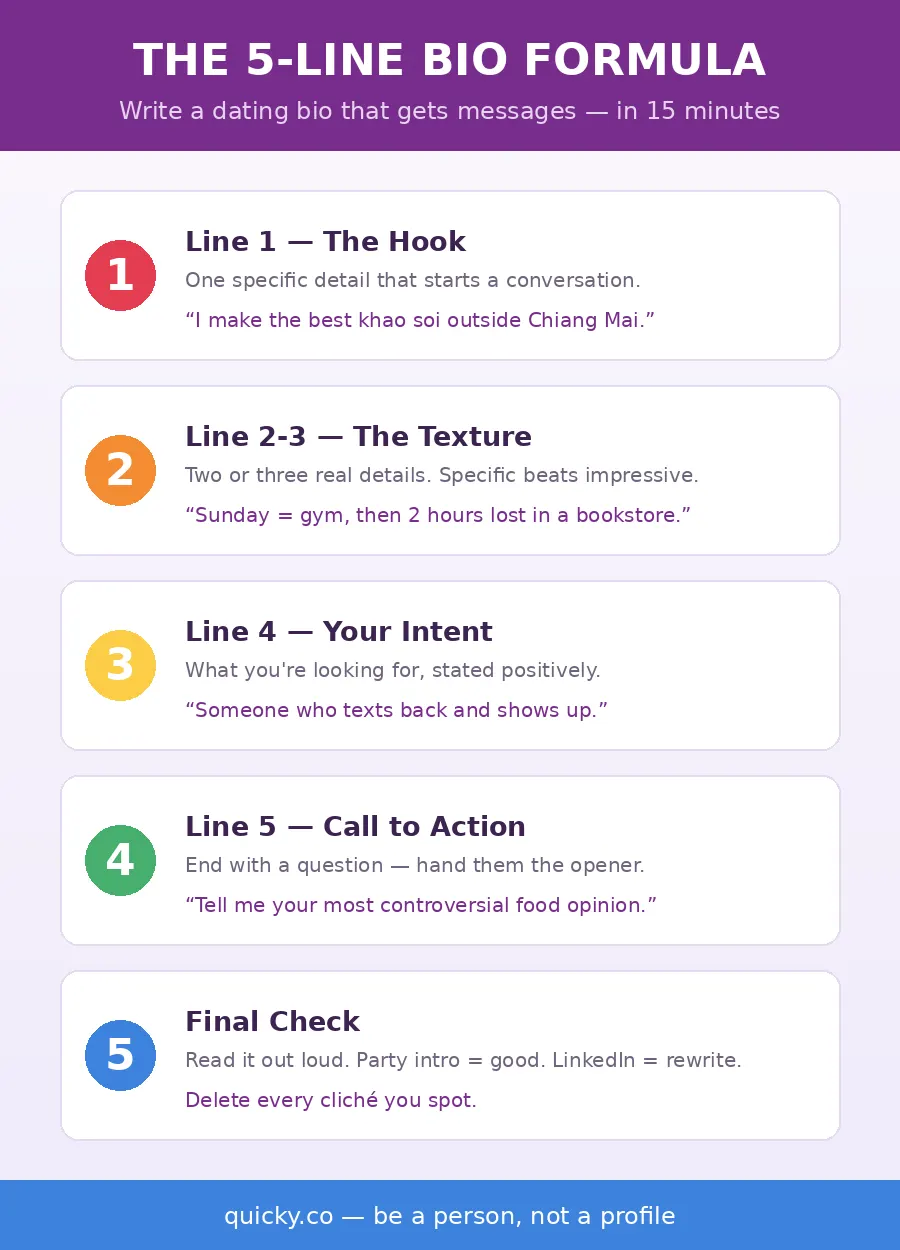
Now the part most people dread: writing about yourself. Forget trying to sound impressive — impressive is generic. The profiles that get quality messages follow a simple structure you can write in fifteen minutes:
- Line 1 — The hook: One specific, concrete detail that starts a conversation. “I make the best khao soi outside of Chiang Mai and I will defend this claim” beats “I love food.”
- Line 2-3 — The texture: Two or three real details about your life. Specificity is the entire game: “Sunday = gym, then wandering a bookstore for two hours” paints a picture; “I like reading and fitness” paints nothing.
- Line 4 — What you’re looking for: Stated positively. “Looking for someone who texts back and shows up” works; “NO flakes, NO games, NO drama” broadcasts baggage. Same information, opposite energy.
- Line 5 — The call to action: End with a question or prompt. “Tell me your most controversial food opinion” gives every match an instant opener — you’ve done the hard part of starting the conversation for them.
Read your draft out loud. If it sounds like something a friend would say about you at a party, it’s good. If it sounds like a LinkedIn summary or a list of demands, rewrite it.
Profile Killers: Delete These Tonight
Sometimes improving a profile is less about adding and more about removing. These are the elements that quietly cost you matches:
- The empty bio. No bio says “I expect my photos to do all the work.” It attracts exactly the kind of attention that photos-only attracts — and filters out everyone looking for substance.
- Negativity of any kind. Complaints about the app, about exes, about “guys on here.” Your profile should focus on what you bring, not what you want to avoid. Bitterness is the fastest left-swipe in existence.
- The cliché stack. “Partner in crime,” “good vibes,” “fluent in sarcasm,” “here for a good time.” These phrases appear in millions of profiles. They’ve stopped meaning anything.
- Lying — even small lies. Age, height, body type. Every lie has a expiration date: the moment you meet. Honest profiles produce fewer matches but dramatically better ones.
- The interrogation bio. A list of requirements the reader must meet before daring to say hi. Standards are healthy; a bouncer’s clipboard is not a personality.
- Trying to appeal to everyone. A profile with no point of view offends no one and interests no one. Your weird hobby is not a liability — it’s your best filter.
Match Your Profile to Your Intent
One profile cannot serve every goal equally, and pretending otherwise creates mismatched expectations on both sides. Be honest with yourself about what you’re primarily looking for, then tune the profile accordingly:
- Looking for friends first? Lead with your social interests and group activities. Photos of your hobbies matter more than your best angles. Say directly that friendship is on the table — plenty of people are searching for genuine gay friendships and will be relieved you said it.
- Looking for a relationship? Signal it without a manifesto. Mention what a good weekend with a partner looks like to you. Depth details — values, routines, what you’re building in life — attract people who are also looking for a serious boyfriend, not just a serious photo.
- Open to whatever develops? That’s legitimate — say it plainly rather than performing intensity you don’t feel. “Seeing what’s out there, open to surprises” is honest and reads as relaxed confidence.
The platform matters too. An app designed for the community — free, ad-free, and built by Thai LGBTQ+ people — lets your profile reach people who share your context, instead of shouting into a generic crowd.
From Match to Conversation: Openers That Get Replies
A great profile earns you matches; a great opener earns you conversations. The mechanics are simple:
- Reference something specific from their profile. “You went to that ramen place in your third photo — worth the queue?” proves you looked. “Hey” and “sup” prove you didn’t.
- Ask something answerable. Open-ended but easy: opinions, recommendations, stories. Questions requiring an essay get postponed forever.
- Match energy, then escalate slowly. Two-line messages deserve two-line replies. Save the life story for date three.
- Suggest the video call or date within a week or two of good conversation. Endless texting creates imaginary intimacy with a person you haven’t met. A short video call keeps momentum and doubles as a safety check — verifying your match is who they claim to be before meeting in person.
Prompts and Profile Questions: Small Boxes, Big Impact
Many apps now supplement the free-text bio with structured prompts — “My perfect Sunday,” “Two truths and a lie,” “The way to my heart is.” Daters often treat these as an afterthought, filling them with one-word answers minutes before giving up. That’s backwards: prompts are the highest-leverage real estate on your profile, because they’re pre-formatted conversation starters.
Three rules for prompt answers that actually work:
- Answer with a story, not a category. “My perfect Sunday: losing badly at badminton, winning dramatically at brunch” gives texture and a smile. “Relaxing with friends” gives nothing.
- Leave a door open. The best answers are slightly incomplete — “I have a strong opinion about pineapple on pizza” practically forces a reply. Mystery invites messages; a closed statement ends them.
- Vary the register. If every answer is a joke, you read as evasive. If every answer is earnest, you read as intense. One funny, one warm, one specific — that mix reads as a whole person.
Two truths and a lie deserves special mention because it’s the single most-answered prompt in dating apps — which means lazy answers (“I like dogs, I’ve been to Japan, I hate coffee”) disappear instantly. Make all three items surprising, and your match rate on that prompt alone will jump.
Test and Iterate: Treat Your Profile Like a Draft, Not a Monument
Here’s what separates people who improve their results from people who complain about the algorithm: iteration. Your first profile is a hypothesis, not a finished product. Nobody writes the perfect bio on the first attempt — but almost anyone can iterate their way to a strong one within a few weeks.
A simple testing loop:
- Change one element at a time. Swap your main photo OR rewrite your hook line — not both at once. If you change five things and results improve, you’ve learned nothing about which change worked.
- Give each version one to two weeks. Daily fluctuation is noise; weekly trends are signal. Note roughly how many matches and — more importantly — how many actual conversations each version produces.
- Optimize for conversations, not matches. A shirtless main photo may maximize matches while minimizing people who read your bio. If your goal is connection, the profile that produces fewer, better conversations is the winner.
- Ask a brutally honest friend. Show them your profile for ten seconds — the way a stranger sees it — and ask what impression they got. Their first-glance read is worth more than your tenth careful review.
And when something works, keep it working: refresh photos seasonally, rotate your hook line monthly, and retire any prompt answer that has never once been mentioned by a match. Your profile is a living document — the daters who treat it that way consistently outperform the ones who set it and forget it.
Frequently Asked Questions (FAQ)
How long should a gay dating profile bio be?
Aim for 50–120 words — roughly four to six short lines. Long enough to show personality and give a message hook, short enough to be read in a scroll. An empty bio underperforms almost any bio; a 500-word essay gets skipped entirely.
Should I say what I’m looking for in my profile?
Yes — clarity attracts compatibility. State it positively (“looking for someone to explore cafés and eventually life with”) rather than as a warning list. Vague profiles produce vague matches; honest intent filters for people who want the same thing you do.
How often should I update my profile?
Refresh photos every few months and whenever your look changes. Small bio updates — a new prompt, a new hook line — are worth doing monthly, since many apps surface recently updated profiles more often, and a fresh first line changes who pauses on you.
Why am I getting matches but no conversations?
Usually a hook problem: the profile creates attraction but gives matches nothing to say. Add a question or a strong specific detail (a bold food opinion, an unusual hobby) to the end of your bio, and send openers that reference the other person’s profile instead of waiting to receive them.
Conclusion: Be a Person, Not a Profile
Everything in this guide reduces to one principle: specificity wins. A clear recent headshot beats a filtered mystery. A khao soi opinion beats “I love food.” A stated intention beats a vague vibe. The profiles that succeed aren’t the most polished — they’re the ones where a real, particular person is visible through the screen.
So write the bio only you could write, choose photos that show your actual life, delete the clichés, and give every match an easy way to start talking. Then let the profile do its job of filtering, and remember it only has to work once. Ready to put your new profile to work? Quicky’s free matching puts it in front of people looking for exactly someone like you — and before your first meetup, take five minutes with our gay dating safety tips so the only surprises are good ones.
References
- Marie Claire UK — Dating Profile Tips: 15 Pro Tips for Making Yours Stand Out
- FernDate — Dating Profile Tips That Actually Get Results in 2026
- David Wygant — Dating Profile Tips for Men That Get Real Responses