
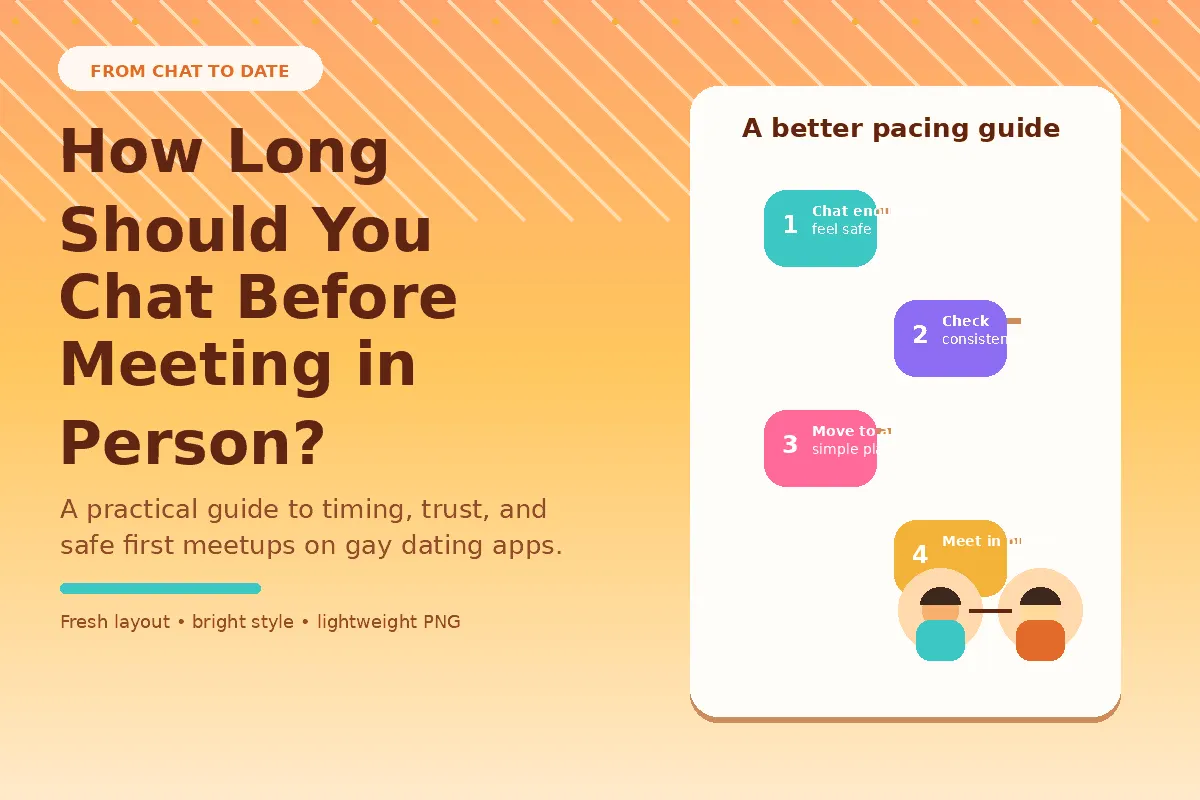
One of the most common questions on a dating app is simple: how long should you chat before meeting in person? In most cases, there is no perfect number of days, no universal rule, and no exact message count that guarantees success. The better answer depends on trust, consistency, safety, mutual interest, and whether the conversation still has healthy momentum. A chat that moves too fast can feel unsafe. A chat that goes on too long can start to feel flat, overly imagined, or stuck.
If you want the broader messaging context first, read Gay Dating App Messaging: From First Match to First Date. This article focuses specifically on the moment when a good conversation should shift from chat into a real-life meeting without rushing, dragging, or losing clarity.
On Quicky, many users want enough time to feel comfortable before meeting, but not so much time that the connection turns into a fantasy built only through texting. That balance matters. A first meeting is not the final proof of compatibility, but it is often the point where you learn more in one hour than you learned from several days of messages.
In this article
Why There Is No Exact Number of Days
People often want a formula because it feels safer. Still, the best timing is rarely about a fixed number. Two people might feel ready after a few days of steady, thoughtful conversation. Another situation might reasonably need more time because one person is new to dating, more cautious, or still unsure about the other person’s consistency. What matters is not speed by itself. What matters is whether enough trust and realism have formed to make meeting feel sensible.
It also depends on how the chat feels. A fast but clear conversation can be better than a slow conversation full of vagueness. Likewise, a long chat is not automatically deeper. Sometimes long chats only create emotional momentum without real-world substance. If both people seem genuinely interested, communicate clearly, and can make a simple plan, the meeting usually does not need to be delayed too long.
At the same time, it is healthy to respect your own pace. If someone pressures you to meet before you feel ready, that is not confidence. It is pressure. A better connection can handle a reasonable amount of patience.
Why Meeting Too Soon or Too Late Can Both Backfire
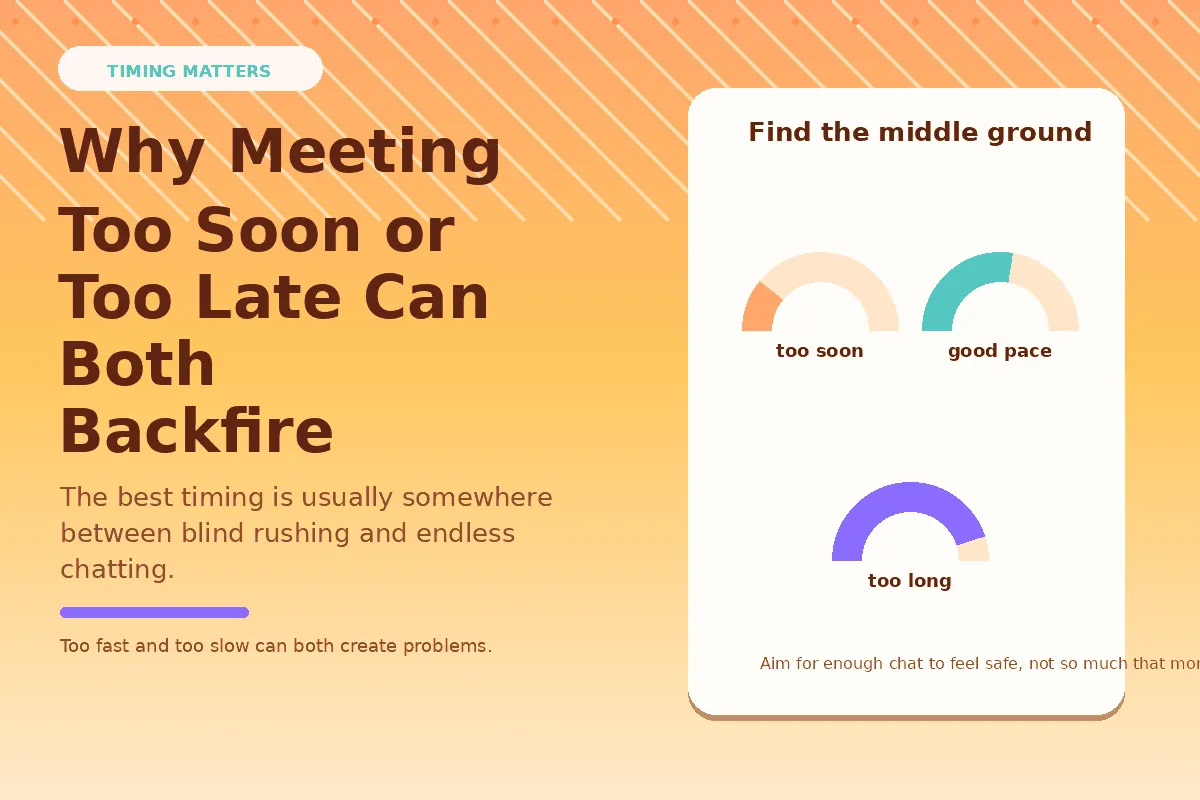
Meeting too soon can create avoidable risk. You may not know enough about the person, the conversation may still be too thin, and basic trust may not be there yet. If the other person has shared very little, avoids normal questions, or seems eager to skip every trust-building step, moving straight to an in-person meeting can feel premature.
Meeting too late can create a different problem. After too much messaging, people sometimes build an imagined version of each other that real life cannot match. The conversation may also lose energy. What began as interest can fade into habit, boredom, or uncertainty. In some cases, one person starts enjoying the attention of chatting more than the actual possibility of meeting.
The healthiest middle ground is usually this: chat long enough to establish safety, mutual interest, and some consistency, but not so long that the relationship lives only inside your phone.
- Too soon can feel unsafe or under-informed.
- Too long can make the connection feel imaginary or stalled.
- The best pace usually balances comfort with momentum.
- Healthy timing should feel mutual, not forced by either side.
Signs You Are Ready to Meet in Person
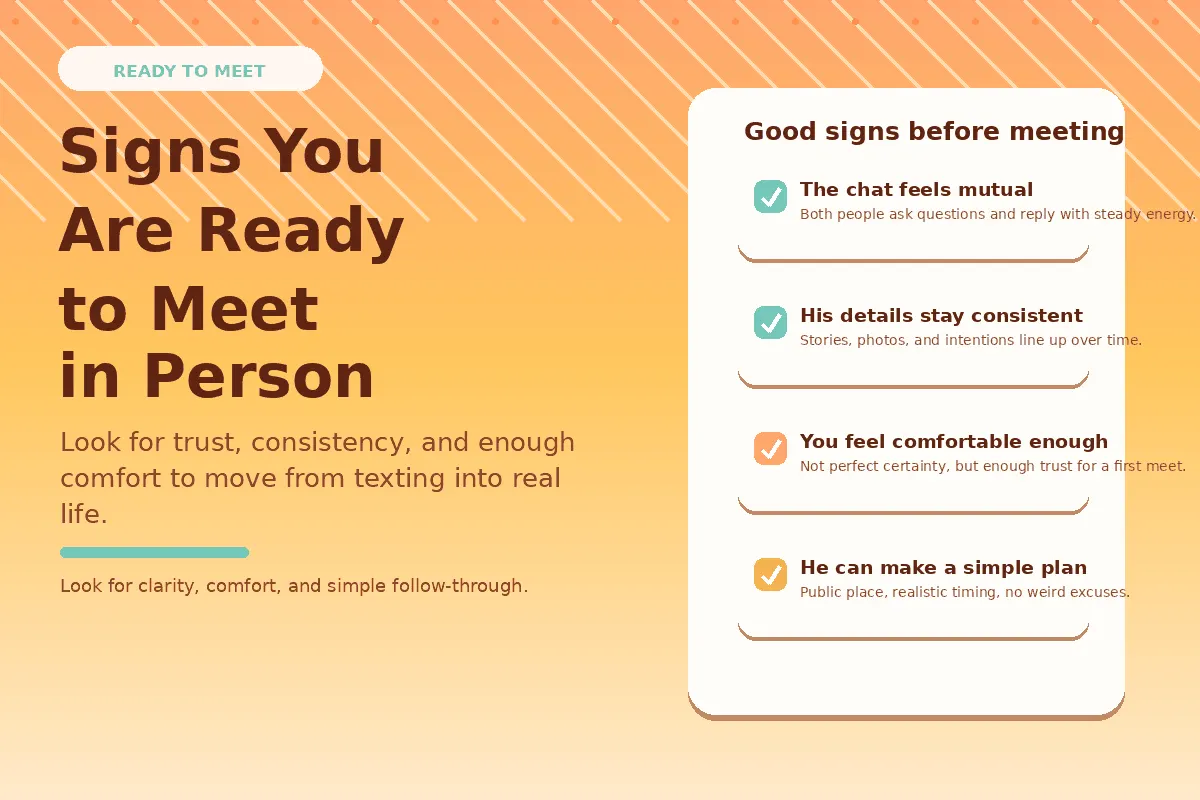
A good sign is that the conversation feels mutual. Both people ask questions, respond with reasonable effort, and show real curiosity instead of just collecting attention. Another strong sign is consistency. The person’s tone, intentions, stories, and basic details hold together over time instead of shifting in suspicious ways.
Comfort matters too. You do not need absolute certainty to meet, but you should feel basically comfortable enough to imagine a short public meetup. If the thought of meeting feels interesting rather than alarming, that often means the chat has reached a healthy next stage.
It also helps when the other person can make a simple, realistic plan. Someone who is truly ready to meet usually does not need drama. He can suggest a clear time, a public place, and a low-pressure first date without making everything strange or intense.
| Sign | What it looks like | Why it matters |
|---|---|---|
| Mutual effort | Both people ask, answer, and follow up | Shows real interest instead of passive validation |
| Consistency | Details stay stable over time | Builds trust and reduces confusion |
| Comfort | You feel cautious but reasonably okay | Helps the first meeting feel manageable |
| Simple planning | He can propose a normal public meetup | Shows realism and follow-through |
Red Flags That Mean You Should Wait Longer
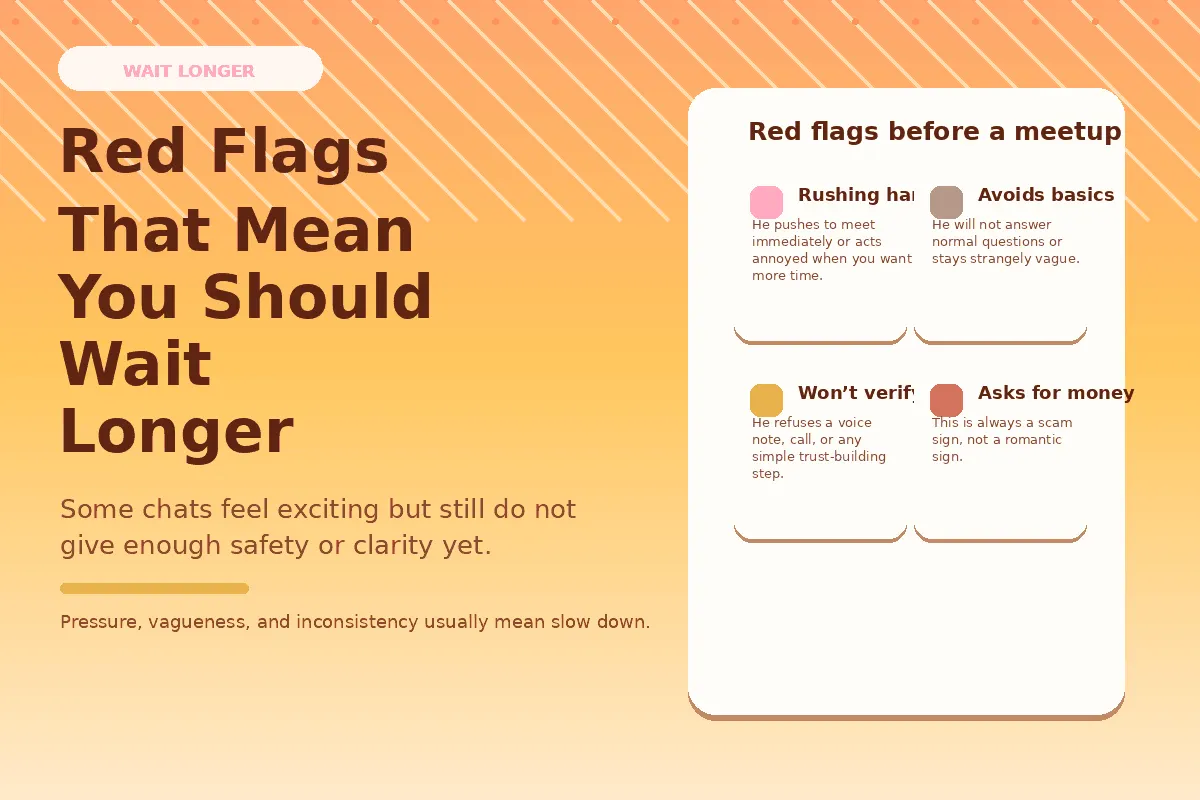
Some chats move quickly in a way that feels exciting, but excitement is not the same as trust. If someone is rushing hard, gets irritated when you want more time, or acts like hesitation is an insult, that is a sign to slow down. Healthy interest does not need coercion.
Other red flags include vagueness, contradictions, avoidance of normal questions, refusal to do any trust-building step, or conversations that turn oddly intense too fast. If someone will not do a voice note, a short call, or anything that makes the interaction feel more grounded, that can be worth noticing.
The clearest red flag is money. If someone you met online asks for money, gifts, financial help, or investment advice, stop immediately. That is not a romantic milestone. It is a scam warning. In that case, the question is no longer how long to chat before meeting in person. The question becomes how fast to exit the situation.
How to Plan a Safe First Meeting
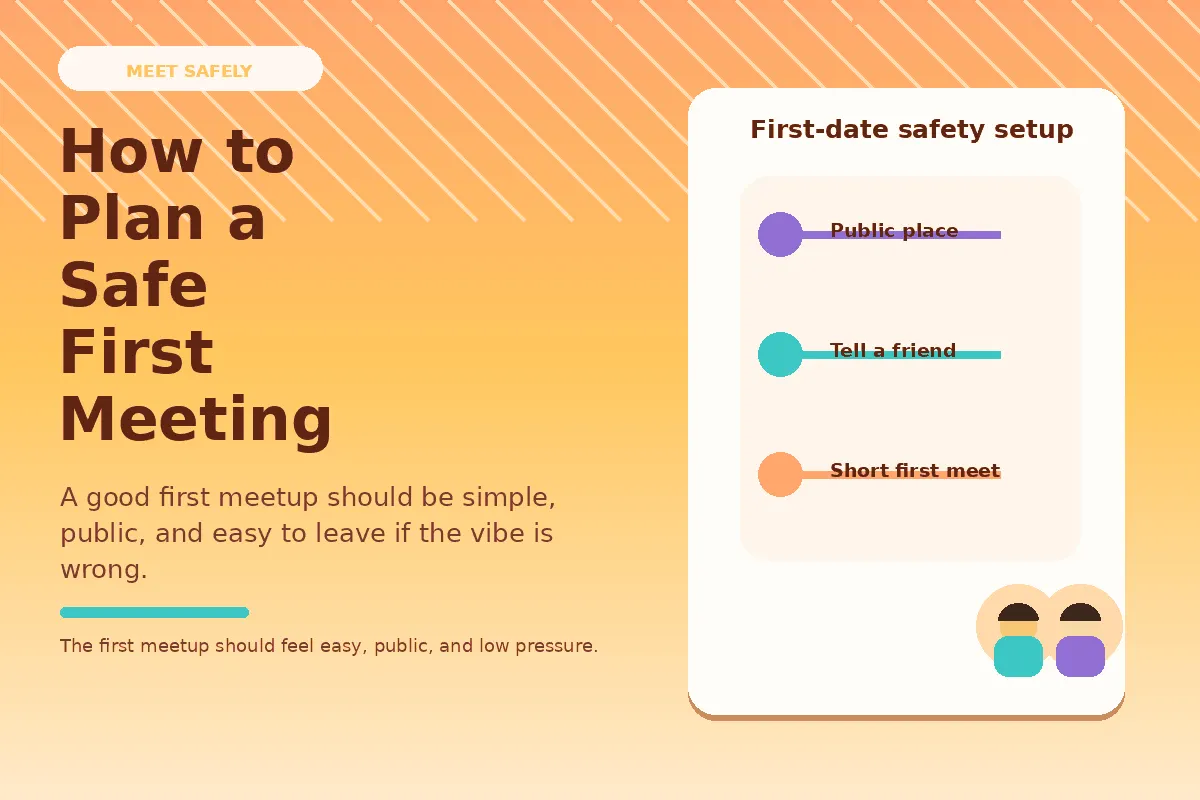
The first meeting should be simple. Choose a public place, keep the plan short, and make it easy for either person to leave if the vibe is off. A coffee, a casual drink, or another low-pressure public meetup works better than something intense or isolated. The goal is to see how the connection feels in real life, not to manufacture a major romantic event immediately.
It also helps to tell a friend where you are going, who you are meeting, and roughly when you expect to be done. That is not dramatic. It is smart. A first meeting can still feel relaxed while you protect yourself in practical ways.
Try to keep expectations realistic too. The meetup is not supposed to confirm your entire future. It is simply the next honest layer of information. You are checking whether the chat translates into real chemistry, comfort, and basic compatibility.
- Meet in public, especially the first time.
- Use your own transportation when possible.
- Tell a trusted person where you are going.
- Keep the first plan short and low pressure.
What If One Person Wants to Meet Much Sooner Than the Other?
This is common. People have different pacing, risk tolerance, and dating habits. One person may want to meet after a few good exchanges because he prefers real-life chemistry over texting. The other may need more time because safety and trust matter more heavily to him. Neither preference is automatically wrong.
The important part is how the difference gets handled. If you need more time, say so clearly. You do not need to apologize for having a pace. If the other person responds with respect, that is a positive sign. If he responds with pressure, impatience, or guilt, that tells you something useful too.
Likewise, if you prefer meeting sooner, you can say that without acting like delay means rejection. The healthiest connections can discuss pacing openly instead of turning it into a power game.
A Good First Meeting Usually Happens at the Point of Enough Trust
In practice, the best answer to how long you should chat before meeting in person is often this: long enough to feel basically safe and informed, but not so long that the connection becomes a purely digital performance. You want enough consistency to reduce obvious risk, enough ease to make the meeting feel possible, and enough momentum that the conversation still feels alive.
That usually means trusting signals more than formulas. Mutual effort, clarity, realistic planning, and respect for your pace matter more than whether it has been three days or ten. Some great dates happen quickly. Some smart people take more time. The right pace is the one that balances safety, comfort, and forward movement.
When you reach that point, meeting in person often gives you better answers than another long stretch of texting ever could.
References
- RAINN – Tips for Safer Dating: Online and In-Person – Official safety guidance on moving from online conversation to in-person dating at your own pace and with practical precautions.
- FTC – What To Know About Romance Scams – Official consumer guidance on online dating scam red flags, including pressure, inconsistency, and requests for money.