
Here’s a modern paradox: your phone can show you five hundred gay men within ten kilometers, and you still don’t have anyone to text on a random Tuesday. Learning how to make gay friends as an adult often feels harder than finding a date — apps are engineered for sparks, not for the slow, ordinary contact that friendship is actually made of. And the gap is real: surveys consistently find that a large share of LGBTQ+ people experience frequent loneliness, with many of us leaning on chosen family precisely because family-of-origin support was never guaranteed.
The good news is that friendship is not luck, chemistry, or a personality prize. It’s a process with known mechanics — and once you see them, the whole thing becomes very buildable. This guide covers where to actually meet people, the math of how friendships form, the follow-up playbook that turns acquaintances into your people, and how to do all of it with or without the bar scene.
In this article
Why It’s Harder Now (and Why That’s Not Your Fault)
- Adult life removed the machine. School and university manufactured friendship automatically: same people, every day, shared struggles. Adulthood dismantles the machine and leaves you to hand-build what used to be free.
- Queer friendship carries extra weight. For many of us, friends aren’t a bonus layer on top of family — they are family. That makes the stakes higher and the loneliness sharper when circles thin out after a move, a breakup, or friends coupling off.
- The scene isn’t one-size-fits-all. Bars remain a beloved part of gay culture, but community has spread — into sports leagues, volunteer groups, classes, game nights, and online communities that spill offline. If bars never fit you, the map is bigger than it used to be.
- Everyone else is also waiting. The stranger at the event hoping someone talks to him first? Statistically, that’s most of the room. Loneliness is common enough that being the one who initiates is less risky than it feels — you’re usually offering something the other person wanted too.
The Friendship Math: Hours Times Repetition
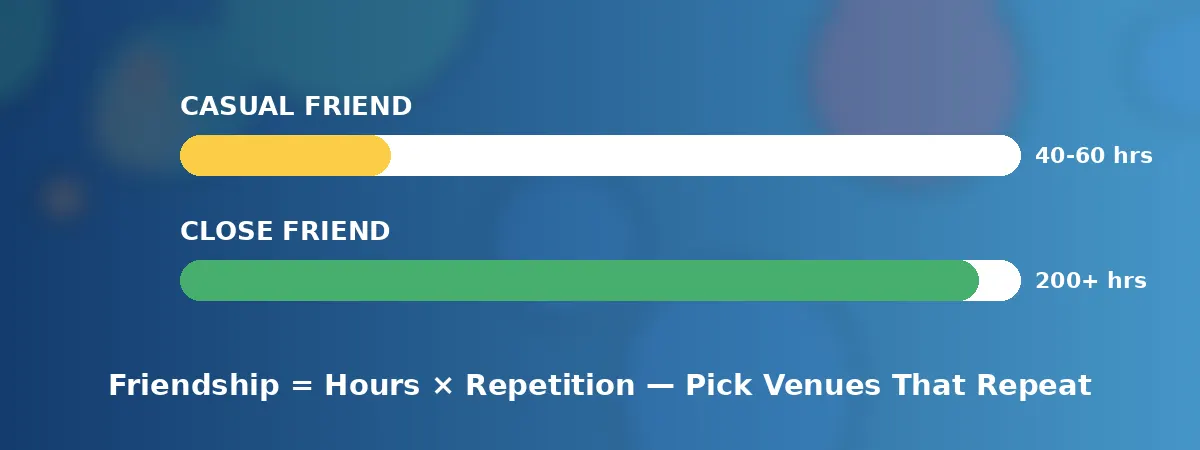
Research on friendship formation puts numbers on what we feel: it takes roughly 40–60 hours together to make a casual friend and 200+ hours for a close one. School racked those hours up invisibly; adulthood makes you schedule them. That single fact explains almost everything about strategy:
- Recurring beats one-off. A weekly badminton game generates 50+ hours a year with the same people automatically. A once-a-year Pride party generates three hours with strangers you’ll never re-find. Choose venues with built-in repetition.
- Shared activities do the talking. Doing something side by side removes the interview pressure of pure socializing — you already have something to discuss and a reason to return next week.
- Proximity plus frequency plus time. None of it requires charisma. It requires showing up to the same place, repeatedly, for months. Ordinary consistency is the actual superpower.
Where to Actually Meet Gay Friends
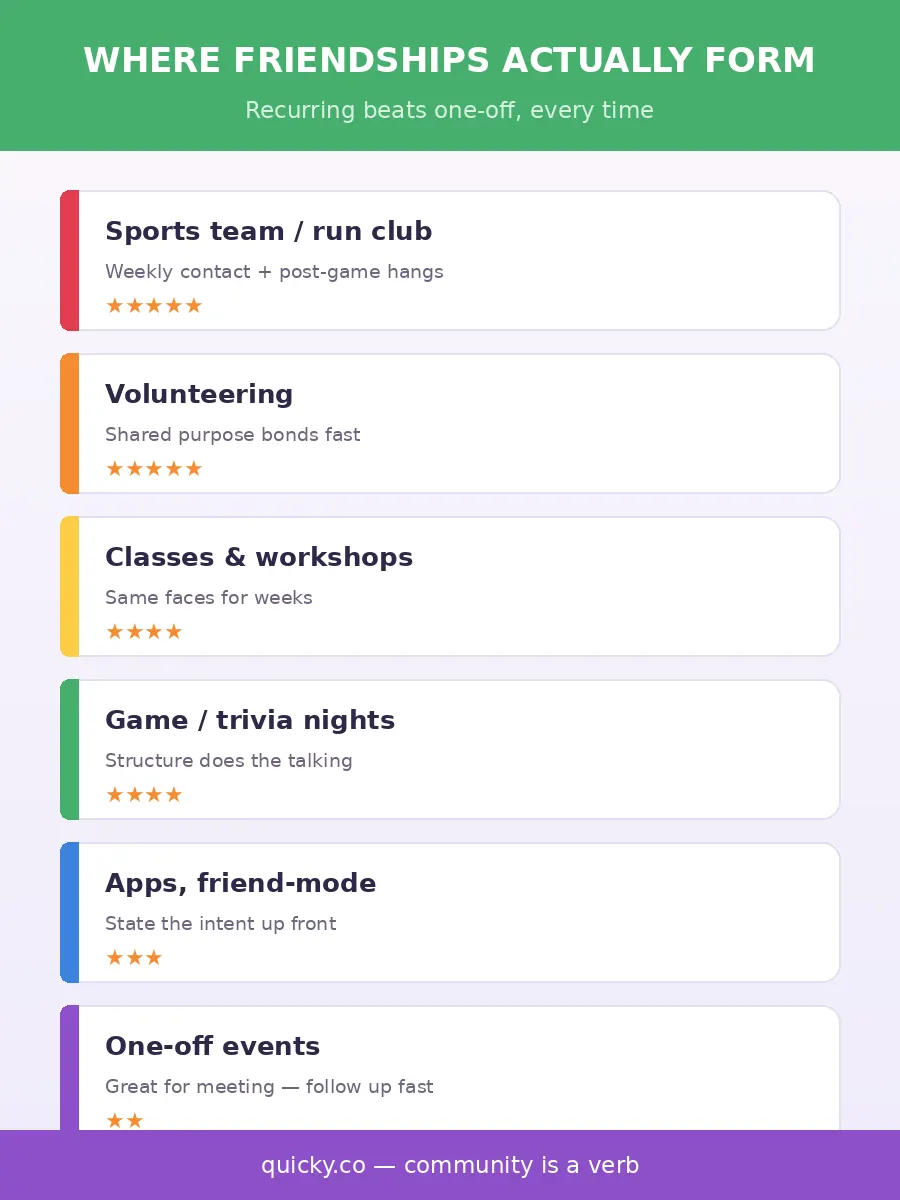
| Venue | Why It Works | Repetition Built In? | Best For |
|---|---|---|---|
| LGBTQ+ sports team / run club | Weekly contact + teamwork + post-game hangs | ✅ Weekly | Almost everyone |
| Volunteering (Pride orgs, community groups) | Shared purpose bonds fast; orgs always need hands | ✅ Ongoing | Purpose-driven people |
| Classes (cooking, language, art, Muay Thai) | Same faces for weeks; built-in conversation | ✅ Course-length | Skill collectors |
| Game / trivia nights | Structured fun, low social pressure | ✅ Weekly-ish | Introverts |
| Gym group classes | Regulars culture; easy small talk | ✅ Weekly | Routine lovers |
| Community apps (friend mode) | Directly states friendship intent | ➖ You create it | New-in-town, shy starters |
| Bars & club nights | Classic for a reason; high energy | ➖ Random crowd | Extroverts, groups |
| One-off events (Pride, festivals) | Great top of funnel — if you follow up | ❌ Annual | Meeting, not building |
The pattern in that table: ongoing groups outperform one-time events, because events give you one chance while recurring activities give you a season of chances with the same people. Use events to find people and recurring venues to build with them.
Apps count too — used with intent. Being upfront that you’re looking for friendship works better than everyone assumes: plenty of guys on gay apps are quietly hoping for exactly that, and our gay friends page covers the friend-first approach on Quicky specifically. Say it in your bio, say it in your opener, and the awkwardness evaporates.
The Follow-Up Playbook: Acquaintance → Friend

Meeting people is the easy half. The conversion step — where most friendships quietly die — is follow-up. The mechanics:
- Make clear invitations, not vibes. “We should hang out sometime” is a pleasantry; “I’m trying that new khao soi place Saturday — come with?” is an invitation. Specific plan, specific time, easy yes. Vague warmth converts at roughly zero percent.
- Take the initiator role on purpose. Someone has to text first, and the person who does gets the social life. Expect to initiate 70% of the time early on — that’s not imbalance, that’s how new friendships bootstrap before reciprocity kicks in.
- Follow up within 48 hours. Met someone great at an event? The connection has a half-life. A simple “great meeting you — you free for coffee this week?” while the memory is warm beats a perfect message three weeks later.
- Layer the contexts. Friendship deepens when you see someone outside the original setting. Gym buddy → coffee. Teammate → movie night. Class friend → market wander. Each new context roughly doubles the closeness.
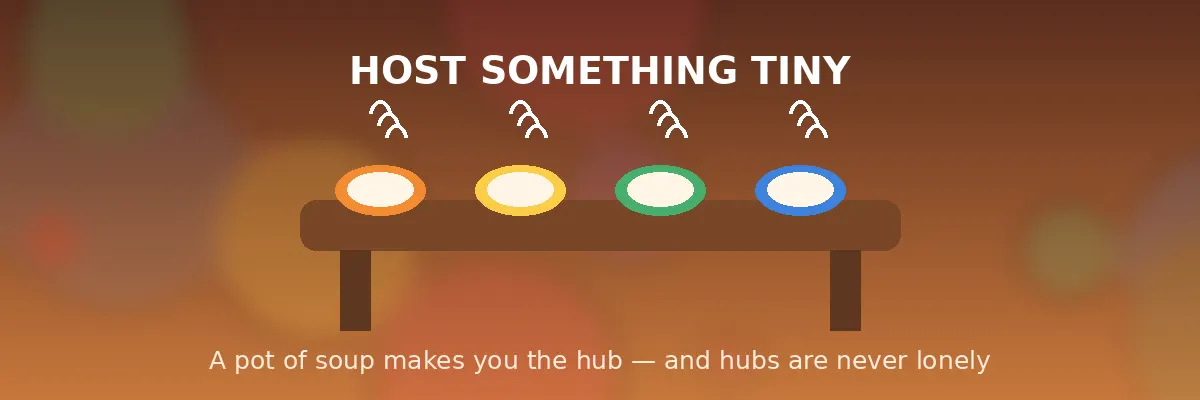
- Host something tiny. Hospitality is the ancient friendship technology and it doesn’t need to be fancy — a pot of soup, a games night, coffee and doughnuts on a Sunday. The person who hosts becomes the hub of a circle, and hubs are never lonely.
Beyond the Bar: Sober and Low-Key Routes
Plenty of us want queer community without building it around drinking — by preference, recovery, budget, or energy. The daytime map is rich:
- Morning culture: run clubs, hiking groups, café meetups, temple-market wanders. Friendships formed at 8am have a different (excellent) texture than ones formed at midnight.
- Hobby-first spaces: board game cafés, book clubs, photography walks, cooking classes — the activity carries the conversation, and nobody’s shouting over music.
- Volunteer shifts: community organizations run on volunteers, and working a door, a booth, or a cleanup crew alongside someone for four hours builds more rapport than four bar nights. Bonus: volunteering often gets you into paid events free.
- Online communities that meet offline: Discord servers, Facebook groups, and app communities that organize real-world meetups give introverts the warm-up lap — you arrive already knowing the group chat.
For the Introverts (a Word of Respect)
None of this requires becoming a social butterfly. Introvert-optimized friendship looks like: one recurring activity (not five), structured settings where the activity does the talking, arriving early when the room is quiet rather than late when it’s loud, one-on-one follow-ups instead of group chaos, and a smaller circle held closer. Two real friends who show up beat forty acquaintances every time — and the mechanics in this guide work at any volume you choose to run them.
Maintenance: Keeping the Friends You Make
- Put recurring hangs on the actual calendar. “First Sunday brunch” survives busy seasons; “let’s hang soon” does not. Rhythm is what turns friends into chosen family.
- Show up for the unglamorous moments. Helping someone move, hospital visits, breakup Tuesdays. Ten minutes of showing up when it’s inconvenient bonds more than ten parties. (And when a friend is going through it, our breakup guide makes a genuinely useful thing to send.)
- Celebrate loudly. Remember birthdays, hype their wins, be the friend who brags about them in front of others.
- Repair small ruptures fast. Adult friendships rarely explode; they erode over unaddressed little things. “Hey, that comment sat weird with me” said kindly within a week keeps a decade-long friendship on the road.
The 90-Day Friend Plan: A Concrete Starting Script
Theory is nice; a schedule is better. If you’re starting from near-zero — new city, post-breakup, or just a thinned-out circle — here’s ninety days of mechanics:
- Days 1–14: choose and commit. Pick exactly one recurring activity from the table above and attend twice. Set your app bio to say you’re looking for friends. Goal: two visits, zero pressure to bond yet — you’re just becoming a face people recognize.
- Days 15–30: become a regular. Keep attending weekly. Learn names, use them. Arrive ten minutes early — pre-activity small talk is where recognition turns into acquaintance. Send one follow-up message to anyone you clicked with, within 48 hours of meeting them.
- Days 31–60: make the first invitations. Convert two acquaintances to a second context: coffee after the activity, a market wander, a movie. Specific plan, specific time. If half your invitations get declined-with-warmth (“can’t Saturday, but next week?”), that’s a success rate, not rejection.
- Days 61–90: create a gathering. Host one tiny thing — games night, soup night, a group outing you organize. Invite four to six people from across your new contexts. The moment you introduce two people who didn’t know each other, you’ve stopped joining a community and started building one.
Ninety days in, you won’t have a decade-deep chosen family — that’s a years-long build — but you’ll have momentum, regulars who light up when you arrive, and a calendar with names on it. From there, the compounding does the work.
Frequently Asked Questions (FAQ)
Where can I make gay friends if I don’t drink or like bars?
Recurring daytime activities are the strongest option: LGBTQ+ sports teams and run clubs, volunteer shifts with community organizations, classes, game nights, and online communities that organize offline meetups. The key ingredient is repetition with the same people, which these provide better than nightlife does anyway.
How do I make gay friends in a new city?
Stack three moves in the first month: join one recurring activity (team, class, or club), set your app profile to state clearly that you’re new in town and looking for friends, and say yes to essentially every invitation for ninety days. New-city friendship is a numbers-and-repetition game early on — selectivity comes later, momentum comes first.
Is it weird to use dating apps to find friends?
Not at all — it’s common and increasingly normal, as long as you’re upfront. State “looking for friends” in your bio and opener so nobody’s expectations cross. Many lasting gay friendships started as app conversations where romance wasn’t the fit but the banter clearly was.
How long does it take to build a real friend group?
Expect meaningful traction in three to six months of consistent showing up, with a real circle at about a year. The research puts casual friendship at 40–60 shared hours and close friendship past 200 — a weekly activity plus regular follow-ups hits those numbers naturally. Slow is normal; slow with consistency always compounds.
Conclusion: Community Is a Verb
Making gay friends as an adult comes down to unglamorous mechanics done warmly: pick recurring venues, show up for months, make specific invitations, follow up within 48 hours, layer contexts, host small things, and maintain what you build. No charisma requirement, no bar requirement, no luck requirement — just repetition plus initiative plus time.
Start this week — not someday: pick one recurring activity from the table, put the first two sessions in your calendar tonight, and make one clear, specific invitation to someone you already sort of know. That is the entire entry fee to a completely different social life a year from now. And if you want the friend-finding to start from your phone, Quicky is free, built by the Thai LGBTQ+ community, and full of guys who’d also love someone to text on a random Tuesday — our conversation guide works just as well when the date is a friend-date.
References
- HomoCulture — How to Make Gay Friends as an Adult
- Vice — How to Make More LGBTQ Friends
- Skip the Small Talk — How to Make Gay Friends: An LGBT Friendship Guide