
On January 23, 2025, district offices across Thailand opened their doors to history: more than 1,750 couples registered their marriages on the very first day that the Marriage Equality Act came into force. With that, Thailand became the first country in Southeast Asia — and one of only a few in Asia — where two people of any gender can legally marry, with every right and responsibility that has always come with the word “spouse.”
More than a year on, the machinery is running smoothly: Thai couples, Thai-foreign couples, and even two foreigners can all register a legally recognized marriage here. This guide covers everything practical — who’s eligible, the exact documents, the district-office process step by step, what your new legal rights actually include, and yes, the fun part: planning the celebration. Whether you’re engaged, dreaming, or reading this next to someone who doesn’t know you’re about to propose — congratulations on living in this timeline.
In this article
What the Law Actually Changed
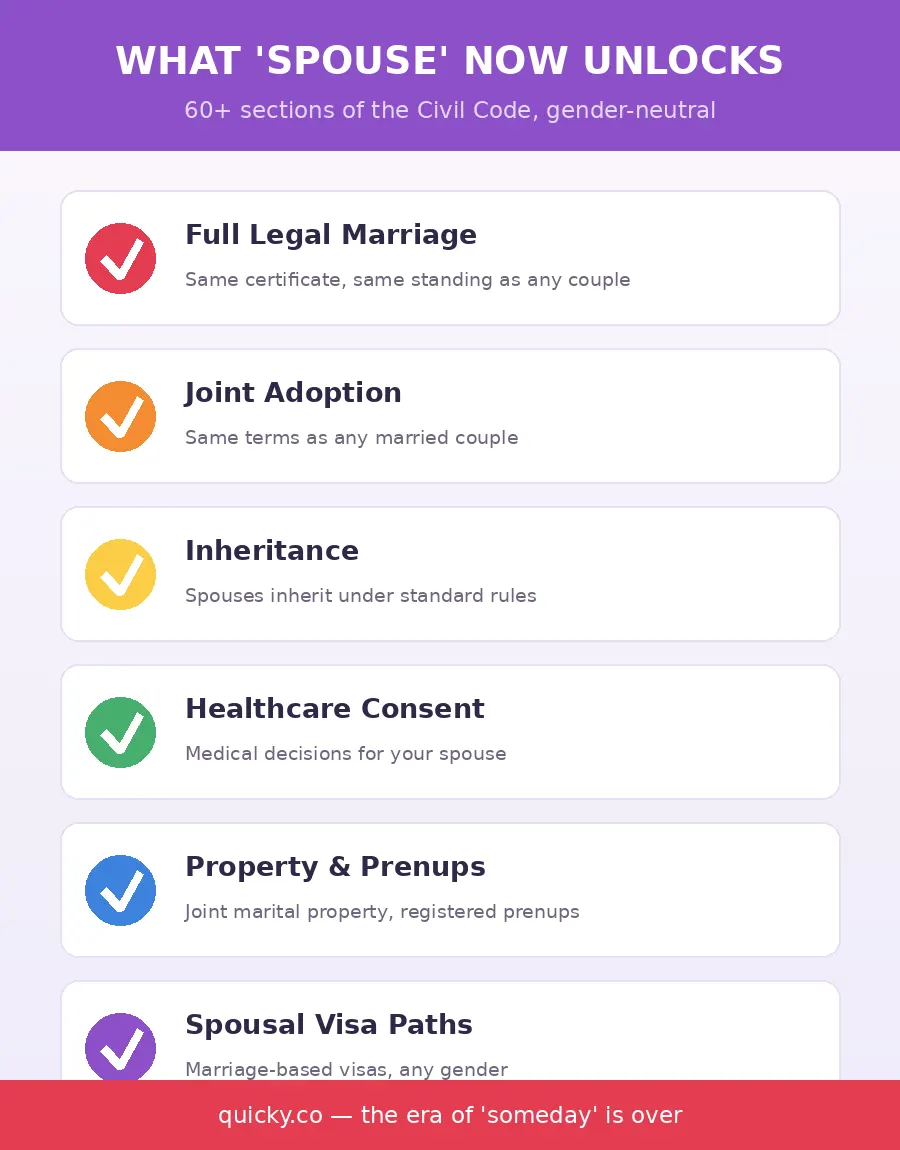
The Marriage Equality Act didn’t create a separate “civil partnership” track — it amended more than 60 sections of Thailand’s Civil and Commercial Code so that marriage itself is defined between two individuals, with gender-neutral “spouse” language throughout. That single redefinition unlocked the full set:
- Full legal marriage — the same institution, certificate, and standing as any other married couple in Thailand.
- Adoption rights — same-sex spouses can jointly adopt children on the same terms as any couple.
- Inheritance — spouses inherit from each other under the same rules that have always applied.
- Healthcare consent — the right to make medical decisions for an incapacitated spouse, ending one of the cruelest gaps of the pre-equality era.
- Property and finances — joint management of marital property and debts, plus the option of prenuptial agreements.
- Spousal visa pathways — marriage to a Thai citizen opens the same visa categories it always has, now regardless of gender.
Who Can Marry: Eligibility Basics
- Any two people — Thai + Thai, Thai + foreigner, or foreigner + foreigner. Two visitors can legally marry in Thailand even if their home countries don’t yet recognize it (more on that wrinkle below).
- Both at least 18 years old — the Act also raised the marriage age to 18; those under 20 need parental consent under standard Thai family law.
- Both legally single — not currently married to anyone else, anywhere.
- Not close blood relatives and legally competent to consent.
The Process for Thai Couples: Refreshingly Simple
If you’re both Thai citizens, the state made this beautifully anticlimactic:
- 1. Bring your ID cards (and a prenuptial agreement if you’ve made one) to any district office — Amphur upcountry, Khet in Bangkok. Any district works; you don’t need to register where you live.
- 2. Both partners appear together with two witnesses, who also bring ID.
- 3. The registrar reviews, you sign, and you’re married. You walk out with official marriage certificates the same day. Many couples do the paperwork in the morning and the party at night.
The Process for Foreign and Mixed Couples
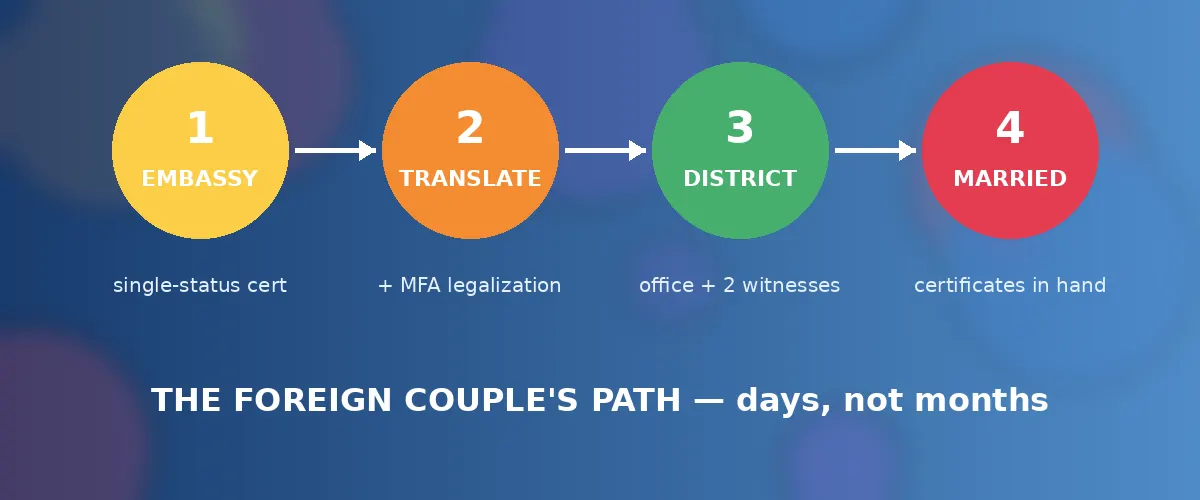
Foreigners can absolutely marry in Thailand — the sequence just has two extra preparation steps before the district office:
- Step 1 — Certificate of no impediment. Each foreign partner obtains a certificate from their own embassy in Thailand confirming they’re single and free to marry (names vary: “certificate of no impediment,” “affirmation of freedom to marry,” “single status certificate”). Book the embassy appointment early — this is usually the slowest step, and requirements vary by nationality.
- Step 2 — Translation and legalization. The embassy document gets translated into Thai and certified by the Department of Consular Affairs at the Ministry of Foreign Affairs. Translation agencies around the MFA handle both steps routinely; allow a few working days (express service exists).
- Step 3 — The district office. Same as everyone: both partners present with passports, the legalized documents, two witnesses with ID, prenup if any. The registrar reviews and registers the marriage.
- Step 4 — Certificates in hand. You receive official Thai marriage certificates. If you’ll use the marriage abroad — for visas, name changes, or recognition at home — get certified translations of the certificate while you’re at it.
| Couple Type | Key Documents | Extra Steps Before Registration |
|---|---|---|
| Thai + Thai | ID cards (+ prenup if any) | None — walk in with witnesses |
| Thai + Foreigner | Thai ID; foreign partner’s passport + embassy certificate | Embassy certificate → translation → MFA legalization |
| Foreigner + Foreigner | Both passports + both embassy certificates | Both partners complete the embassy/MFA chain |
Honest planning note for international couples: budget one to three weeks in Thailand for the full document chain if doing it yourselves — embassy appointment availability is the variable nobody controls, so book that slot before you book flights — or engage a local family-law firm to compress it — a popular option for destination weddings where the couple lands, signs, and celebrates within days.
One Wrinkle Worth Knowing: Recognition Back Home
Thailand will marry you regardless of your nationality — but whether your home country recognizes the marriage depends entirely on its own laws. Couples from countries with marriage equality generally have straightforward recognition; couples from countries without it hold a marriage that’s fully valid in Thailand (and typically in other equality countries) even if it’s not recognized at home. For anything consequential — immigration, inheritance, taxes across borders — a consultation with a lawyer who knows both jurisdictions is money well spent.
The Celebration: Where Paperwork Meets Party

The registration takes twenty minutes; the celebration is yours to design — and Thailand hands you extraordinary raw material: a wedding industry famous worldwide, venues from beach clubs to century-old teak houses, and a culture that genuinely loves a party. A few directions couples are taking it:
- Thai ceremony traditions are open to you. Many couples weave in beloved elements: the water-pouring blessing (rod nam sang), white thread ceremonies, flower garlands, a morning alms-giving for an auspicious start. Local wedding planners are increasingly experienced with same-sex ceremonies, know which elders and celebrants are enthusiastic officiants, and handle the cultural choreography beautifully.
- The destination menu is absurd. Beach vows in Phuket or Samui, a lantern-lit garden in Chiang Mai, a riverside hotel in Bangkok with the skyline as backdrop. (Our gay Thailand travel guide doubles as a venue-scouting map, and the date ideas guide covers the honeymoon.)
- Timing tips: November–February for weather, Yi Peng season for lantern magic, Pride month for maximum community energy — and book popular venues six months out for high season.
- Budget reality check: Thailand’s wedding industry delivers spectacular value — a full celebration here often costs a fraction of the equivalent in Europe, Australia, or the US, which is exactly why the destination-wedding boom followed the law.
The Visa Question: Building a Life Together
For Thai-foreign couples, the wedding certificate is also an immigration document. Marriage to a Thai citizen opens the marriage-visa pathway — the long-stay category that lets a foreign spouse live in Thailand year-round with annual renewals, and after enough qualifying years, potentially pursue permanent residency. The practical notes couples learn quickly: the visa has financial requirements (maintained funds in a Thai bank or provable income), renewals involve genuine-relationship documentation, and starting the process soon after registration keeps your legal status and your marital status in sync. For two foreigners marrying here, the certificate doesn’t itself grant Thai residency — but it’s fully valid for spousal immigration processes in third countries that recognize the marriage, which is precisely why many couples from non-recognition countries choose Thailand for the legal act itself.
How We Got Here: A Short History Worth Telling at the Wedding
The law didn’t arrive from nowhere. Thai activists, couples, and allied lawmakers spent more than a decade pushing drafts through parliaments, courts, and public campaigns — civil partnership bills that stalled, constitutional petitions, Pride marches that grew from hundreds to hundreds of thousands. When the Marriage Equality Act finally passed in 2024 with overwhelming votes in both houses and took effect on January 23, 2025, the first-day queue of 1,750 couples included partners who had waited twenty and thirty years for a piece of paper their relationships had earned long before. That history is worth a toast: every couple who registers now stands on that work, and every registration normalizes the next one — in Thailand and across a region watching closely. Taiwan came first in Asia, Nepal followed, Thailand made it three; the neighborhood map is still mostly unfinished, which makes every Thai wedding quietly part of something bigger.

Practical Wisdom Before You Sign
- Consider a prenup like any modern couple. Especially with international assets or businesses — it must be registered at the time of marriage, not after, so decide beforehand.
- Do the paperwork before the party. A common and sensible pattern: legal registration quietly first, celebration whenever and wherever you want. The certificate doesn’t care about the sequence, but venues and guests book better with flexibility.
- Keep multiple certified copies of everything. Immigration offices, banks, and foreign bureaucracies all want originals-or-certified — copies cost little at registration time and save headaches for years.
- Marriage changes your legal defaults. Inheritance, property, healthcare consent — the law now assumes your spouse first. If you have wills, insurance beneficiaries, or old paperwork naming others, update them to match your new reality.
Frequently Asked Questions (FAQ)
Can two foreigners get a same-sex marriage in Thailand?
Yes. The law applies to any two individuals regardless of nationality — two visitors can legally marry in Thailand even if their home country doesn’t permit same-sex marriage. Each needs a valid passport and a certificate of single status from their embassy, translated and legalized through the Thai Ministry of Foreign Affairs, then registered at any district office with two witnesses.
How long does it take to get married in Thailand as a foreigner?
The registration itself takes under an hour. The document chain before it — embassy appointment, translation, MFA legalization — typically takes several days to two weeks depending on your embassy’s speed and whether you use express services. Thai citizens with ID cards can register same-day with no preparation at all.
Do same-sex married couples get the same rights as other couples in Thailand?
Yes — that’s the entire design of the Act. It amended the Civil and Commercial Code itself rather than creating a separate institution, so adoption, inheritance, healthcare consent, marital property, prenuptial agreements, and spousal visa pathways all apply identically, with gender-neutral “spouse” language throughout.
Will my Thai same-sex marriage be recognized in my home country?
It depends on your country’s laws, not Thailand’s. Countries with marriage equality generally recognize it like any foreign marriage; countries without it typically won’t, though the marriage remains fully valid in Thailand and usually in other equality jurisdictions. For immigration or inheritance stakes, consult a lawyer familiar with both legal systems before relying on recognition.
Conclusion: The Era of “Someday” Is Over
For generations, couples like us planned lives around workarounds — powers of attorney standing in for marriage, “roommate” on the lease, hospital visits at a nurse’s discretion. Thailand ended that era with a stroke of legislation and a queue of 1,750 couples proving the demand was always there. The process is real, the rights are real, and the district office is open Monday morning.
If you’ve found your person — whether across town or across an ocean (our long-distance guide covers closing that gap) — the path from here to “spouse” is shorter than it’s ever been in this region’s history. And if you’re still looking for him? Quicky is free, built by the Thai LGBTQ+ community — and somewhere out there is a guy whose district-office paperwork has your name on it.
References
- Nation Thailand — Legalisation of Same-Sex Marriage Comes Into Force: Registration Requirements
- PS Law and Business — Same-Sex Marriage Is Legal in Thailand: What Foreigners Need to Know
- Siam Legal International — Marriage Registration in Thailand