
He lives in Bangkok; you’re in Chiang Mai. Or he’s in London and you’re in Thailand, counting time zones on your fingers before every call. Long-distance relationships happen to gay couples constantly — we move cities for work and acceptance, we meet incredible people while traveling, and dating apps connect us across borders as easily as across the street. The question isn’t whether a gay long-distance relationship can work. Plenty do. The question is what separates the couples who thrive from the couples who fade.
The answer, according to relationship therapists who specialize in gay couples, is not romance, willpower, or luck. It’s structure: deliberate communication rhythms, honest agreements, a visit strategy, and — crucially — a shared plan to eventually close the distance. This guide covers all of it.
In this article
Can Gay Long-Distance Relationships Actually Work?
Yes — with one honest caveat. Therapists who work with gay couples describe successful relationships as resting on three C’s: commitment, communication, and compromise. Distance doesn’t change that formula; it amplifies it. Every weakness a couple has gets magnified by a few hundred kilometers, and every strength does too.
The caveat: relationship coaches broadly agree that an LDR works as a season, not a permanent state. At some point, you have to actually be together — sharing space, chores, bad moods, and Tuesday nights — to know whether you’re compatible in real life and not just on video calls. A long-distance relationship without any plan to eventually be in the same city isn’t quite a relationship yet; it’s a beautiful correspondence. That doesn’t diminish it — but naming it honestly is the first act of the structure this guide is about.
So the master framework looks like this:
- Make the present sustainable — rhythms and rituals that keep you genuinely connected week to week.
- Make the terms explicit — clear agreements about exclusivity, expectations, and boundaries.
- Make the future concrete — a real, dated intention to close the distance.
Communication: Rhythm Beats Volume

The most common LDR mistake is confusing quantity with quality — messaging constantly all day, every day, until conversation becomes wallpaper. The couples who last do something different: they build a rhythm.
- Share the boring stuff. Counterintuitively, this is the big one. Don’t curate your life into highlights — ask him what to have for dinner, complain about the gym, narrate the small stuff. Everyday texture is how people fall in love and how they keep knowing each other. A relationship fed only on scheduled deep talks starves.
- Protect a daily touchpoint. It doesn’t need to be long — a good-morning voice note, a fifteen-minute call before bed. What matters is that it’s prioritized: your plans with him come first, even when the plan is just a phone call.
- Schedule one real date per week. A synced movie night with a watch-together app, cooking the same recipe on video, an online game session, a virtual gallery tour. Dates need a start time and your full attention — phone down, laptop closed, present.
- Respect time zones like a shared calendar. If you’re seven hours apart, alternate who takes the awkward slot. One person always sacrificing their sleep breeds quiet resentment fast.
- Say the hard things early. Feeling distant, drained, or anxious about the arrangement is inevitable — the mistake is hiding it until it curdles. Naming it early turns “this isn’t working” into “let’s make an adjustment,” which is a conversation couples survive.
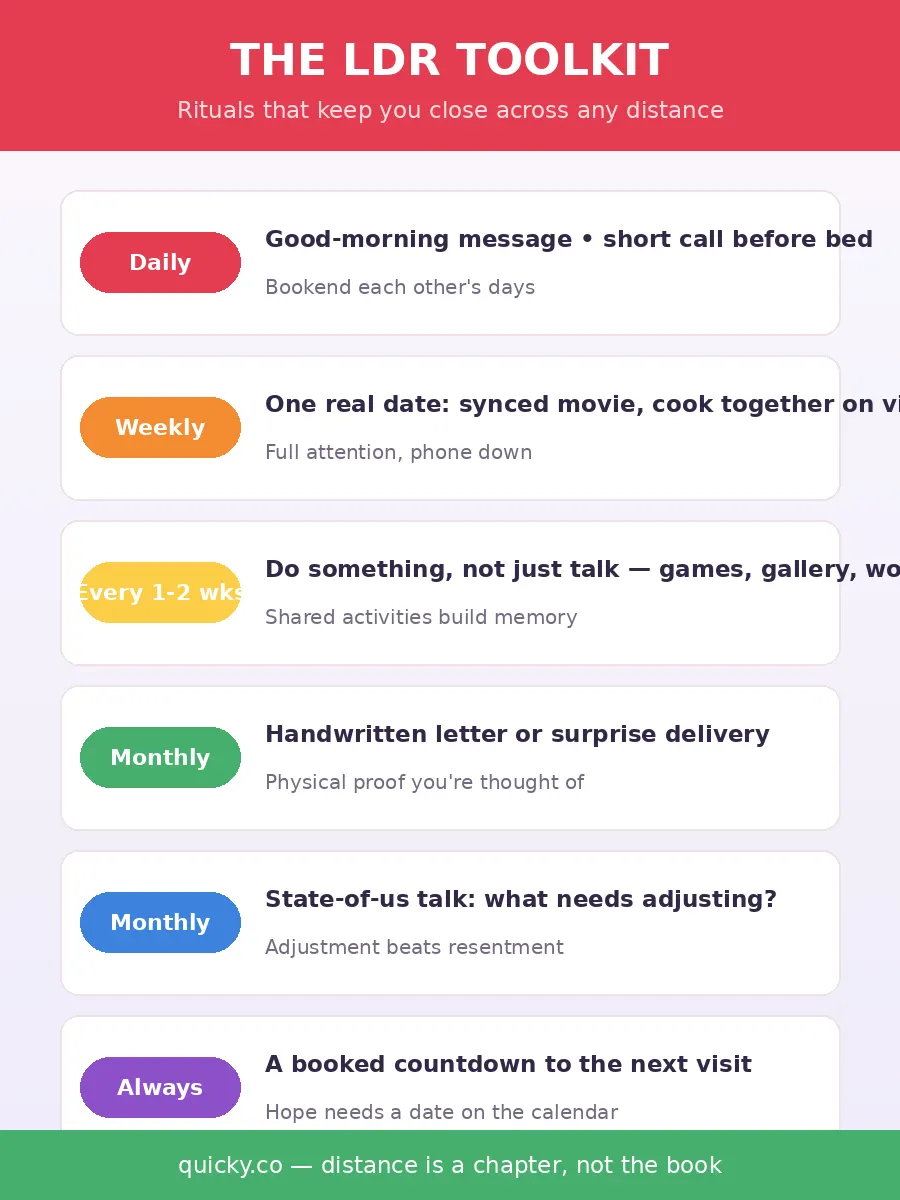
The LDR Toolkit: Rituals That Keep You Close
| Ritual / Tool | What It’s For | Suggested Frequency |
|---|---|---|
| Good-morning / good-night message | Bookending each other’s days | Daily |
| Short voice or video call | Hearing tone, not just text | Daily or near-daily |
| Synced movie / series night | Shared experiences, shared jokes | Weekly |
| Cook-the-same-dish video date | Doing, not just talking | Every 1–2 weeks |
| Handwritten letter or surprise delivery | Physical proof you’re thought of | Monthly |
| State-of-us conversation | Adjusting what isn’t working | Monthly |
| Countdown to the next visit | Something concrete to look forward to | Always active |
The last row is non-negotiable wisdom from every LDR veteran: never say goodbye without the next visit booked. Lonely stretches are bearable when there’s a date on the calendar; open-ended separation is what erodes couples.
The Conversation You Can’t Skip: Defining the Terms

Here’s where gay LDRs genuinely differ from the generic advice articles: our community talks about relationship structure more openly, and that’s an advantage — if you use it. Surveys of gay men consistently find that a significant share of couples negotiate some form of consensual non-monogamy, while many others are firmly monogamous. Neither model predicts success. What predicts success is that both partners are operating under the same agreement.
Before the distance starts — or right now, if you skipped it — sit down and answer together:
- Are we exclusive? Fully monogamous, open with rules, or something else entirely? Vague answers create anxiety that gnaws at the relationship’s foundations; explicit answers, whatever they are, create calm.
- If open — what are the rules? What’s okay, what isn’t, what gets shared, what stays private. Agreements only work when they’re specific.
- What does “checking in” look like? Daily contact expectations, response-time expectations, what to do when one of you goes quiet during a busy week.
- What would break us? Uncomfortable but clarifying. Knowing each other’s true dealbreakers beats discovering them mid-crisis.
Revisit the agreement whenever circumstances change — a new job, a new city, a longer separation than planned. An agreement made for a three-month gap may not fit a two-year one.
Trust and Jealousy: Managing the Distance in Your Head
Distance gives imagination too much room. He posts a photo from a night out, takes three hours to reply, and your brain writes a novel. Every LDR deals with this; the healthy ones deal with it deliberately:
- Name jealousy as information, not accusation. “I felt anxious when I saw that story and I want to talk about it” is workable. Silent monitoring and pointed comments are not.
- Don’t police, and don’t invite policing. Location-sharing demands, password exchanges, and check-photo requests treat surveillance as intimacy. Trust that requires monitoring isn’t trust.
- Keep building your own life. The fuller your local life — friends, hobbies, goals — the less weight each unanswered message carries. Ironically, the best thing you can do for a long-distance relationship is have a rich life outside it. If your social circle needs expanding, finding new gay friends in your own city is a relationship skill, not a betrayal of the relationship.
- Assume good faith by default. Time zones, work, and dead batteries explain 99% of delayed replies. Reserve concern for patterns, not incidents.
Visits: Engineering the Reunion (and Surviving the Goodbye)

Visits are the fuel an LDR runs on — and they have their own craft:
- Alternate the traveling. One person always flying breeds imbalance in money, energy, and unspoken scorekeeping. If incomes differ wildly, alternate effort instead: one buys flights, the other covers everything on the ground.
- Mix vacation-mode and life-mode. Early visits are naturally honeymoon-like — plan some of those spectacular dates (our Bangkok and Chiang Mai date ideas guide is a good arsenal). But deliberately include normal life too: groceries, laundry, his regular gym, a quiet work-from-home day together. You’re not just visiting each other; you’re testing the future.
- Plan the goodbye day. The last day has a gravity of its own. Keep it low-key, book the next visit before the flight, and agree on a small ritual — a last breakfast spot, a specific song for the ride to the airport. Rituals turn dread into rhythm.
- Budget honestly. Flights, visas, and time off are real costs. Build them into your finances like rent, not like surprises. If travel costs are quietly straining one partner, that’s a state-of-us conversation, not a secret.
The Endgame: Closing the Distance
Everything above keeps an LDR alive. This is what makes it going somewhere. Couples who successfully close the distance treat it as a project with a timeline, not a someday:
- Set a horizon, even a soft one. “We’ll be in the same city within two years” changes every decision — job applications, savings, apartment leases — from drifting to converging.
- Decide the where with eyes open. Who moves? The answer involves careers, families, visas, and — for international couples — the legal landscape. Thailand’s marriage equality law has made it a genuinely viable landing place for same-sex couples building a legal life together, which changes the calculus for many Thai-foreign relationships.
- Do the paperwork research early. Visas, work permits, and recognition of your marriage abroad take months to years. Whichever direction you’re moving, start the research the moment the horizon is set — bureaucracy waits for no romance.
- Rehearse before you leap. A one-month cohabitation trial — one working remotely from the other’s city — surfaces the real-life compatibility questions before anyone resigns from a job.
When It Wobbles: Adjust or End?
Every long-distance relationship hits rough patches — the question is telling a fixable dip from a fundamental mismatch. A useful sorting rule: logistics problems are adjustable; direction problems usually aren’t.
- Signs to adjust: calls feel like a chore lately, one of you is exhausted by the travel burden, the time-zone rhythm stopped working after a job change, jealousy spiked around a specific event. These are scheduling and agreement problems — exactly what the monthly state-of-us conversation exists to fix.
- Signs to end kindly: the horizon keeps moving and neither of you truly intends to relocate, one partner consistently deprioritizes contact and feels relief rather than longing, or visits reveal that in-person life together doesn’t work. Distance didn’t cause these; it revealed them.
- Have the conversation on video, not text. Serious relationship conversations deserve faces and voices. Text flattens tone exactly when tone matters most.
- Ending an LDR is not failure. A relationship that taught you how to communicate deliberately and love someone across a map gave you skills for the rest of your life. Some chapters end so better ones can start.

Frequently Asked Questions (FAQ)
How often should long-distance couples talk?
Daily touchpoints plus one real weekly date is the rhythm most therapists recommend — but the right answer is whatever both partners explicitly agree to. Consistency matters more than volume: a reliable fifteen-minute nightly call beats sporadic three-hour marathons followed by silence.
Do open relationships make gay LDRs easier or harder?
Neither, inherently. Research and clinical experience suggest relationship structure doesn’t predict success — clarity does. Monogamous and consensually non-monogamous LDRs both work when the agreement is explicit, specific, and honored, and both fail when the terms are vague or violated.
How long can a long-distance relationship last?
As long as it has a horizon. LDRs function well as a defined season — months to a few years — with a shared intention to eventually share a city. Indefinite distance with no plan tends to plateau into a correspondence rather than deepen into a partnership.
What’s the biggest mistake long-distance couples make?
Curating instead of sharing. Showing your partner only your highlight reel — and skipping the boring, grumpy, ordinary parts of life — feels loving but starves the relationship of the everyday texture that intimacy is actually made of. The second biggest: ending a visit without the next one booked.
Conclusion: Distance Is a Chapter, Not the Book
A gay long-distance relationship asks more of you than a same-city one — more deliberateness, more honesty, more logistics. But couples come out of the distance chapter with skills most couples never build: they know how to communicate on purpose, negotiate agreements out loud, and plan a future as a team. Sustain the present, define the terms, aim at a real future — that’s the entire method.
And if you’re reading this before the relationship exists — still searching for someone worth crossing distances for — start close to home. Meet people nearby on Quicky — free and built for the Thai LGBTQ+ community, put your best foot forward with our profile guide, and if the right person happens to live a flight away, meet them safely with our gay dating safety checklist — then come back to this article. You’ll be ready.
References
- Emen8 — Going the Distance: Top Tips for a Successful Long-Distance Relationship
- Gay Therapy LA (Ken Howard, LCSW) — How to Succeed in a Gay Long-Distance Relationship
- Little Gay Book — How to Make a Long Distance Relationship Work