
Let’s open with the two research findings that should frame every conversation about gay open relationships. First: they’re common — studies consistently find that roughly 40–50% of gay male couples practice some form of consensual non-monogamy, versus single-digit percentages in straight couples. Second, and more important: research finds no difference in happiness or stability between monogamous and open gay couples. The structure doesn’t predict success. What predicts success — in either model — is whether both partners genuinely chose it, defined it clearly, and keep talking about it.
That means this guide isn’t advocacy — for either side of the question. Monogamy is a complete, beautiful answer, and so is openness — what’s not an answer is drift, pressure, or ambiguity wearing either label. What follows is the honest engineering: whether opening is right for you, the structures available, the agreement framework therapists actually use, jealousy management, and the health logistics — plus the harder conversations, like what to do when you and your partner want different models.
In this article
The First Truth: This Is a Fit Question, Not a Virtue Question
- Neither model is more evolved. Open couples aren’t more honest than monogamous ones; monogamous couples aren’t more committed than open ones. Both framings are community myths, and both insult half of all happy couples.
- The real variable is congruence. Couples thrive when the structure matches what both partners authentically want — and struggle when one partner is performing a preference to keep the other. Sound familiar? It’s the same clarity principle that governs situationships: arrangements work when both people would describe them identically, out loud.
- Most conflict isn’t about sex — it’s about ambiguity. Therapists who specialize in consensual non-monogamy are emphatic on this: jealousy spirals, resentment, and blindside moments trace overwhelmingly to unclear agreements, not to the openness itself.
Should You Open? The Right and Wrong Reasons
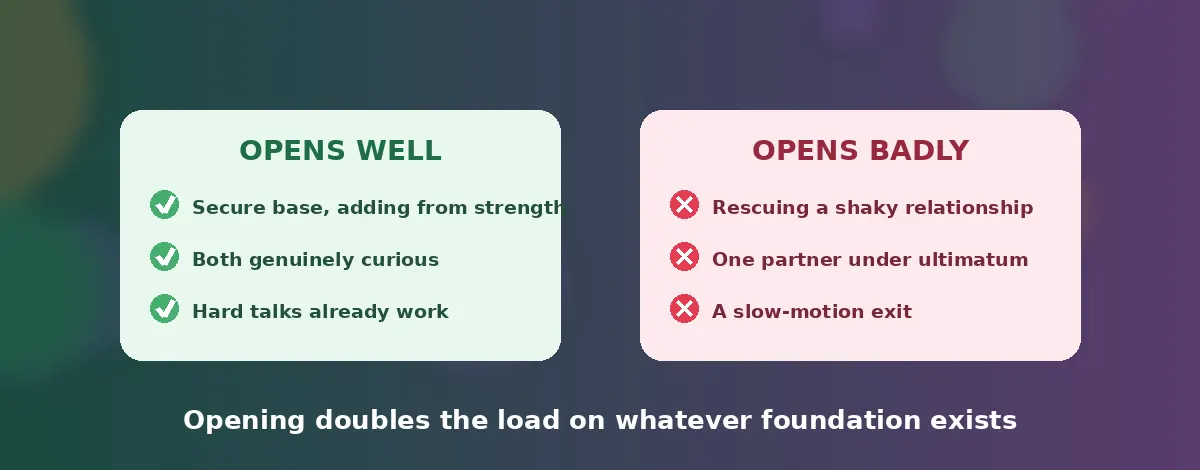
Reasons that tend to work: the relationship is secure and you’re adding from strength, not patching from weakness; both partners are genuinely curious (not one convincing the other); your communication already handles hard topics well; and you’re motivated by honesty about desire rather than avoidance of a conversation.
Reasons that tend to fail: using openness to rescue a relationship already in trouble (it amplifies existing cracks — a couple that can’t discuss dishes can’t discuss this); one partner reluctantly agreeing to avoid a breakup (that’s not consent, that’s hostage negotiation with extra steps); opening as a slow-motion exit; or skipping the internal work of jealousy by outsourcing it to rules. The therapist consensus is blunt: opening a shaky relationship doesn’t distribute the load — it doubles it.
The Spectrum: Open Isn’t One Thing
“Open” covers a wide range of structures, and couples design their own point on the spectrum:
- Together-only: outside experiences happen only as a couple. The most common starting point.
- Independent but casual: separate outside encounters allowed, but nothing recurring — no ongoing outside connections.
- Open with boundaries: recurring outside connections permitted within agreed limits (time, emotional depth, disclosure levels).
- Polyamory: full permission for additional romantic relationships, with its own extensive ethics of time, honesty, and care for everyone involved.
None of these is the destination the others lead to — couples live happily at every point, move in both directions over the years, and (importantly) close again during seasons that need it: new baby nephew levels of family stress, health challenges, or simply a chapter where you both want just each other. Treat the spectrum as a menu you order from repeatedly across a long relationship, not a ladder you must climb — the couples who struggle are usually the ones who assumed the first agreement was permanent.
The Agreement: The W5 Framework
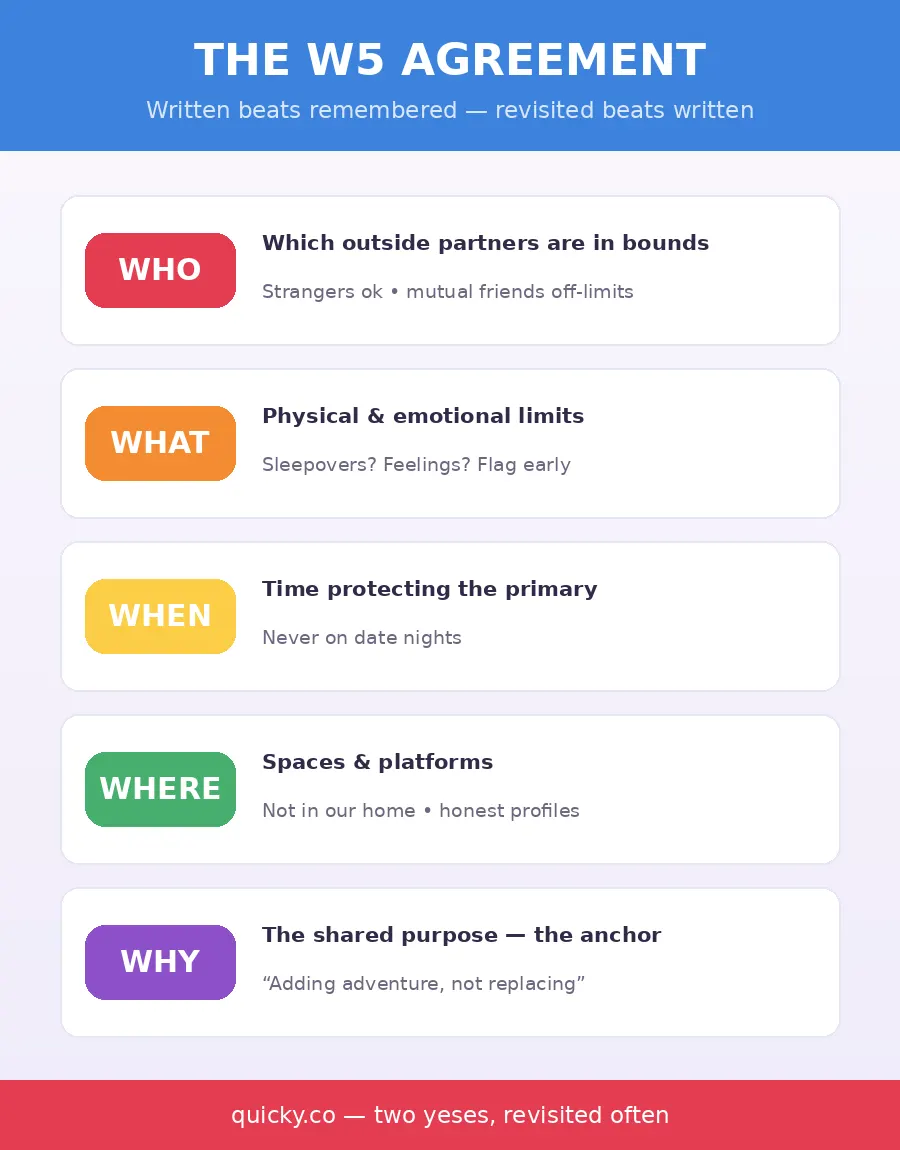
Therapists who work with open gay couples recommend building the agreement around five explicit questions — ideally written down, always revisited:
| Question | What You’re Deciding | Example Decisions |
|---|---|---|
| Who | Which outside partners are in/out of bounds | Strangers fine, mutual friends off-limits; exes: discuss first |
| What | What’s permitted physically and emotionally | Physical yes, sleepovers no; developing feelings: flag early |
| When | Time boundaries protecting the primary | Never on date nights; travel weeks have their own rules |
| Where | Spaces and platforms | Not in our home; app profiles honest about being partnered |
| Why | The shared purpose — the anchor question | “Adding adventure, not replacing anything” — said out loud |
Plus the two meta-rules that make any agreement durable: disclosure levels (full details, headlines only, or don’t-ask-don’t-tell — all workable, but pick one deliberately) and a renegotiation clause (either partner can call a review anytime, and the agreement gets a scheduled check-in — monthly at first, quarterly once stable). An agreement that can’t be revisited isn’t an agreement; it’s a trap with a signature on it.
Jealousy: Information, Not Emergency
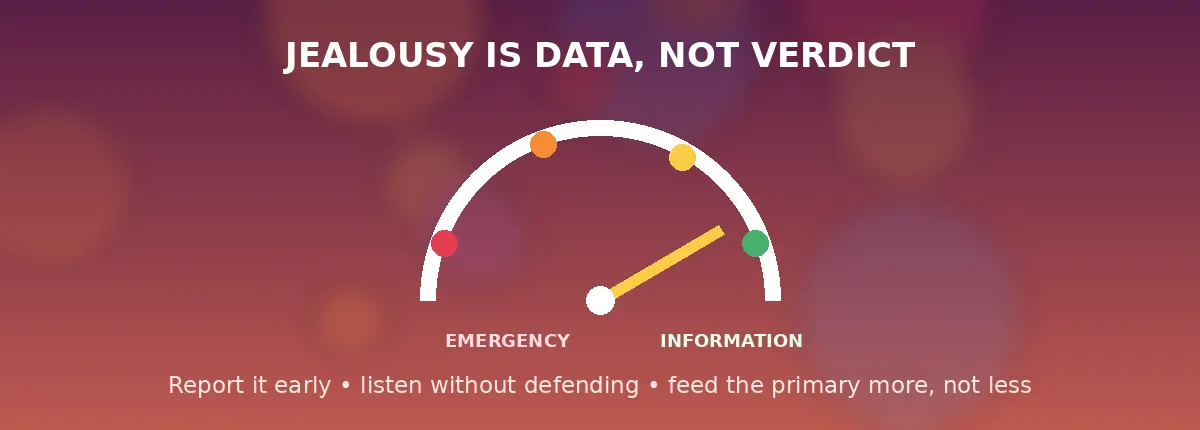
- Expect it, even if you “shouldn’t” feel it. Jealousy in non-monogamy is normal and near-universal, and it doesn’t mean the relationship is failing or that you’re not cut out for openness. It’s data about a need — usually for reassurance, time, or a boundary adjustment.
- Report it; don’t prosecute with it. “I felt insecure when you got home late Saturday — I think I need a check-in text next time” converts jealousy into an agreement improvement. Silent stewing converts it into resentment inventory.
- Listen without defending. When he brings his jealousy, resist the scoreboard (“but YOU did the same thing”). Vulnerability exchanged without judgment is what makes the whole structure safe — therapists identify this single skill as the difference between open couples who thrive and those who combust.
- Feed the primary deliberately. The counterintuitive rule veterans swear by: opening a relationship requires more attention to your partner, not less. More affection, more presence, more of the vulnerable talking. Outside novelty is cheap; primary security is the expensive resource that funds it.
The Health Layer: Non-Negotiable Logistics
Openness adds a shared health responsibility, and handling it like adults is part of the ethics — in fact, couples with explicit health agreements consistently report that the structure made them more rigorous about testing and prevention than they ever were while single:
- Safer-sex agreements are part of the W5 “what” — decided together, explicitly, before anyone’s out the door.
- Testing rhythm upgrades to quarterly, together. Two calendars, one schedule. It doubles as a natural agreement check-in.
- PrEP is the standard conversation. For couples in Thailand it’s free for eligible groups — and both partners being on the same page about prevention removes an entire category of anxiety. Our sexual health guide covers the full toolkit, from PrEP access to U=U.
- Disclosure duties run in all directions. Outside partners deserve honesty about your situation; you two deserve honesty about outside encounters’ relevant details. Health information is never in the don’t-ask-don’t-tell bucket.
When You Want Different Models: The Mismatch Conversation
The hardest version isn’t opening or staying closed — it’s when he wants one and you want the other. The ethics:
- Neither of you is wrong. A monogamy preference is not insecurity; an openness preference is not disloyalty. These are orientations toward relationship structure, and pathologizing either poisons the conversation.
- Pressure invalidates the result. An openness agreed to under ultimatum, or a monogamy promised under guilt, fails on schedule — with interest. If the answer only came after a siege, you don’t have an agreement; you have a countdown.
- Trial structures exist. Some couples test carefully — together-only experiences first, generous veto power, scheduled reviews with a genuine option to close. Workable if the reluctant partner holds real power to end the experiment without penalty.
- And sometimes it’s an incompatibility. Painful but true: structure mismatch can be a legitimate reason two good people don’t work, exactly like mismatched cities or timelines. Naming it honestly beats a decade of one partner quietly grieving inside the other’s preferred model. (Our Gay dating red flags: warning signs puts it simply: wanting different structures makes you incompatible, not toxic.)
The Opening Conversation: How to Raise It Without Breaking Anything
For many couples the scariest part isn’t the structure — it’s the first sentence. Raising the topic reads, to an unprepared partner, as “you’re not enough,” so the craft is in separating curiosity from complaint:
- Frame it as a question, not a proposal. “I’ve been curious how you think about monogamy for us — can we talk about it sometime, zero agenda?” opens a conversation. “I want to open the relationship” opens a negotiation with a winner and a loser already implied. Start with the former; you may spend several conversations there, and that’s healthy pacing.
- Lead with the security, not the desire. The first thing he needs to hear is what isn’t changing: “You’re my person; nothing about that is in question.” The topic lands entirely differently after that sentence than before it.
- Expect and honor the wobble. A surprised or hurt first reaction is normal and isn’t the final answer — give it days, not minutes. Pushing for resolution in the first conversation is how a discussable topic becomes a wound.
- No timing ambushes. Not after conflict, not during a rough patch, not when either of you has someone specific waiting in the wings — that last one converts a structural conversation into a betrayal reveal, and agreements born there rarely survive.
- Consider a professional referee. Couples therapists experienced with consensual non-monogamy turn this from a minefield into a structured process — worth it especially when the first conversations keep stalling in the same spot.
Frequently Asked Questions (FAQ)
Are open relationships more common among gay couples?
Yes — research since 2010 consistently finds that roughly 40–50% of gay male couples practice some form of consensual non-monogamy, compared with about 4–5% of heterosexual couples. Equally notable: studies find no difference in happiness or stability between open and monogamous gay couples. Structure doesn’t predict success; clarity and mutual consent do.
What rules should an open relationship have?
Build the agreement around the W5 framework: who (which outside partners are in bounds), what (physical and emotional limits), when (time protections for the primary relationship), where (spaces and platforms), and why (the shared purpose). Add explicit safer-sex agreements, a chosen disclosure level, and a standing renegotiation clause with scheduled check-ins. Written beats remembered.
How do you deal with jealousy in an open relationship?
Treat it as information rather than emergency: jealousy is normal, near-universal, and usually points at a need for reassurance, time, or a boundary adjustment. Report it early and specifically instead of stewing, listen to your partner’s without defending, and respond by feeding the primary relationship more — more presence, affection, and honest talking — not by pretending the feeling away.
Can an open relationship go back to being monogamous?
Yes, and healthy ones keep that door explicitly open — couples routinely close during demanding life seasons or simply because preferences evolved, and many re-open later or never. The renegotiation clause exists precisely for this. What doesn’t work is one partner unilaterally declaring the change; like the opening, the closing is a two-yes decision.
Conclusion: Two Yeses, Revisited Often
Strip away the debates and gay open relationships run on the same engine as every other healthy structure: two authentic yeses, specific agreements, jealousy handled as data, the primary relationship fed first, and a standing appointment to renegotiate as life moves. Monogamy built on those foundations thrives; openness built on them thrives; and either one built on drift, pressure, or silence struggles — the model was never the variable that mattered.
Whatever structure fits you, it starts with saying what you actually want — to yourself, then out loud. Quicky is free, ad-free, and built by the Thai LGBTQ+ community — where saying what you’re looking for, whatever it is, has always been the whole point.
References
- Tandem Psychology — Gay Open Relationships: Pros and Cons (Whitton et al., Parsons et al., 2019)
- Gay Therapy LA (Ken Howard, LCSW, CST) — Open Relationship Ground Rules: Who What When Where Why
- IAM Clinic — Considering Open Relationships for Gay Couples: Pros, Cons and Advice