
You text every day. You’ve met his dog. Saturday nights are assumed, his hoodie lives at your place, and last month he held your hand through your grandmother’s funeral week. But ask “so what are we?” and the air changes. You’re not his boyfriend. You’re not not his boyfriend. You are, in the defining word of this dating era, in a situationship — and if the ambiguity is quietly eating you, this guide is the exit map.
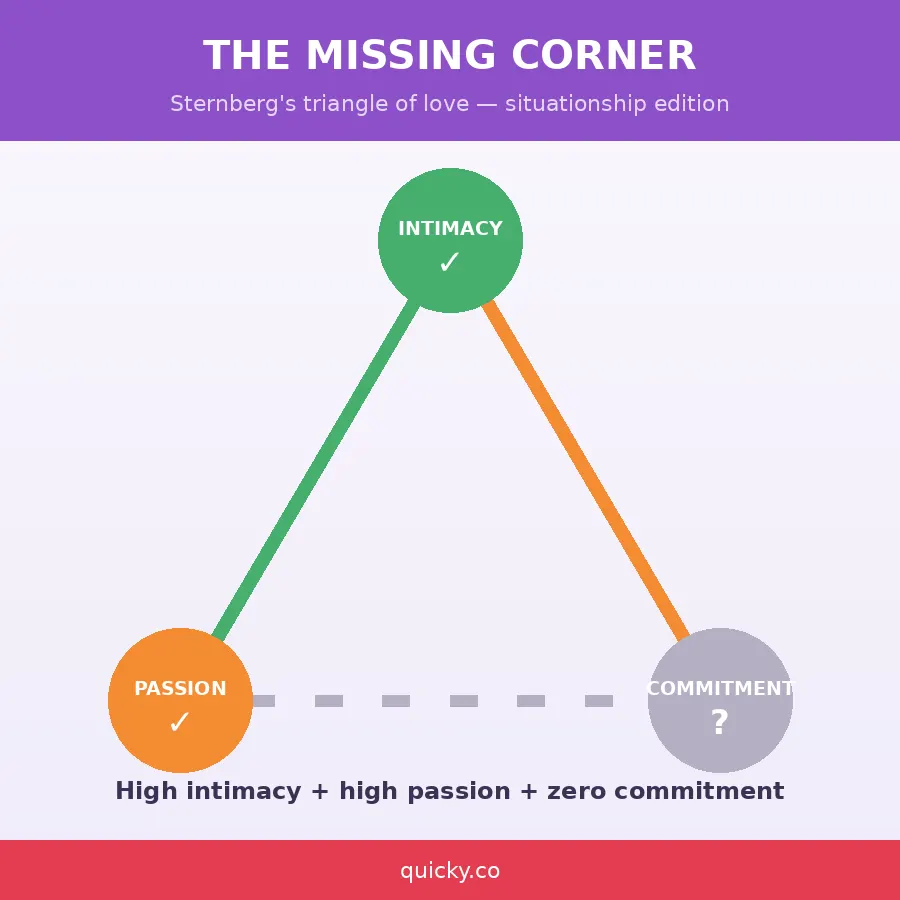
Psychologists now define the thing precisely: a romantic connection with real time, real intimacy, and real physical closeness — but no labels, no future planning, and no commitment. In the classic triangular theory of love, it’s high intimacy plus high passion with the commitment dial at zero — and it turns out that missing third corner explains almost everything about why these arrangements feel simultaneously so good and so bad.
In this article
The Signs: More Than Friends, Less Than Defined
- The label conversation is structurally avoided. “What are we?” gets deflected with humor, vagueness, or “why do we need labels?” — a question that sounds philosophical and functions as a no.
- No future tense. Plans exist inside the next week; nothing exists beyond it. Songkran trips, concerts two months out, meeting at anyone’s family table — all conspicuously unbooked.
- Consistency runs hot and cold. Intense weekends, then patchy weeks. Present when it suits, ambiguous when it doesn’t.
- Your worlds don’t merge. You haven’t met his friends (or you’re introduced with careful non-labels), and the relationship lives in a bubble — usually one apartment and one group chat of two.
- The Psychology Today tell: when you’re alone and think about him, you feel worse. Loved-and-secure produces warmth in absence; ambiguous-and-hooked produces anxiety audits. Your baseline mood about someone is the most honest instrument you own.
Why You Can’t Just Leave: The Actual Psychology
People outside situationships give the world’s least useful advice: “just end it.” Here’s why it’s harder than that, and why that’s not a personal failing:
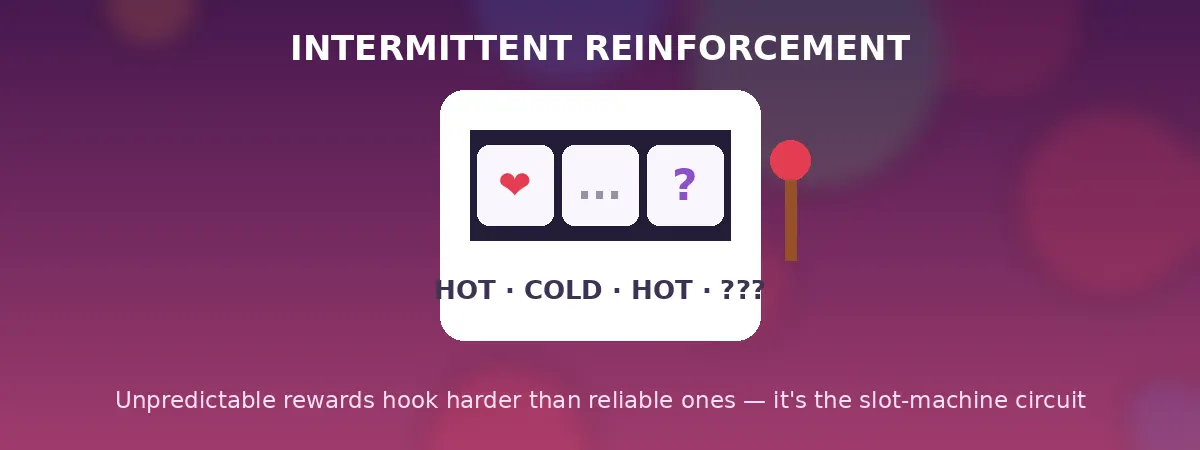
- Intermittent reinforcement — the slot-machine circuit. Neuroscience research shows unpredictable rewards trigger stronger dopamine responses than reliable ones. His inconsistency doesn’t weaken the hook; it deepens it. The anxiety of not-knowing keeps you more engaged, not less — the same mechanism that keeps gamblers at the machine.
- Grief with nowhere to land. A breakup is painful but legible: something ended, you can mourn it. A situationship never closes the file — it’s permanently half-open, so hope never fully extinguishes and grief never fully starts. You can’t get over something that refuses to officially exist.
- The anxious-avoidant tango. Research repeatedly finds these arrangements stabilized by one partner who fears abandonment (and accepts crumbs to avoid losing contact) paired with one who fears engulfment (and keeps the exits unlocked). Each triggers exactly the behavior that keeps the other stuck.
- Sunk-cost mathematics. Eight months in, walking away means “wasting” eight months — so you invest a ninth. The ledger only ever grows in one direction.
- The measurable cost: studies consistently link relationship ambiguity to elevated anxiety and emotional instability versus defined partnerships — with surveyed daters naming lack of real connection, boundary confusion, and feeling used as the top injuries. The gray zone isn’t neutral ground; it has a rent, and you’re the one paying it.
The Gay-Dating Layer: Why We Breed These
- “Chill” is a performance requirement. App culture punishes wanting things out loud — asking for definition risks the cardinal accusation of being intense. So everyone under-states their needs, and two people who might both want a relationship successfully convince each other neither does.
- The default pipeline runs backwards. Gay dating often sequences intimacy first and questions later — which builds real closeness before anyone has established what it’s for. High intimacy + high passion + unasked questions is the situationship recipe, verbatim.
- Abundance keeps the commitment dial low. A grid of alternatives in the pocket makes “why define this?” feel rational — for the partner benefiting from the ambiguity.
- The small scene adds exit friction. Ending an undefined thing with someone in your extended social orbit feels like breaking something that “wasn’t even real” — so it drifts on instead. (You will share venues afterward; our breakup guide’s small-community playbook applies here fully.)
The Honest Caveat: Sometimes It’s Genuinely Fine
Clinicians are fair on this point, and so should we be: undefined connection is legitimate when it’s mutually, honestly chosen. Two people fresh out of relationships, mid-transition between cities, or genuinely wanting low-stakes companionship can run a warm, ethical situationship for a season. The test has one question: would both of you describe the arrangement the same way, out loud, without flinching? If yes — carry on, revisit periodically, and enjoy. If one of you is performing contentment while privately hoping — that’s not a mutual arrangement; that’s one person subsidizing another’s convenience with their patience.
Situationship vs Everything Else: The Definition Table
| Friends w/ Benefits | Situationship | Relationship | |
|---|---|---|---|
| Emotional intimacy | Deliberately low | High — that’s the trap | High |
| Labels | Explicitly “just friends” | Avoided / deflected | Stated and mutual |
| Future planning | None, by design | None, by avoidance | Normal and assumed |
| Consistency | Casual, low expectation | Hot-and-cold | Reliable |
| Friends & worlds | Sometimes overlap already | Kept separate | Progressively merged |
| Both would describe it identically? | Usually yes | Usually no | Yes |
The last row is the whole diagnosis: FWB and relationships are agreements; a situationship is usually one person’s arrangement and another person’s waiting room.
While You Decide: Protecting Yourself Inside the Gray Zone
Maybe you’re not ready for the clarity conversation this week — that’s allowed. But undefined shouldn’t mean undefended. House rules for surviving the gray zone with your self-respect intact:
- Match your investment to the defined reality, not the hoped-for one. If he’s committed to nothing, he doesn’t get boyfriend-tier access to your weekends, your emotional labor, and your exclusivity by default. Calibrate what you give to what’s actually been agreed — not as punishment, but as accounting.
- Keep dating your own life. Friends, gym, hobbies, and yes — openness to meeting other people, unless exclusivity has been explicitly agreed (and if it has been agreed, congratulations: that was a definition, and you’re further along than you thought). An undefined arrangement that quietly demands defined-relationship loyalty is having its cake and eating yours.
- Set the private deadline now. Choose a date — a month out, two at most — by which you’ll either have the conversation or exit. Write it down. Ambiguity expands to fill all available patience; a deadline is the container.
- Notice what the arrangement is costing in real time. The nights decoding his response times, the plans you didn’t make in case he called, the dates you didn’t go on. The gray zone bills weekly; most people only total the invoice at the end.
The Clarity Conversation: How to Actually Ask
The way out of ambiguity is embarrassingly direct: you ask. Not as an ambush, not at 1am, not mid-argument — but you ask. The craft:
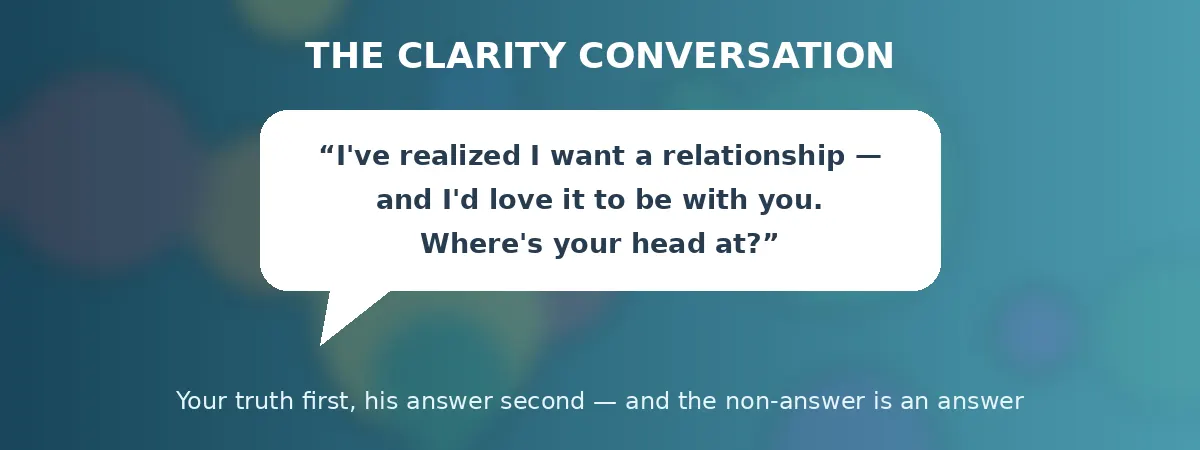
- Lead with your truth, not an interrogation. “I’ve realized I want a relationship — and I’d love it to be with you. Where’s your head at?” states your position, makes the invitation, and hands him a clean question. It’s warmer and stronger than “what are we,” which asks him to define you both while you hide your cards.
- Pick a calm, sober, private moment. A walk, a quiet dinner at home. Big questions deserve conditions where real answers are possible.
- Then let the answer be the answer. A yes with follow-through: wonderful — you were two people one conversation away. A no: painful but priceless — you just bought back your future at the cost of one evening.
- The non-answer is an answer. “I’m not ready for labels,” “let’s keep enjoying this,” “why change what works” — all translate identically: the current arrangement serves me and I’d like it to continue. After months together, “I don’t know yet” is a decision wearing indecision’s clothes.
- No prosecuting, no persuading. You cannot argue someone into wanting commitment, and a commitment extracted under pressure has the shelf life of the pressure. State, ask, listen, decide.
If the Answer Is No: The Exit With Your Dignity Attached

- Decline the downgrade package. He’ll often offer continuation at current terms — the terms were working, for him. Accepting them after hearing “no” converts you from hopeful to knowingly settling, and the ambiguity anxiety gets replaced by something worse: certainty you’re choosing crumbs.
- End it like the real thing it emotionally was. The relationship was undefined; your feelings weren’t. Grieve proportionally to what you actually invested — our breakup guide doesn’t check whether it was official.
- Expect the boomerang. Situationship partners have a documented habit of reappearing when the arrangement’s absence becomes inconvenient — usually right as you stabilize. A returning boomerang carrying the same non-commitment is not a plot twist; it’s a rerun. New terms in writing (well — out loud) or no re-entry.
- Next time, front-load the clarity. State what you’re looking for in your profile and early conversations, watch consistency over charisma (the Gay dating red flags: warning signs is the checklist), and give any new ambiguity a private deadline — two or three months of undefined is a phase; a year is a policy.
Frequently Asked Questions (FAQ)
How long should a situationship last before defining the relationship?
A useful private benchmark: by two to three months of consistent involvement, you know enough to say what you want, and so does he. Beyond that, ambiguity stops being “taking it slow” and starts being an arrangement. There’s no prize for asking late — the sunk-cost math only worsens, and the clarity conversation costs the same evening whenever you have it.
Can a situationship turn into a real relationship?
Yes — research and lived experience agree it happens when both people are ready to commit, and it almost always converts through an explicit conversation rather than silent drift. What doesn’t work: waiting for accumulated time to automatically upgrade the label, or hoping increased effort will be noticed and reciprocated. Ask the question; the ones that convert, convert out loud.
Why do I feel so anxious in my situationship?
Because ambiguity is neurologically expensive: unpredictable connection triggers stronger dopamine hooks than stable affection (intermittent reinforcement), while the undefined status denies your brain the clarity it needs to relax. Studies consistently associate relationship ambiguity with elevated anxiety versus defined partnerships. The anxiety isn’t you being dramatic — it’s the accurate output of an unstable input.
Is being in a situationship always bad?
No — when both people honestly want the same undefined, low-commitment connection and would describe it identically out loud, it’s a legitimate arrangement, especially in transitional life seasons. It turns harmful when the wanting is asymmetric: one person genuinely content, the other performing contentment while hoping. The single-question audit: could you both state the arrangement to each other’s faces without anyone flinching?
Conclusion: Clarity Is a Kindness — Start With Yourself
A situationship survives on one fuel: unasked questions. The psychology that keeps you stuck — the slot-machine inconsistency, the grief with nowhere to land, the sunk costs — all of it loses power the moment the question gets asked out loud. So audit honestly (would you both describe this the same way?), ask warmly (your truth first, his answer second), and honor whatever comes back — including the non-answer, which was always an answer. You’re not asking too much by wanting to know what you’re in. You were only ever asking too little.
And when you’re ready for connections that come with their intentions attached — Quicky is free, ad-free, and built by the Thai LGBTQ+ community. Say what you want in the first week. The right guy finds that refreshing, not intense.
References
- The Attachment Project — What Is a Situationship? Signs, Psychology, When & How to Leave
- Psychology Today — 5 Signs of Being Stuck in a Situationship
- Cleveland Clinic — Situationship: What It Is and 5 Signs You’re In One