
Let’s begin with the sentence every coming out guide should open with: you don’t owe anyone a coming out. Not your family, not your friends, not the community, not an anniversary date on a calendar. Living authentically is a gift you may choose to give yourself — on your timeline, in your way, to the people you select. Researchers who study this describe coming out not as a single dramatic moment but as a process — one you might move through gradually, pause, and even step back from, and all of that is normal.
So read this guide the way it’s written: not as pressure, but as preparation. If and when you decide the moment is right, these are the tools — how to gauge readiness, who to tell first, what to actually say, how the Thai family context changes the playbook, and how to plan for every outcome. Take what’s useful. Leave the rest. There’s no deadline.
In this article
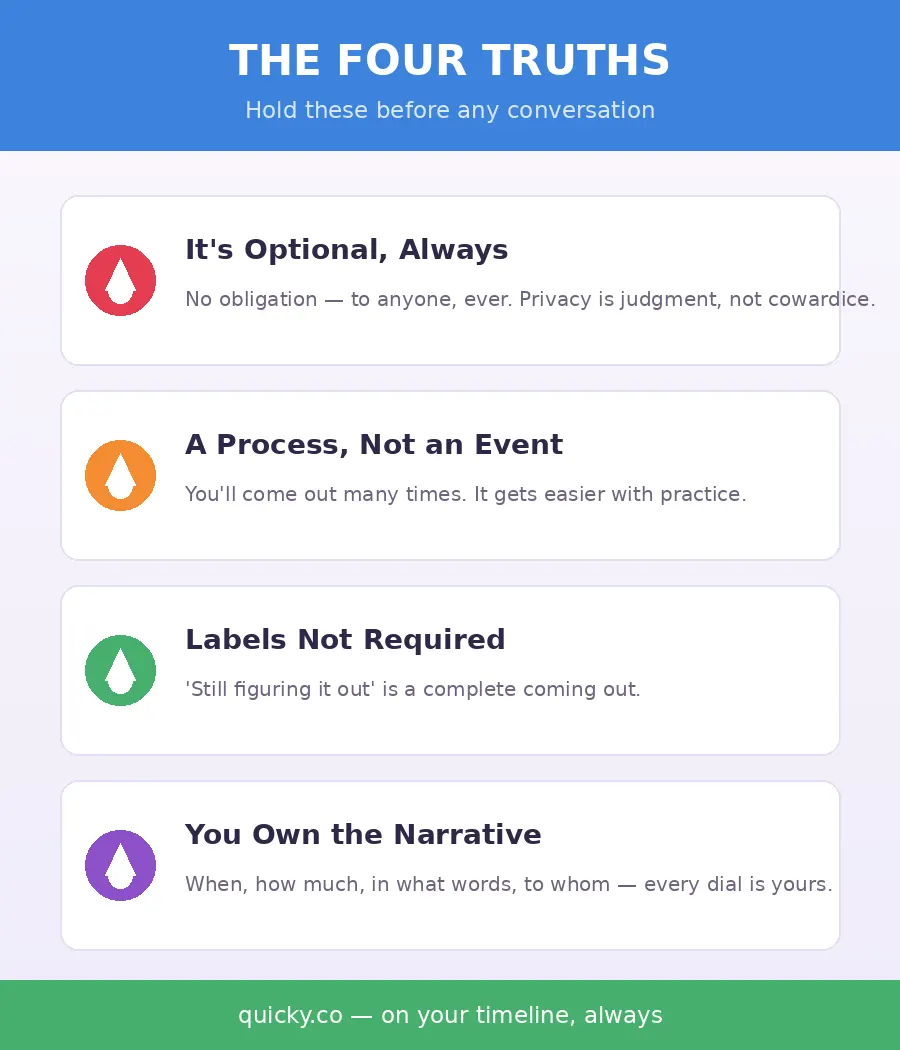
The Truths to Hold Onto First
- Coming out is optional, always. Choosing privacy in some rooms and openness in others isn’t cowardice — it’s judgment. Experts are unanimous: you have no obligation, and you don’t carry the community’s weight on your shoulders.
- It’s a process, not an event. You’ll come out many times across a life — to yourself, a friend, family, coworkers, a new dentist who asks about your “wife.” Each is a separate decision, and it genuinely gets easier with practice.
- Labels are not mandatory. You can come out while still exploring. “I’m figuring things out, and I wanted you to know” is a complete, honest coming out. Identity can evolve; certainty is not the entry fee.
- You control the narrative. When, how much, in what words, to whom — every dial belongs to you. Anyone who tries to rush, out, or script you is overstepping, full stop.
Gauging Readiness: The Honest Pre-Check
“Ready” doesn’t mean fearless — almost nobody is fearless. It means the practical foundations are in place:
- Safety first, genuinely. How do the people you’d tell talk about LGBTQ+ topics when they think no one’s checking? Their unguarded commentary is your best forecast. If your read suggests real risk — emotional, physical, or financial — waiting for a safer environment is wisdom, not weakness.
- Independence check. If you depend on someone for housing, tuition, or income, factor honestly what a bad reaction could cost, and line up contingencies before, not after. This isn’t pessimism; it’s the same planning you’d apply to any major life move.
- A support system in place. At least one person who already knows and affirms you — a friend, a community, even an online group — transforms the experience. Never let a high-stakes conversation be your first coming out.
- Your motivation is yours. The strongest comings-out are pulled by desire for authenticity, not pushed by someone else’s ultimatum or a partner’s timeline. If the pressure is external, it’s okay to slow down.
Start With Yourself
The first coming out is internal, and it deserves real care. Say the words to yourself in the mirror; write them in a journal; let them stop feeling like a confession and start feeling like a fact. As one community organization puts it beautifully: you’re not confessing to a crime — this is you at your happiest and most real. The more comfortable the words are in your own mouth, the steadier they’ll come out when it counts. If self-acceptance itself is the hard part, an LGBTQ+-affirming counselor is a wonderful companion for this stage — many of us did that work first, and it shows.
Choosing Your First Person
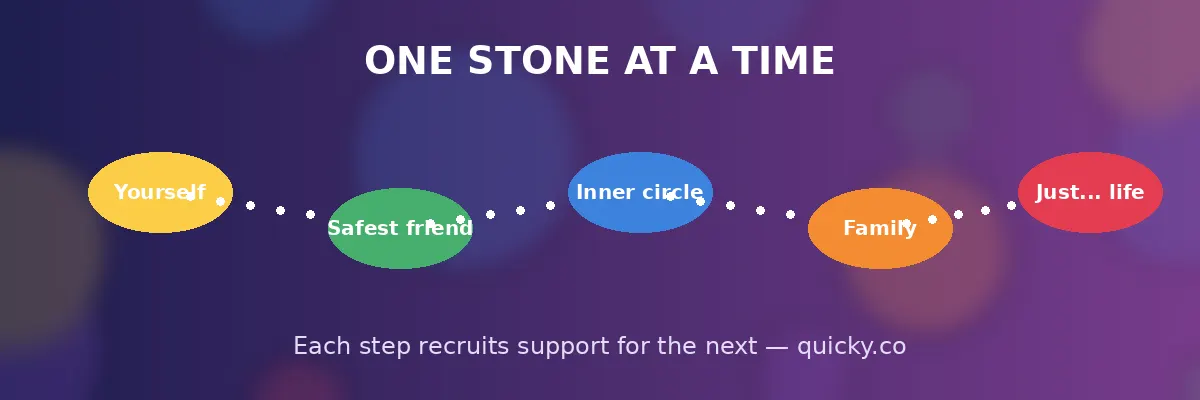
Strategy matters here more than anywhere: start with the most accepting person in your life. Not the most important — the most affirming. The friend with queer friends, the cousin with the Pride sticker, the colleague who spoke up when someone made a joke. A warm first experience builds the confidence and the ally that every later conversation draws on. Many people deliberately sequence it: safest friend → inner circle → wider circle → family → everyone else. Each success recruits support for the next step.
The Conversation Itself

There’s no required script, but preparation lowers the heart rate:
| Situation | An Approach That Works | Quiet Tip |
|---|---|---|
| First friend | “I want to tell you something because I trust you — I’m gay.” | Private, unhurried setting; let them ask questions |
| Parents / elders | Short, warm, reassuring: “I’m still me. I wanted you to know me fully.” | Expect a process, not a verdict — first reactions evolve |
| Siblings / cousins | Often the easiest bridge — and future allies with parents | A supportive sibling in the room changes family math |
| Workplace | Casual normalcy: mention your partner or weekend like anyone would | Read the culture and policies first; you owe work nothing |
| Dating profile | Already done — apps can be where you’re out first | Keep app life and family life separated until you merge them |
| Letter or message | Legitimate when live conversation feels unsafe or overwhelming | Gives them processing time; offer to talk after |
Universal mechanics: pick a calm, private moment with no audience and no time pressure; lead with warmth (“I’m telling you because you matter to me”); keep the first version short; and let silence happen — surprised people need a beat. You’ve had years to process this; they’re on minute one. Their first reaction is a starting point, not the final score.
The Thai Context: Coming Out Without the Announcement
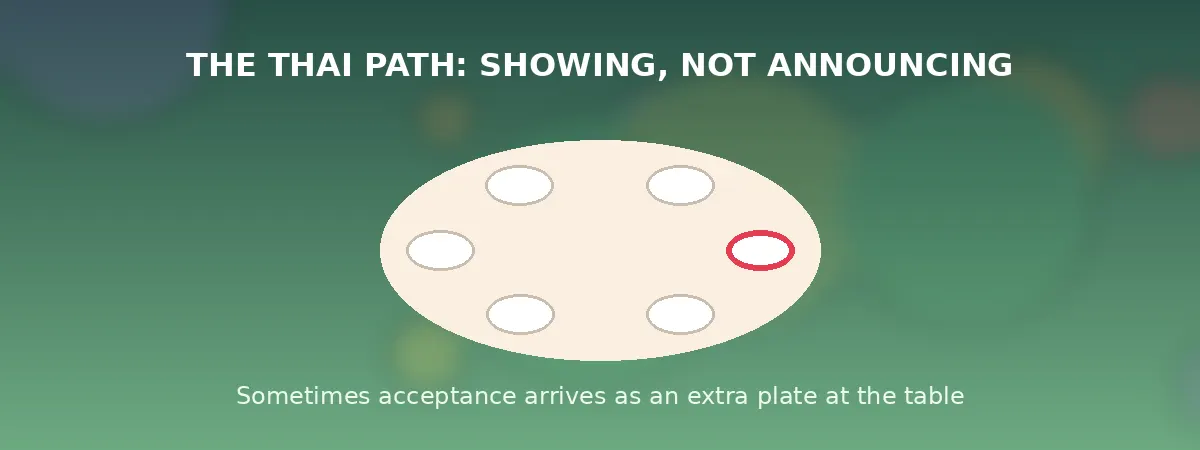
Western guides assume coming out means a declaration. Thai family culture often works differently, and it’s worth naming honestly: many Thai families operate on gradual, unspoken understanding — the partner who starts appearing at family dinners, the mother who begins setting an extra plate without a conversation ever happening. In a culture that values family harmony and kreng jai, “showing” over years can be a valid, gentle path that lets everyone adjust at their own pace.
- Both paths are legitimate. The explicit conversation and the gradual unveiling both count. Some families need words; some do better with time and normalcy. You know yours.
- Patience isn’t the closet. Letting your family arrive slowly — while you live openly elsewhere — is a strategy, not a failure of courage.
- The landscape is with you. Marriage equality is now Thai law, LGBTQ+ visibility saturates Thai media, and acceptance keeps rising generation by generation. Time is on your side in this country more than almost anywhere in the region — parents who react badly in year one often stand at weddings in year five.
- Watch for the quiet acceptance signals. Questions about your “friend,” invitations extended to him, the subject changing from silence to small talk. Thai families often say yes in actions long before words.
Plan for Every Outcome
- If it goes well: let it be celebrated. Answer questions patiently, share resources for family members who want to understand more, and enjoy the specific lightness of being fully seen by someone who loves you.
- If it’s mixed or clumsy: most reactions are. Awkward questions and initial silence usually reflect surprise, not rejection. Give it weeks, keep the relationship warm, and let normal life do the persuading.
- If it goes badly: have the net pre-built — a friend to call, a place to stay if needed, your finances and documents in your own control. Then remember: their reaction describes their journey, not your worth. Many relationships that break on the news repair over years; and the community — chosen family — is real family for exactly these seasons. Our guide to building your people exists for this. If the weight gets heavy, LGBTQ+-affirming counselors and community organizations are genuinely there for it.
After: The Ongoing, Ordinary Part
Coming out never fully finishes — new jobs, new friends, new doctors — but it stops being an event and becomes a preference setting: you decide, room by room, how much of yourself the moment deserves. Most people find the later rounds barely register. And the life on the other side is the point: dating openly (your profile, written without code words), a relationship you don’t edit in conversation, maybe someday a district office appointment with your family in attendance. Every earlier step was in service of that ordinary, unremarkable freedom.
Coming Out at Work: The Optional Arena
Work deserves its own note, because the calculus differs from family: the relationships are chosen for you, the stakes are financial, and the norms vary wildly between a Bangkok creative agency and a conservative provincial office. The practical read: check how the company actually behaves — policies, how leadership talks, whether out colleagues exist and thrive — before deciding how open to be. Then remember that workplace coming out is rarely an announcement anyway; it’s usually just declining to edit yourself. Mentioning your partner in Monday small talk the way anyone would, bringing him to the team dinner, a photo on the desk. Casual normalcy tends to land better than a formal disclosure — it frames the information as unremarkable, which is exactly the frame you want colleagues to adopt.
And the permission slip, one more time: being out at home and private at work — or the reverse — is not hypocrisy. It’s the room-by-room judgment every LGBTQ+ person exercises, and you can revise it any time the environment or your priorities change. Plenty of people stay professionally private for years and open up after a promotion, a job change, or simply a shift in what they’re willing to spend energy concealing. The dial is yours.
Frequently Asked Questions (FAQ)
How do I know if I’m ready to come out?
Check foundations, not feelings: a reasonable read that key people are safe to tell, independence or contingencies if you depend on them, at least one affirming person already in your corner, and motivation that comes from you rather than someone’s pressure. Nervousness is universal and isn’t a “not ready” signal — danger, dependence without a backup, and external pressure are.
Who should I come out to first?
The most accepting person available — not the most important. A warm first experience builds confidence and gives you an ally for harder conversations later. Many people sequence deliberately: safest friend first, inner circle, then family. High-stakes conversations should never be your first attempt.
Do I have to come out to my family?
No. Coming out is always optional, and selective openness is a legitimate permanent arrangement. In Thai family culture especially, gradual unspoken understanding — living openly while letting family arrive at their own pace — is a common and valid path. Explicit words, gradual showing, or privacy: all three are yours to choose.
What if my family reacts badly?
Prepare the net beforehand: someone to call, a place to go if needed, control of your own essentials. Then hold two truths — their first reaction is rarely their final position (families often evolve over months and years), and your worth was never on the ballot. Lean on chosen family and community support, and consider an affirming counselor if the weight lingers. You are not alone in this, statistically or otherwise.
Conclusion: On Your Timeline, Always
Whatever brought you to this article — quiet curiosity, a decision already made, or three a.m. searching — here’s the summary that matters: you’re not broken, you’re not late, and you’re not obligated. Prepare the foundations, choose your people, keep the first version short and warm, plan for every outcome, and let it be a process. Millions have walked this road and found ordinary happiness on the other side; the path is well-worn and the company is good.
And whenever you’re ready for that side of things — friends who get it, dates who never need an explanation — the community is already here. Quicky is free, private, and built by Thai LGBTQ+ people — a place to be fully yourself, starting today, no announcement required.
References
- San Francisco Gay Men’s Chorus — How to Come Out Safely: Essential LGBTQ+ Guide
- Northwestern Medicine — LGBTQ Guidance: Tips for Coming Out
- The Trevor Project — Coming Out: A Handbook