
Let’s start with an unusual confession: we make a dating app, and we’re about to tell you to use dating apps less — or at least very differently. Because the numbers have become impossible to ignore. Surveys in the last two years consistently find that nearly eight in ten dating app users report feeling fatigued or burned out, with users averaging close to an hour a day of swiping and walking away more drained than hopeful. If opening the apps has started to feel like a second job you never applied for, you’re not broken and you’re not bad at dating. You’re having a normal response to a system that demands constant emotional output for very little meaningful return.
This guide covers what dating app burnout actually is, the specific mechanics that cause it, the signs you’re in it, a reset protocol that isn’t just “take a break,” and — the part most articles skip — how to come back and date in a way that protects your energy instead of draining it.
In this article
What Dating App Burnout Actually Is
Researchers who study this describe burnout in three measurable parts, and longitudinal studies of active app users find all three climbing over time:
- Emotional exhaustion. Swiping out of habit instead of curiosity, replying days late, dreading the “hey, how’s your week” ritual. Therapists even report physical symptoms — chest tightness, stomach knots — during long scroll sessions. The tiredness is real, not dramatic.
- Inefficacy. The creeping sense that nothing you do works — that your photos, openers, and effort go into a void. Studies show this feeling increases with continued use, which is why “try harder” backfires.
- Depersonalization. Profiles stop feeling like people. You catch yourself judging humans like a product feed, feeling oddly irritated by perfectly nice matches, having the same conversation on autopilot. When people become cards, connection becomes impossible — for everyone involved.
Why the Apps Drain You: Four Mechanics
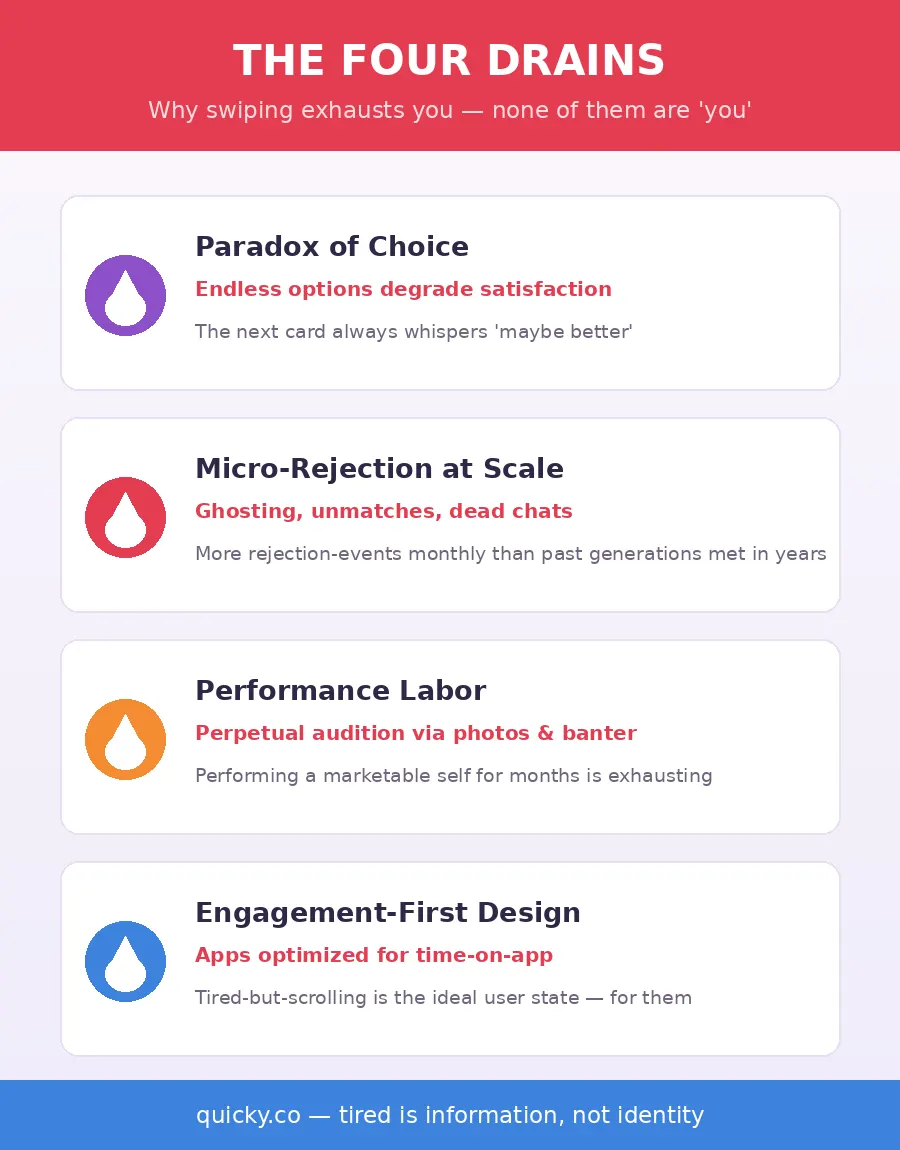
- 1. The paradox of choice. Classic psychology research scaled to romance: evaluating endless options degrades decision quality, satisfaction, and commitment — the next card always whispers maybe better. Maximizer-style daters (scan everything, settle never) burn hottest.
- 2. Industrialized micro-rejection. Unanswered openers, silent unmatches, conversations that evaporate mid-plan. Each one is tiny, but rejection physiology doesn’t pro-rate — an active user absorbs more rejection-events in a month than previous generations met in years, and the aggregate grinds self-worth.
- 3. Performance labor. App dating is perpetual bidirectional assessment: being judged on photos, auditioning via banter, maintaining a marketable self. Performing an identity for months is exhausting in a way nobody budgets for.
- 4. Engagement-first design. Many platforms are optimized to keep you swiping, not to get you off the app and into a relationship — notifications, streaks, paywalled visibility. You’re tired partly because tired-but-still-scrolling is, for some business models, the ideal user state.
Notice what’s missing from that list: anything wrong with you. Burnout is the predictable output of choice overload, concentrated rejection, performance demands, and engagement-optimized design running for months against ordinary human wiring. That framing matters practically, not just emotionally — because if the system produces the exhaustion, then changing how you use the system (not becoming somehow tougher) is the fix. Which is exactly what the rest of this guide does.
The Signs: A Quick Self-Check
| Sign | What It Looks Like | The Counter-Move |
|---|---|---|
| Habit swiping | Opening the app without deciding to; scrolling numb | Delete home-screen icon; app only by appointment |
| Reply dread | Messages sit for days; “can’t have this conversation again” | Fewer conversations, fully present in each |
| Cynicism spike | Irritated by nice people; assuming everyone’s a waste of time | That’s depersonalization — time for a real break |
| Delete-reinstall loop | Rage-quit relief, lonely-evening reinstall, repeat | A planned break with an end date beats rage cycles |
| Self-worth on the scoreboard | Mood tracking match counts; slow days feel like verdicts | Metrics diet: check matches twice a week, max |
| Depleted dates | Showing up flat because swiping already spent you | Protect date-day energy; no swiping before dates |
Three or more sound familiar? You’re burned out — and the fix has two phases: reset, then return differently.
Phase One: The Reset (It’s Recovery, Not Quitting)
- Take a real break — two to four weeks minimum. Research confirms that stepping back to focus on self-care genuinely resets the system. Not a punishment, not giving up: recovery. Log out, remove the apps from your phone, tell yourself the return date so the exit feels chosen rather than defeated.
- Notice the withdrawal, then the quiet. Week one, your thumb will reach for the ghost of the app — that’s habit, not longing. By week two, most people report something surprising: relief, and evenings that feel longer.
- Refill the actual tank. Burnout drains the same battery that dating requires: energy, optimism, curiosity about people. Refill it where it reliably refills — friends, movement, hobbies, sleep. (This is also the perfect window to invest in friendship; our guide to making gay friends is the companion piece.)
- Keep meeting people, analog. A break from apps isn’t a break from humans. Run clubs, classes, community events — the recurring-venue strategy works for romance too, and it reminds you that chemistry exists outside a card interface.
Phase Two: Return Smarter — The Sustainable Swiping Rules
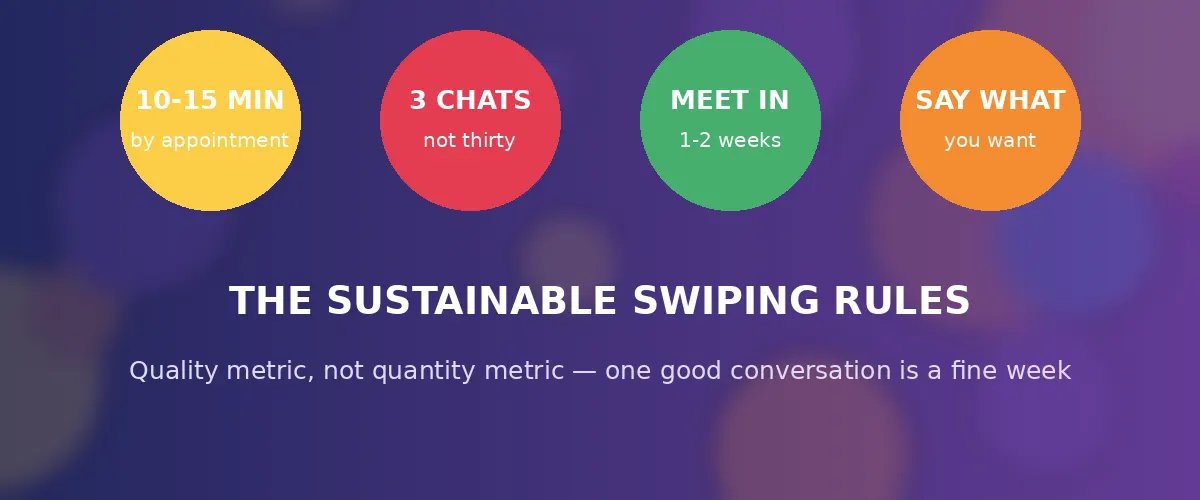
Coming back the same way guarantees the same crash. The rules that keep the second run sustainable:
- Time-box it. Ten to fifteen minutes, once or twice a day, by appointment — then the app closes. Even platforms themselves now recommend capping swipe time to prevent decision fatigue. Endless access is the burnout engine; a boundary is the off-switch.
- Run three conversations, not thirty. Attention spread across a dozen chats produces a dozen shallow fades. Two or three conversations getting real presence out-produce a full inbox, every time.
- No endless chatting. If a conversation has no plan to meet (or at least video call) within a week or two, let it go gracefully. Pen-pal limbo is where energy goes to die — and a short video call doubles as the smart-safety move our dating safety guide recommends anyway.
- State your intent plainly. The emerging norm daters call “clear-coding”: say what you’re actually looking for — casual, serious, friends, figuring it out — in your bio and early chat. Transparency filters out the mismatches that used to cost you three weeks each. Pair it with an honest profile (see the profile guide) and half your old burnout sources vanish.
- Quality metric, not quantity metric. Stop counting matches; start counting good conversations per week. One is a fine week. The scoreboard you choose is the mood you get.
- Satisfice, don’t maximize. The research is blunt: people who look for “good and real” are happier and more successful than people who scan forever for “best possible.” When someone’s kind, interesting, and attraction is present — close the app and go on the date.
The Mindset Shift That Makes It Stick
Underneath the tactics is one reframe: date from capacity, not from deficit. Swiping while lonely, bored, or depleted is dating on an empty battery — you make careless choices, half-hearted messages, and show up flat, which produces bad results, which deepens the depletion. The loop runs in reverse too: a full life makes you a better dater, better company, and — not coincidentally — more attractive. The app becomes one door among several instead of a slot machine you check at midnight.
And give yourself permission for seasons. On-season when you have energy and curiosity; off-season when life needs the bandwidth. People who date in seasons report more success and more sanity than people grinding year-round. The apps will still be there. The right person isn’t a limited-time offer that expires the week you rest.
Where We Fit (the Honest Version)
We’ll say the quiet part out loud: an app’s design choices either fight burnout or feed it. It’s why Quicky is free with no ads — no incentive to farm your attention — and built by and for the Thai LGBTQ+ community, where the point is meeting people, including friends, not maximizing your minutes-on-app. Use it in ten-minute appointments, state your intent, meet people in real life, and honestly? Close it when you’ve found what you came for. That’s the app working as intended.
Burnout in Gay Dating Specifically: The Extra Layers
Everything above applies to every dater — but gay app culture adds a few amplifiers worth naming, because naming them is half the defense:
- The apps carry more of the load. For LGBTQ+ people, apps aren’t one option among many — in plenty of places they’re the primary meeting infrastructure. When one channel carries your whole romantic life, fatigue in that channel feels like fatigue about love itself. It isn’t. Building parallel channels — community events, sports teams, friend-of-friend introductions — takes structural pressure off the swiping.
- Body-first culture hits harder. Grid-style interfaces built around torsos and stats concentrate appearance judgment beyond even mainstream apps. If the grid is corroding how you see your own body, that’s a real cost — curate ruthlessly, block freely, and remember the grid is a marketing format, not a measurement of you.
- The same-faces problem. In smaller cities, a few weeks of swiping can exhaust the visible pool, and re-seeing the same profiles reads as personal failure. It’s just population math. Widen the radius on travel weekends, use app modes aimed at friendship and community, and let real-world circles introduce you to the people the algorithm never surfaces.
- Rejection can echo old wounds. For some of us, app rejection lands on top of earlier rejections — family, school, closets. If swiping is reopening something deeper than this week’s unmatch, that’s worth honoring with more than a break: an LGBTQ+-affirming counselor is the right tool, and using one is a power move, not a defeat.
Frequently Asked Questions (FAQ)
Is dating app burnout real or am I just being dramatic?
It’s real, measured, and common: large surveys put app fatigue at roughly 78% of users, academic studies document rising emotional exhaustion over just twelve weeks of use, and therapists report clients with genuine stress symptoms from swiping. A predictable response to a demanding system is not drama — it’s data.
How long should a dating app break be?
Two to four weeks is the practical minimum — long enough for the habit loop to break and your baseline mood to reset. Set a return date when you leave so the break feels chosen, and come back with new rules (time-boxed sessions, fewer conversations) rather than resuming the old pattern that caused the crash.
Should I just delete dating apps forever?
Only if you want to — apps are a tool, not an obligation, and meeting people through activities, friends, and community works wonderfully. But most people don’t need abstinence; they need boundaries. Time-boxed, intention-stated, meet-quickly usage keeps the tool useful without the burnout tax.
Why do I feel worse about myself after swiping?
Because apps concentrate micro-rejections — unanswered messages, silent unmatches — into a volume human self-esteem never evolved to process, while the interface quietly frames your worth as a match count. The counter-moves: a metrics diet, fewer-but-realer conversations, and dating only from a reasonably full tank. If low mood persists beyond the apps, talking to a professional is a strong move, not a last resort.
Conclusion: Tired Is Information, Not Identity
Burnout isn’t a verdict on your dateability — it’s feedback about how you’ve been dating. Rest properly, come back with boundaries, run three real conversations instead of thirty half ones, say what you want, meet people quickly, and keep a life so good the app is optional. That’s the whole cure. Dating is supposed to add to your life; from here on, let it.
References
- GoodTherapy — Dating App Burnout: How to Cope With Swiping Fatigue
- Simply Psychology — Dating Burnout: Why the Apps Exhausted Everyone
- Bumble Support — Managing Dating App Burnout