
Here’s a statistic that surprises almost everyone outside the community and almost no one inside it: research suggests roughly one in four gay male couples has an age difference of ten years or more — dramatically higher than in straight relationships — and about 5% of same-sex couples span twenty-plus years. More surprising to the skeptics: studies consistently find these couples reporting high satisfaction, trust, and commitment when emotional connection and mutual respect are strong. The gay age gap relationship isn’t an exception we tolerate; it’s a mainstream shape of gay love, and it deserves better than the jokes it gets.
It also deserves honesty. Age gaps come with real dynamics — life-stage differences, power questions, outside judgment — that thrive on exactly one treatment: being named out loud and handled like adults. So this is the complete honest guide: why gaps are so common in our community, what the research actually says, the ethics checklist that separates healthy from harmful, the conversations that matter, and the art of the united front.
In this article
Why Age Gaps Are So Common in Gay Love
- The pool works differently. Gay dating pools are smaller and less age-segregated — our venues, apps, and social circles mix generations far more than straight equivalents, so connections across decades simply happen more.
- Delayed timelines re-sync people. A 38-year-old who came out at 35 and a 27-year-old who came out at 19 can be at remarkably similar relationship stages — the closet years shuffle everyone’s developmental calendar (our first relationship guide covers this), which makes chronological age a much weaker predictor of compatibility than it is elsewhere.
- Fewer inherited scripts. Without a standard-issue template for what a gay couple “should” look like, we assemble relationships from actual compatibility rather than demographic matching — and sometimes compatibility spans generations.
- Intergenerational connection is community tradition. Mentorship and cross-generation friendship have always run through gay culture — older men who lived through history the younger generation only reads about, younger men living openly in the world that older generation fought to build — and our spaces mix those generations constantly. Sometimes that meeting becomes romance.
What the Research Actually Says
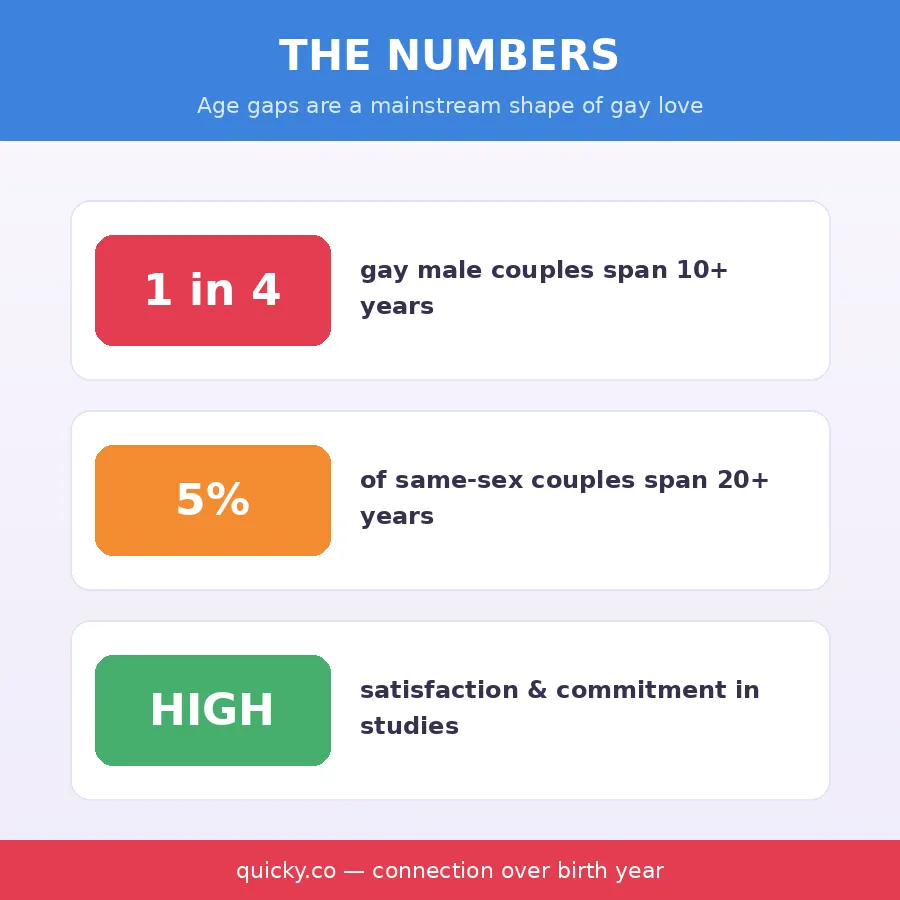
- Satisfaction runs high. Studies of same-sex age-gap couples repeatedly find strong satisfaction and commitment — with strong emotional connection cited as the key ingredient, not the gap size.
- More egalitarian than assumed. The stereotype insists on power imbalance; the research finds instead that gay age-gap couples tend toward genuinely mutual, egalitarian dynamics — stability and life experience flowing one way, vitality and fresh perspective the other, with both partners naming real benefit.
- The gap itself isn’t the risk factor. What predicts trouble is the same list as every couple: poor communication, mismatched goals, disrespect — plus one addition unique to the format: unexamined power dynamics. Which brings us to the honest section.
The Ethics Checklist: Power, Money, and the Ick Test
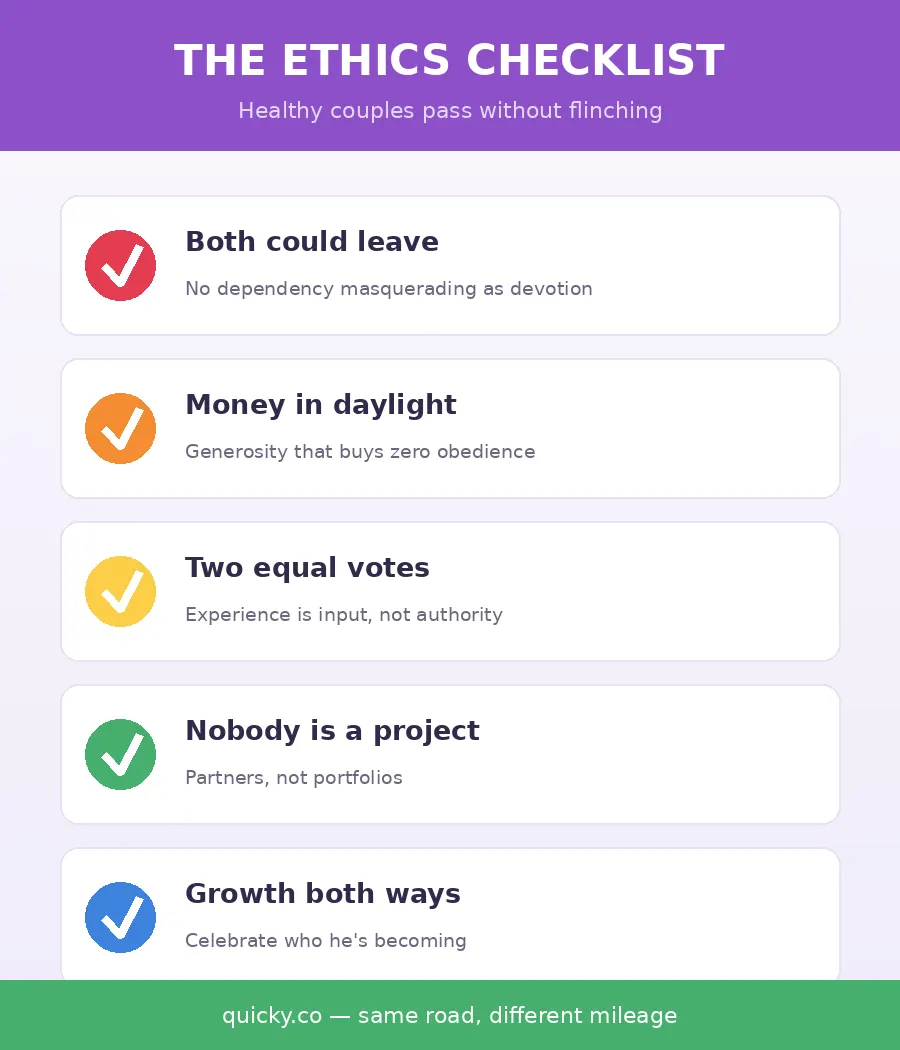
Age gaps often come with gaps in money, experience, and social power. That’s not automatically a problem — but pretending the gaps don’t exist is how they become one. The checklist healthy couples can pass without flinching:
- Both are adults, full stop — and both could leave. A healthy age-gap relationship survives the question “if he lost the apartment/visa/allowance tomorrow, would he stay?” If one partner’s presence depends on the other’s resources, that’s not a relationship dynamic; it’s an employment dynamic wearing one.
- Money is transparent, and generosity has no invoice. The older (or richer — not always the same) partner covering more can be loving and fine — when it’s discussed openly and buys zero obedience. Support that arrives with control attached (“I pay, so I decide”) fails the test regardless of ages.
- Decisions run on two votes. Where to live, whose career flexes, how weekends look. “I’m older, I know better” is not a voting system; experience is input, not authority.
- Neither partner is a project. The older partner isn’t a retirement plan; the younger isn’t a renovation opportunity or a vitality supplement. Partners, not portfolios.
- Growth is allowed in both directions. The younger partner will evolve — careers, confidence, opinions. A healthy older partner celebrates that; one who preferred the more moldable earlier version fails the test. (The Gay dating red flags: warning signs applies at every age.)
The Real Challenges (Named Honestly)
| Challenge | What It Looks Like | What Helps |
|---|---|---|
| Life-stage mismatch | One building a career, one eyeing retirement; different energy for nights out | Name the stages explicitly; design a shared rhythm, not a compromise nobody chose |
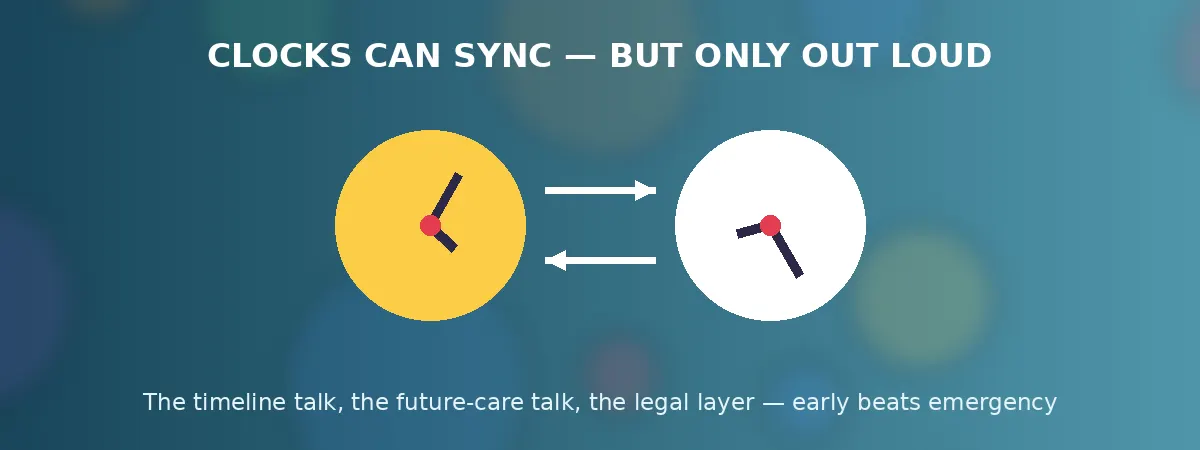
| Different clocks | Kids, settling down, big moves — wanted on different schedules | The timeline conversation early (below); clocks can sync, but only out loud |
| Separate friend worlds | His circle talks mortgages; yours talks weekend plans | Keep both circles; build some shared couple-friends who span ages |
| Reference gaps | Music, memes, history lived vs. history studied | Treat as exchange, not obstacle — you each hold a library the other can visit |
| Health horizons | Longer-term care and aging realities arriving asymmetrically | Adult conversations + legal protections early, not during a crisis |
| External judgment | Assumptions, jokes, family resistance | The united front (below); outcomes prove critics wrong on schedule |
The Conversations That Matter More With a Gap
- The timeline talk. Kids or not — and when? Where does settling down land on each calendar? A 15-year gap can mean wanting the same things a decade apart; discovering that in year one beats discovering it in year six.
- The future-care talk. Unromantic, essential, and easier every year you have it earlier: how you’ll handle health and aging, what support looks like, what each partner needs to feel secure about the far future.
- The legal layer. With marriage now available in Thailand, age-gap couples have the full toolkit: marriage itself, wills, healthcare consent rights, property arrangements. Couples with bigger gaps have more reason than anyone to put protections in writing early — love handles the everyday; paperwork handles the emergencies.
- The check-in cadence. Therapists who work with age-gap couples recommend regular relationship reviews — the gap evolves as life stages shift, and the couples who thrive renegotiate as they go rather than running on year-one settings forever.
Handling the Judgment: The United Front
The scrutiny is real — and, disappointingly, some of it comes from inside the community. The playbook:
- Pre-agree the public script. A calm, united, one-line answer for nosy questions (“we’re very happy, thanks for asking”) delivered identically by both partners. Drama requires a crack; present none.
- Let time argue. Nothing converts skeptical friends and family like years of evident happiness. Most family resistance is worry in costume; consistency answers worry better than debate ever does. (The long-game strategy from our meeting-the-family guide applies doubly here.)
- Own the labels or bin them. “Daddy” jokes and assumptions will happen. Couples handle it best when they’ve decided together what’s funny, what’s fine, and what gets shut down — so neither partner is left absorbing jabs alone at a party.
- Thai bonus: the culture has a head start. Thai social life already runs on graceful age acknowledgment — the พี่/น้อง structure builds age difference into everyday language as respect rather than scandal, and mixed-age social circles are unremarkable here in a way Western couples envy. Many Thai families process an age-gap partner more easily than Western ones; the respect vocabulary already exists.
Making It Thrive: The Gap as Feature
- Trade your superpowers deliberately. Stability, perspective, and calm one way; energy, novelty, and fresh eyes the other. The happiest age-gap couples don’t minimize the difference — they run it as the relationship’s engine.
- Stay curious across the gap. His decades hold stories; your present holds discoveries. Couples who treat the difference as a permanent conversation never run out of material.
- Don’t parent, don’t perform youth. The older partner isn’t the responsible adult of the house; the younger isn’t obligated to be perpetual entertainment. Two adults, different mileages on the odometer, exactly the same road ahead.
- Keep the standard checklist too. Date nights, bids, novelty, courting — every spark-tending tool works identically across a gap. The gap changes some conversations; it changes none of the fundamentals.
Dating Across the Gap: Notes for Each Side
Before the relationship, there’s the dating — and each side of the gap has its own homework:
- If you’re the younger one: date him for who he is, not for the stability costume — and check your own honesty on that regularly. Expect friends to raise eyebrows and expect some older-partner habits (earlier nights, established routines) to be features of the package, not bugs to fix. Keep your independence loudly intact: your own income trajectory, your own friends, your own name on things. The relationships that age well are the ones where the younger partner never needed the older one — just wanted him.
- If you’re the older one: the burden of the power audit sits mostly with you, because you usually hold more of it. Watch for the mentor-slide — advice becoming direction becoming control — and actively make room for his no. Date his actual self, not his youth as a commodity; if what you love most about him is an age, that’s an expiry date, not a relationship. And keep your peers close: an older partner whose entire social world becomes his younger boyfriend has recreated the dependency problem in mirror image.
- For both: the early conversations run the same as any couple — intentions, exclusivity, pace — just with the timeline talk arriving sooner than average. Clarity is kindness at every age; with a gap, it’s also insurance.
Frequently Asked Questions (FAQ)
Are age gap relationships common among gay men?
Very — research suggests roughly one in four gay male couples has a gap of ten years or more, far above the rate in straight couples, and about 5% of same-sex couples span twenty-plus years. Smaller and less age-segregated dating pools, re-shuffled coming-out timelines, and a community tradition of intergenerational connection all contribute.
Can a relationship with a big age gap actually work?
Yes — studies of same-sex age-gap couples consistently report high satisfaction, trust, and commitment, with strong emotional connection as the key ingredient. The gap itself isn’t the risk factor; unexamined power dynamics, unspoken timeline mismatches, and poor communication are — all of which are addressable by naming them early and reviewing regularly.
How do you handle the power imbalance in an age gap relationship?
By refusing to let it stay unexamined: full financial transparency with generosity that buys zero obedience, decisions running on two equal votes regardless of experience, both partners genuinely free to leave, and neither treating the other as a project. If the relationship would survive the resources disappearing, the power is healthy; if it wouldn’t, that’s the conversation to have.
What should age gap couples discuss early?
The timeline talk (kids, settling down — wanted when?), the future-care conversation about health and aging horizons, and the legal layer: marriage (now available in Thailand), wills, and healthcare consent, which matter more with bigger gaps. Add a regular check-in cadence, since life stages keep shifting and year-one agreements need periodic renegotiation.
Conclusion: Same Road, Different Mileage
Age-gap love asks exactly what all love asks — respect, honesty, aligned intentions — plus one extra discipline: naming the dynamics others would rather joke about. Pass the ethics checklist, have the timeline and future-care conversations early, put the legal protections in writing, present the united front, and then run the difference as the feature it is: two libraries, two energies, one relationship that outsiders slowly stop questioning because it visibly works. The numbers were always on your side; now the playbook is too.
And if the right guy for you happens to be a different generation — Quicky is free, ad-free, and built by the Thai LGBTQ+ community, where connection has always mattered more than birth year.
References
- Gay Therapy Center — Age Gaps in Gay Relationships
- Oliver Drakeford Therapy — Navigating Age-Gap Relationships
- Michael Pezzullo, LMFT — The Truth About Age Gaps in Gay Relationships