
So it happened. There’s a boyfriend now — an actual boyfriend, who calls you his boyfriend, in a first gay relationship that half of you is celebrating and the other half is quietly panicking about, because everyone else seems to have gotten a decade of practice you never did. First: congratulations. Second, and read this part twice: if your first relationship is arriving at 22 or 28 or 40, you are right on time.
Here’s the truth straight guides never need to print: many of us spend our teenage years — the practice years everyone else got — in the closet, observing romance instead of rehearsing it. The first-boyfriend milestone arrives late not because you’re behind, but because the timeline was borrowed from you. So you’re now running the beginner curriculum with an adult’s life attached, which is awkward and absolutely fine. This guide is that curriculum: the chemical storm, the pacing, the classic first-timer traps, and the firsts nobody warns you about.
In this article
The Late-Bloomer Truth: Your Timeline Isn’t Broken
- “Delayed gay adolescence” is real and near-universal. The clumsy crushes, the learning-by-doing, the low-stakes heartbreaks that teach — many gay men do that developmental chapter in their twenties or thirties, compressed and with higher stakes. If your first relationship feels like being handed a car with no learner years: correct, that’s exactly what it is.
- Everyone in the community gets this. “First boyfriend at 31” raises zero eyebrows among people who understand the closet years. Anyone who mocks a late start is telling you about their character, not your timeline.
- Beginner is a phase, not an identity. The learning curve is steep precisely because it works — most of what this article covers, you’ll only need to learn once.
The Chemical Storm: Keep Your Head in the Fireworks
What you’re feeling right now has a name — new relationship energy — and a chemistry set: a flood of dopamine, oxytocin, and norepinephrine convincing you that the way he laughs is objectively the greatest sound ever recorded. Enjoy every second. Also know what the storm does to judgment:
- It fast-forwards fantasies. Planning the condo and the golden retriever on date four is the drug talking. Experts’ unanimous advice: slow your roll and exist in the moment — you only get the honeymoon chapter once, and racing through it to the imagined ending wastes the best part.
- It hides information. The storm makes everything he does adorable — which means your judgment about compatibility is chemically compromised for a few months. Not a problem, just a reason to let time gather data before making storm-sized decisions (moving in belongs after the weather clears — our moving-in guide explains why).
- It eventually settles — and that’s not the end. Around some months in, the fireworks calm into something warmer and quieter. First-timers regularly mistake this for “losing feelings.” It’s actually the relationship starting — the storm was the trailer; this is the film.
Pace It: Slow Is the Cheat Code
- Don’t merge lives in week two. The temptation is enormous — you waited years for this. But daily sleepovers, shared everything, and canceled friend plans by week three is how beginners burn out a good thing. One day at a time; he recently became part of a life you’d already built.
- Friends first, always still. Keep your friendships fed — partner AND friends, not partner INSTEAD of friends. The classic beginner error is making him your only person, which suffocates him and isolates you. (Your chosen family remains load-bearing infrastructure, especially now.)
- Match no one’s pace but your own. Some couples say “I love you” in a month; others take six. Your comparison feed is not your relationship. The only correct speed is the one where both of you stay comfortable and honest.
- Let it be imperfect in real time. Not every date will be cinematic. Ordinary Tuesdays are not a warning sign; they’re what lives are made of.
The Communication Starter Kit
- Say needs out loud — he cannot read minds. The beginner fantasy is that real love means intuiting everything. The adult reality: “I need some alone time to recharge, it’s not about you” is a sentence, and sentences work. Expectations stated early prevent resentments compounding later.
- Learn your first repair. Your first fight is coming (see below), and the skill that decides everything isn’t avoiding conflict — it’s repairing after it: cool down, no name-calling, “I feel X when Y” instead of “you always,” and actually returning to finish the conversation. Disagreement is two humans working as designed.
- Ban the comparisons. His ex, your imagined versions, couples online — comparison corrodes from both directions. He’s a new person; give him a new file.
- Ask instead of spiraling. Slow reply? Quiet evening? Things seem “way worse in your head than they really are” is documented beginner physics. One calm question beats three hours of detective work, every time. (If actual red flags appear, that’s different — the Gay dating red flags: warning signs tells them apart.)
The Exclusivity Talk: The One Conversation Not to Postpone
One exception to all the “slow down” advice: clarity about what you two are deserves early attention, precisely because app-era defaults are ambiguous. A few beginner-friendly notes:
- “Boyfriend” is a conversation, not an assumption. Three great dates don’t automatically deactivate anyone’s apps — in modern dating, exclusivity is agreed out loud, not inferred from vibes. If you’re assuming and he’s still swiping (or vice versa), nobody betrayed anyone; the conversation just hasn’t happened.
- The script is short. “I really like where this is going, and I’d like us to be exclusive — where are you at?” Ninety seconds, total. The answer is either wonderful news or crucial information, and both beat weeks of wondering.
- Beginner advantage: you’re allowed to want things. First-timers often fear that asking for definition looks needy. The opposite is true — stating what you want is the most attractive adult move in the entire playbook, and anyone who mocks the question just answered it. (If the answer stays foggy for months, our situationship guide names what’s happening.)
The Firsts Nobody Warns You About
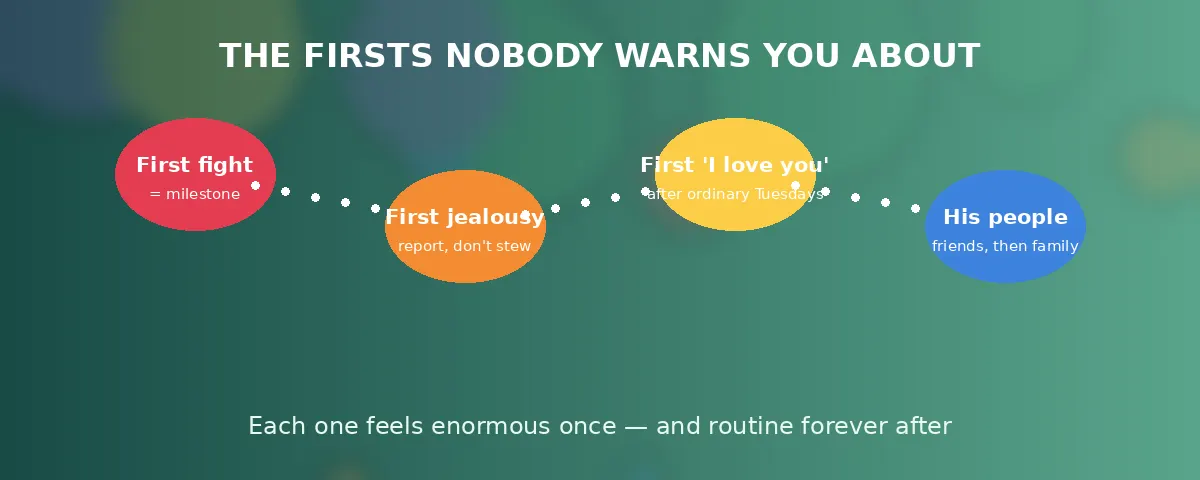
- The first fight feels like the end of the world and is actually a milestone: you’re now close enough to disagree. Handle it with the repair kit above and you’ll both exhale on the other side, closer.
- The first jealousy ping — he laughs at someone’s message, an ex likes his photo. Normal hardware. Report it gently if it persists (“that made me feel weird, can we talk?”) rather than prosecuting or stewing.
- The first “I love you” — no formula, but one tip from every veteran: don’t deploy it mid-fireworks in week two just because the chemicals are loud. Say it when it’s survived a few ordinary Tuesdays and still feels true. And if he says it first and you’re not ready — “I’m getting there, and I like where this is going” is an honest, kind answer.
- Meeting each other’s people — friends first (how he is with his crew is real data), family later when it’s earned; our meeting-his-family guide handles that boss level when it comes.
- The first calibration of “us” in public — hand-holding comfort levels, what you post, who knows. Two people can be at different out-ness stages; agree on the shared setting explicitly, revisit as it evolves, and never out each other by default. (The coming out guide covers mismatched timelines with care.)
The Classic First-Timer Traps
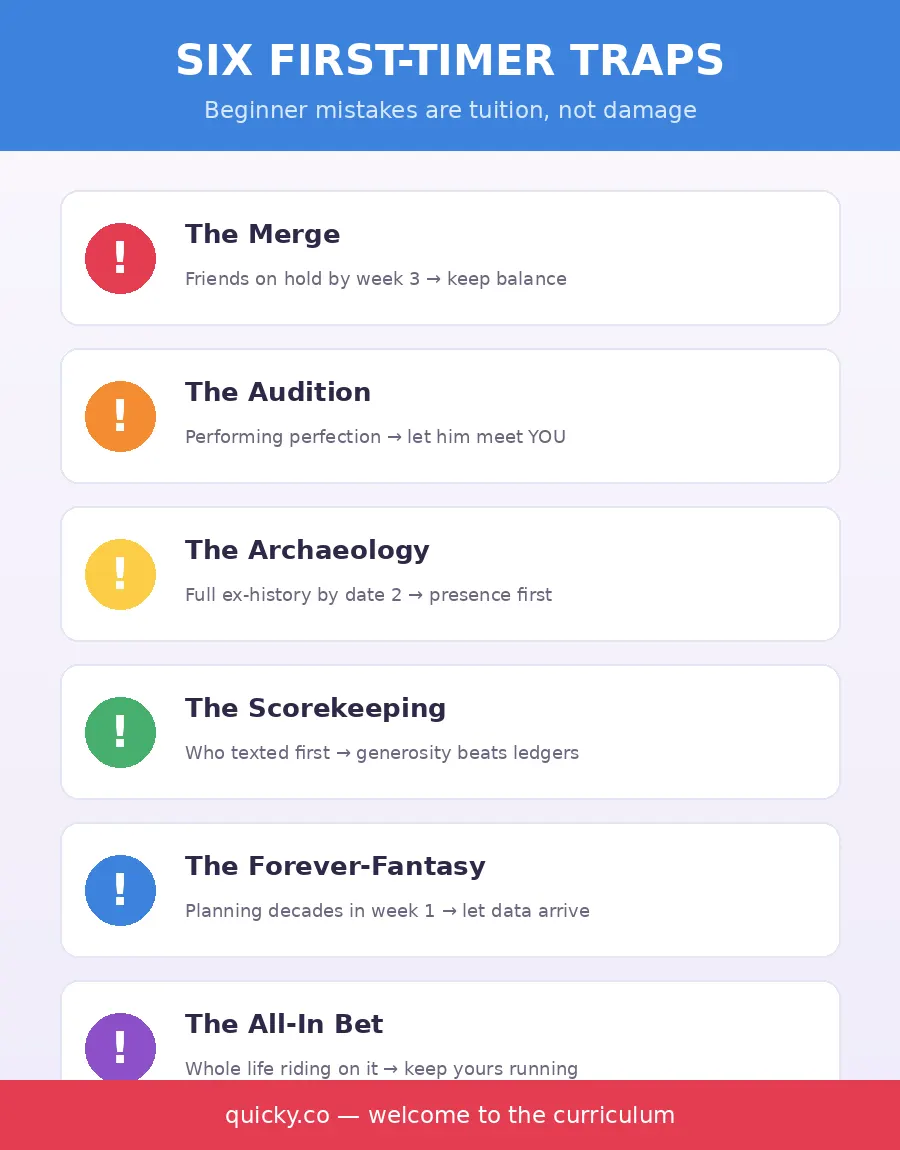
| Trap | What It Looks Like | The Fix |
|---|---|---|
| The merge | Together daily by week 3; friends on hold; hobbies abandoned | Deliberate balance: partner AND friends AND solo time |
| The audition | Performing a perfect boyfriend instead of being yourself | He chose you; let him meet you. Masks expire anyway |
| The archaeology | Full dating-history excavation by date two | Histories unlock gradually; presence first, past later |
| The scorekeeping | Tracking who texted first, who planned more | Generosity with communication beats ledgers; ask for what’s missing |
| The forever-fantasy | Planning decades during week one’s fireworks | Enjoy now; let time gather real data before big decisions |
| The all-in bet | Your worth, schedule, and future riding on one new thing | Keep your whole life running; the relationship joins it |
Grace for the Learning Curve (Including If It Ends)
- You will overdo something. Text too much one week, need too much reassurance one month, handle a jealousy ping clumsily. So will he. Beginners make beginner mistakes — that’s not damage, that’s tuition, and self-compassion processes it faster than shame does.
- Many first relationships end — and that’s data, not doom. The quiet statistical truth: first relationships teach you what you need, what you can give, and what your dealbreakers actually are, and often that’s their full job. If it ends, grieve it properly (the breakup guide exists), then notice what it taught — every long, happy relationship in history was preceded by someone’s instructive first.
- And some firsts go the distance. Plenty of first boyfriends become husbands — especially when both people pace it, communicate like adults, and let the storm settle into something real. There’s no rule either way; there’s just the two of you, learning.
Frequently Asked Questions (FAQ)
Is it normal to have your first relationship late as a gay man?
Extremely — it’s closer to the norm than the exception. Years spent in the closet delay the practice chapter most straight peers got in adolescence, so first relationships at 25, 30, or 40 are ordinary in the community and raise no eyebrows. You’re not behind; the timeline was borrowed from you, and the curriculum works at any age.
How fast should a first relationship move?
Slower than the chemicals suggest. New relationship energy floods judgment with dopamine for the first months, which is wonderful and also why experts advise pacing: keep your friendships and routines running, don’t merge lives in the first weeks, and let big decisions (exclusivity talks aside — those deserve early clarity) wait until the storm settles and real data accumulates.
When should you say “I love you” for the first time?
When it has survived some ordinary days and still feels true — not mid-fireworks in week two when the chemistry is doing the talking. There’s no universal timeline; couples range from a month to six or more. If he says it first and you’re not there yet, an honest “I’m getting there, and I really like where this is going” is a kind, complete answer.
What if my first relationship doesn’t work out?
Then it did what most first relationships do: taught you what you need, what you can give, and where your real boundaries are. That’s curriculum, not failure — grieve it genuinely, extract the lessons without self-blame, and carry them forward. Nearly every lasting relationship in existence was preceded by someone’s instructive first attempt.
Conclusion: Welcome to the Curriculum
Your first relationship asks you to learn everything at once — the chemistry management, the pacing, the communication, the milestone firsts — all while feeling more than you have ever felt about another person. So run the beginner protocol: enjoy the storm without obeying it, get the exclusivity clarity early, keep your whole life running alongside him, say needs out loud, repair after the first fight, and extend both of you the generous grace that every learning curve — including his — requires. Late start, fast learner — that’s the standard community trajectory, and it works.
And if you’re reading this before the first boyfriend — still searching for the guy who’ll get your beginner era — Quicky is free, ad-free, and built by the Thai LGBTQ+ community, where plenty of guys are on their first lap too. Everyone starts somewhere; the good ones just start honestly.
References
- The Everygirl — 18 Pieces of Advice to Help You Build a Healthy New Relationship
- Marriage.com — 25 Things You Wish You Knew Before Your First Relationship
- Dr. NerdLove — What I Wish I Knew Before My First Relationship