

It always follows the same choreography. First a toothbrush stays over. Then a shirt earns hanger rights. Then one Saturday you’re at the homeware shop buying more hangers and someone says the sentence: “…should we just live together?” Moving in together is the biggest unofficial milestone a couple hits — bigger in daily-life terms than anniversaries and, some argue, a truer test than engagement. It’s also where wonderful relationships either compound… or quietly discover they were two great solo acts sharing a bed.
The difference between those outcomes is rarely love. It’s preparation — a handful of honest conversations that most couples skip because the romance feels like it should carry everything. Relationship researchers are blunt about this: couples who can discuss the big-picture topics before the boxes get packed navigate cohabitation dramatically better. So here’s the complete pre-flight: the readiness check, the money treaty, the chores accord, choosing the place, and the honest map of the first six months.
In this article
Are You Actually Ready? The Honest Signals
Therapists who work with gay couples emphasize one master principle: moving in should be an emotional decision, not a circumstantial one — a natural outgrowth of where the relationship has arrived, not something that happens to you because a lease expired. The green-light signals:
- Big-picture talks don’t detonate. You can discuss future goals, money, and even dealbreakers without the conversation spiraling. If finances and future plans are undiscussable now, a shared address will not make them easier.
- You’re aligned on what this step means. Same page on commitment and direction — moving in as a chapter of building a life, not an ambiguous experiment one of you privately reads as pre-engagement and the other as convenient.
- Conflict has a working repair loop. You’ve disagreed, recovered, and come out understanding each other better. Cohabitation manufactures small conflicts daily; the repair skill is the actual prerequisite.
- You’ve seen each other un-curated. Sick, stressed, morning-grumpy, family-frazzled. If the relationship has only existed in date-mode, sharing a bathroom is a big reveal to take on faith.
- The quirks are already priced in. You know how he is, he knows how you are, and acceptance — not a renovation plan — is the operating mode.
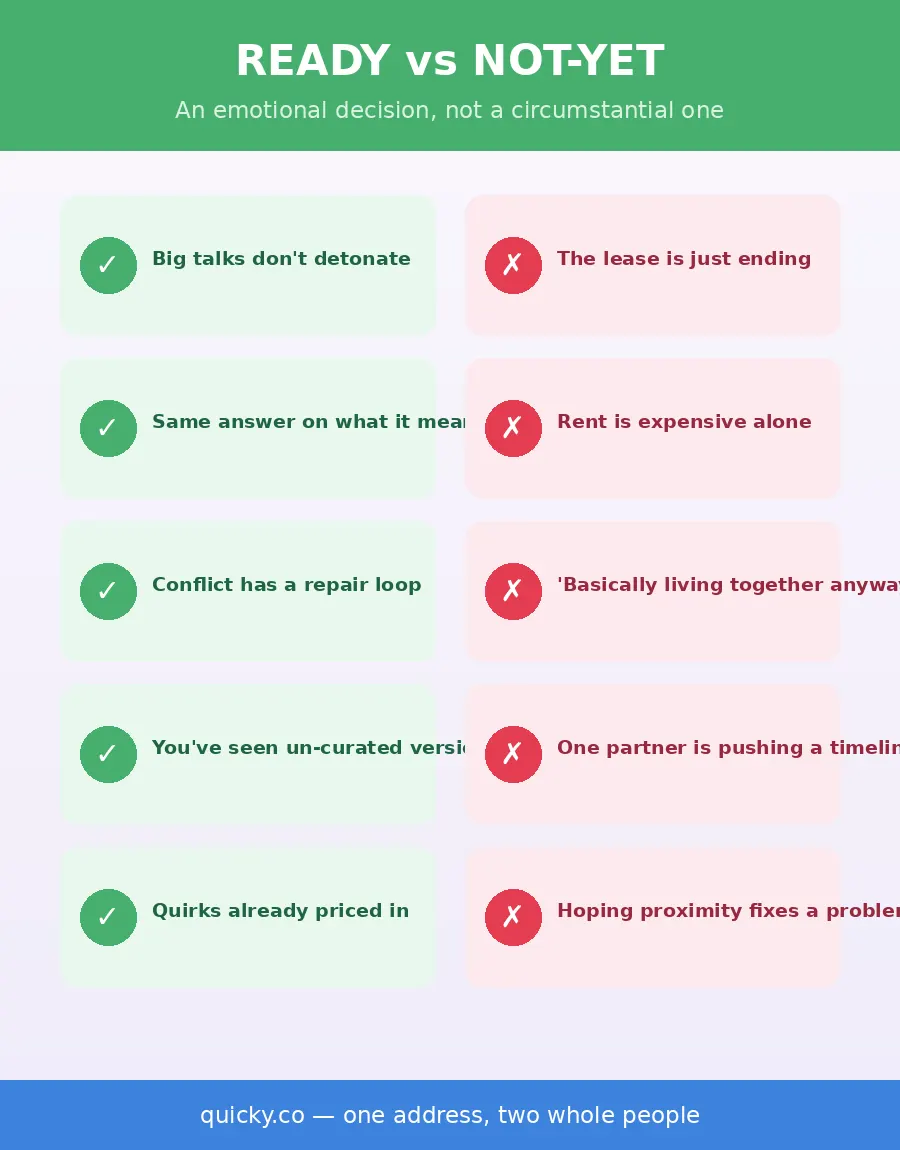
And the wrong reasons — each fixable by waiting, none fixable by moving: the lease is ending and this is convenient; rent is expensive alone; you’re “basically living together anyway” so why decide consciously; one partner is pushing a timeline; or you’re hoping proximity will fix a problem distance didn’t cause. Couples who “fall into” living together often report feeling like life happened to them — and resentment loves that soil.
The Money Conversation (Have It Before the Boxes)

Couples fixate on sharing space and get ambushed by sharing bills. Money is the top cohabitation stressor for a simple reason: no app can replace the direct conversation most of us were raised to avoid. The agenda:
- Choose a split philosophy out loud. 50/50 is simple and fair when incomes are similar; proportional-to-income is fairer when they’re not. Neither is wrong — undiscussed is wrong. Revisit when either income changes.
- Define “joint” vs “personal.” Rent, utilities, groceries: joint. His gym, your gadgets, gifts to your own families: personal. A shared account or a tracked ledger for joint expenses keeps the math unemotional.
- Surface the invisible ledgers. Debts, family support obligations, savings habits, money anxieties. You don’t need identical finances — you need visible ones.
- Never become the sponsor by accident. The old community wisdom stands: affection and rent are separate line items. If one partner covers more by agreement, write the agreement in daylight — generosity with resentment attached is a loan, not a gift.
- Thailand-practical: put both names on the lease where possible (protection and paper trail for both), and if property or marriage enters the picture later, remember prenups in Thailand register at marriage — our marriage guide covers that chapter.
The Chores & Space Accord
Surveys of cohabiting couples put domestic labor and sleep/space friction right behind money in the conflict rankings. Thirty minutes of treaty-writing prevents two years of low-grade warfare:
- Calibrate “clean.” His “clean” and your “clean” are different numbers until proven otherwise. Walk the apartment and define done-ness for dishes, laundry, bathroom, floors.
- Divide by inclination, not ideology. He likes cooking, you don’t mind laundry — great, trade. What matters is that both of you rate the split as fair, and that it’s revisited when it drifts.
- Schedule the un-romantic stuff. Whose alarm rings first, who showers when, WFH desk arrangements, quiet hours. Sleep-schedule friction is a top-three fight; solve it with logistics, not lectures.
- Protect alone-time explicitly. Needing an hour of silence after work isn’t rejection — but only if it’s stated up front. “I recharge alone for a bit, then I’m all yours” is a sentence that saves marriages.
- You’re a team, not a merger. Keep your own friends, hobbies, and evenings out. Two full lives sharing a home beats one fused blob wondering where their identities went. (Your friendships still need feeding — our friends guide stays relevant precisely now.)
The Pre-Move Conversation Checklist
| Conversation | Core Questions to Settle | When |
|---|---|---|
| Why & what it means | Is this building toward a future or solving a lease? Same answer from both? | Before deciding |
| Money | Split philosophy? Joint vs personal? Debts visible? | Before signing anything |
| Chores & standards | What does “clean” mean? Who does what? Review cadence? | First week |
| Space & schedules | Alone-time needs? Sleep schedules? WFH zones? | First week |
| Guests & social life | Friends over — how often? Hosting rules? Notice expected? | First month |
| Family & visibility | Who knows what? How do we handle visits and questions? | Before the move |
| The exit clause | Uncomfortable but adult: if this doesn’t work, what’s the plan? | Before signing |
Choosing the Place: Neutral Ground Wins

- A new place beats moving into his. When one partner joins the other’s established apartment, they’re a guest in someone else’s systems for months. A neutral new home makes both of you founders. If moving into an existing place is the practical call, rearrange enough that it becomes ours — and clear real closet space, not one pity drawer.
- Location math for two. Both commutes, both gyms, both social orbits. The apartment that’s perfect for one life and miserable for the other purchases resentment at market rates — split the commute pain evenly, or trade it against something else explicit.
- Budget below the maximum. Rent that either of you could carry alone for a few months during a job change or rough patch is the sleep-at-night number. Thailand’s rental market is kind — use that kindness for margin, not square footage.
- Handle the ex-artifacts. Photos, gifts, furniture with history — decide together what a fresh start includes. It’s not jealousy to want the new home to belong to the new chapter.
The First Six Months: The Honest Map
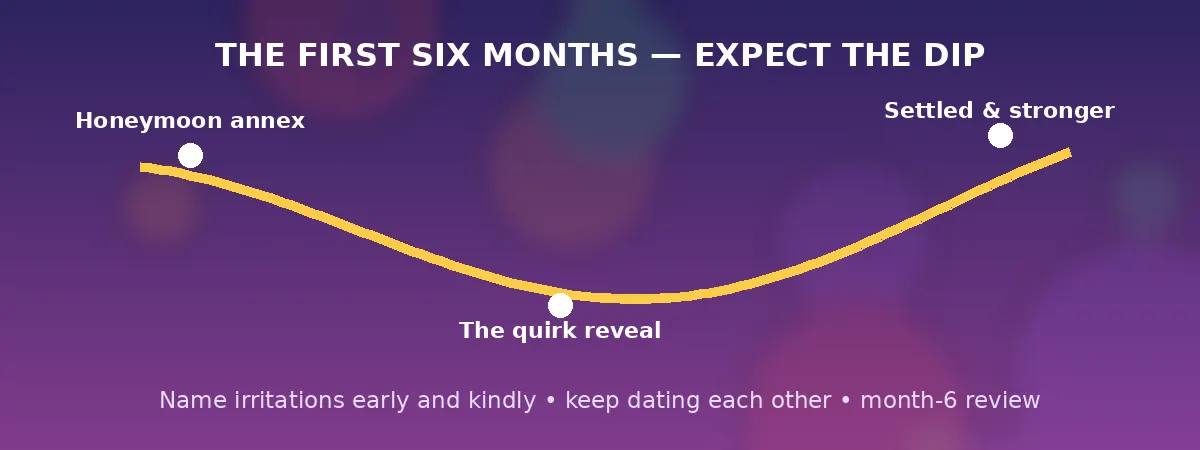
Veteran couples all report the same arc, so expect it on purpose:
- Weeks 1–4: the honeymoon annex. Everything is playing house. Enjoy it loudly.
- Months 2–4: the quirk reveal. The cute becomes visible as the constant. He stacks dishes wrong. You discover you’re the loud chewer. This phase is normal, universal, and survivable — name irritations early and kindly (“gentle startup”: I feel / about what / I need) instead of archiving them for a future explosion.
- Keep dating each other. Cohabitation’s sneakiest tax is that time together stops being intentional. Protect a real date night — out of the house, phones down (the date ideas guide exists for exactly this) — and don’t let intimacy become another chore on the rota; routine is its natural predator, effort its antidote.
- Month 6: the review. A deliberate check-in over a good dinner: what’s working, what needs renegotiating, is the money split still fair, are we happier than we were apart? Couples who schedule this conversation have it calmly, with wine; couples who skip it have the same conversation eventually anyway — mid-argument, about dishes, at a worse volume.
The Thai Layer: Family, Visibility, and the Lease
Cohabiting in Thailand adds a few local dimensions worth deciding on purpose rather than by default:
- Moving in is often the “showing” step. In Thai family culture, a shared address frequently does the work of an announcement — the “roommate” who appears at Songkran, then at every dinner, then in the family photos. If that gradual path is yours, align on the story you’re both telling and the pace you’re both comfortable with; mismatched scripts (“he’s my partner” vs “he’s my roommate”) in front of the same relatives get awkward fast. Our coming out guide covers the showing-not-announcing path in depth.
- Visits flow differently here. Thai family involvement — parents dropping by, obligations upcountry, festival travel — tends to run higher than Western defaults. Agree early on hosting expectations, how holidays split between two families, and what happens when his mother arrives with food and opinions at 9am on a Sunday.
- Paperwork protects both of you. Both names on the lease where the landlord allows it; big shared purchases documented; and for condo purchases specifically, remember that ownership registered under one name stays legally one person’s — a real conversation now that marriage (and marital property law) is an available upgrade path.
- The neighborhood check. Thailand is broadly welcoming, and urban condos doubly so — but comfort varies by building and province. A quick sense-check of the vibe before signing beats discovering the juniper-eyed neighbor after.
Frequently Asked Questions (FAQ)
How long should a gay couple date before moving in together?
There’s no magic number — readiness beats calendar math. The real prerequisites: you’ve navigated conflict and repaired, discussed money and future plans without detonation, seen each other un-curated, and both frame the move as building a life rather than solving a lease. For many couples that lands somewhere around a year or more, but the signals matter, not the months.
How should couples split rent and bills?
Two defensible systems: 50/50 when incomes are comparable, or proportional-to-income when they’re not. The system matters less than the conversation — agree explicitly, define joint versus personal expenses, track shared costs somewhere neutral, and revisit whenever either income changes. Undiscussed money arrangements are where resentment compounds.
What do gay couples fight about most after moving in together?
The research is consistent: money, fairness of household chores, and sleep/space friction top the list, with intimacy frequency close behind. All four are treaty problems, not love problems — couples who define “clean,” agree on splits, schedule around sleep differences, and keep dating each other pre-empt the majority of it.
Is moving in together a step toward marriage?
It can be whatever you both agree it is — that agreement being the point. Some couples treat cohabitation as the pre-marriage proving ground (and with marriage equality now Thai law, that path is fully real); others build permanent unmarried lives together. The only wrong version is two partners silently holding different answers.
Conclusion: One Address, Two Whole People
Moving in together works when it’s chosen consciously, negotiated honestly, and maintained deliberately: an emotional decision over a circumstantial one, money and chores settled in daylight, a home that belongs to both of you, dates that survive the shared calendar, and a six-month review on the books. Do the unromantic preparation and the romantic part gets room to thrive — that’s the whole trick.
And if you’re reading this from the other end — still looking for the person worth buying extra hangers for — the search is the fun part. Quicky is free, ad-free, and built by the Thai LGBTQ+ community — somewhere out there is a guy whose dish-stacking method you’ll one day lovingly tolerate forever.
References
- The Gottman Institute — Moving In Together: Are You Ready?
- Little Gay Book (Dr. Frankie Bashan) — Are You and Your Partner Ready to Move In Together?
- Gay Therapy LA (Ken Howard, LCSW) — Gay Men Who Live Together Too Early